The awkward moment in online shopping often arrives after the exciting one. The shirt is paid for. The furniture looks perfect. Then comes the delivery menu: a bewildering choice, an unsuitable service, a promise that the warehouse will have to explain later. For the retailer, those small details can become very large costs.
nShift sells software for that stretch of commerce. It helps businesses decide what delivery options to display, book carriers, print labels, communicate progress and handle the parcels coming back. Its latest addition follows the shipment into finance, checking whether the carrier’s invoice matches what was agreed and what actually happened. The company’s ambition is to make the delivery promise manageable from beginning to end.
The scale is substantial: nShift reports more than a billion shipments supported annually across 190 countries. Its customers include retailers, manufacturers and third-party logistics providers. The interesting thing about that reach is the accumulated detail: which carrier serves which place, how a warehouse books it, and what evidence remains when something goes wrong. nShift’s company overview puts its network at more than 1,000 carrier connections.
01The furniture that needed a better menu
Granit, the Scandinavian lifestyle retailer, offers a useful view of the problem. Oversized furniture headed to Germany was putting pressure on delivery margins. Its old link-based approach could not reliably steer customers toward workable services or exclude unsuitable ones. A clean-looking checkout was concealing an untidy operational decision.
Using nShift Checkout, Granit rebuilt the rules so customers saw delivery methods that applied to their orders. Germany received two clearly differentiated options for oversized deliveries. Separate arrangements handled parcel lockers and parcel shops. The company also put an A/B-testing framework in place to refine prices, promises and the order in which choices appeared.
“If you give customers the logic, the choice and the clarity, they’ll tell you what’s actually valuable.”Viktor Mercil · CTO, Granit
The Granit account reports more stable margins, without assigning a percentage. The practical lesson is specific: remove services that do not fit the order before experimenting with how to sell the remaining choices. Copying that approach requires accurate product dimensions, usable carrier rules and someone willing to decide which promises the retailer can afford.
02Five businesses inside one name
The nShift name appeared in 2021, attached to a business with much older roots. The company traces its expertise to 1997 and describes its formation through five established brands: Unifaun, Consignor, Transsmart, Returnado and Webshipper. That history explains why this relatively young name arrived with a mature carrier network.
The underlying consolidation was led by private equity. Francisco Partners announced its Consignor acquisition in July 2020 at a transaction value of NOK 1.5 billion. Consignor’s founder, Peter Thomsen, had run the business for 23 years. That figure belongs to the Consignor transaction; treating it as a venture round raised by nShift would tell the wrong story.
Consignor and Unifaun completed their merger in February 2021, with Francisco Partners and Marlin Equity Partners becoming equal shareholders that together held a majority. The August brand launch accompanied the acquisition of returns specialist Returnado. The commercial logic was straightforward: combine regional connections and shipping execution with more of the customer journey.
There is expertise behind the interface. The company reports more than 100 carrier specialists and 200 software engineers. Its careers material advertises hybrid work, training and innovation days, while stressing customer focus and simplicity. Those are employer statements, but they fit the work: delivery software has to accommodate the stubborn peculiarities of many different transport businesses. The careers site describes product teams working across engineering and design.
03From a carrier connection to a customer conversation
The product range follows the order. Checkout manages the delivery menu and its rules. Deliver covers shipping execution, labels and carrier automation. Track gives the retailer branded updates and tracking pages. Returns manages the reverse journey, while Emissions supplies shipment-related reporting. Businesses can select modules around their existing operations.
- 01ChooseOffer a service that fits the order.
- 02DispatchBook the carrier. Print the label.
- 03ExplainTrack progress. Handle the return.
- 04ReconcileMatch the bill to the shipment.
That puts nShift between ecommerce systems, warehouse software and the carriers themselves. Its reported 450-plus software integrations matter because delivery choices must survive the handoff into fulfillment. A 2022 partnership with Blue Yonder connected the delivery offering with broader supply-chain and order-management capabilities. Amazon Shipping also lists nShift among its integrators.
Metapack and Sendcloud are overlapping alternatives. nShift’s case rests on the breadth of its carrier connections and the ability to link operational shipping with checkout, tracking and returns. Its own competitor comparisons are sales material, so buyers should test the carriers and workflows they actually need. A large library is useful only if the required service works in the required market.
Stenströms shows why the local detail matters. Its early consumer ecommerce experience borrowed from its wholesale setup. During the pandemic, the shirtmaker reconsidered that approach and chose nShift in 2021. It localized delivery in ten important markets, displaying familiar local carriers and clearer delivery information. The customer story reports a 153% increase in international shipments. That is a reported business outcome alongside the changes, not proof that software alone caused the growth.
04The return trip is part of the sale
For Quiz, the pressure came from returns volumes and customers asking what had happened to their orders. Manual processing consumed time and left gaps in visibility. The fashion retailer first adopted nShift Returns, then added Track to improve the conversation after checkout.
Digital returns introduced carrier-linked QR codes and paper-free options, with notifications and better visibility for warehouse teams. Quiz anticipated a 25–30% saving in staff time. The distinction matters: this was an expected saving. Its published account separately reports fewer service calls and engagement with branded tracking communications up to five times that of traditional marketing messages.
A retailer can borrow the sequence without borrowing the headline numbers. First make the return traceable. Then use the status information to answer questions before customers contact support. The messages still need to be useful: a branded page with stale information merely gives the customer a more attractive place to become annoyed.
05Now check the bill
On August 27, 2026, nShift announced Audit. The new product checks freight invoices against contracted tariffs and shipment records. A charge can use the agreed rate and still be wrong because the shipment was canceled, the weight differs or the billed service was not used. The launch announcement extends the platform’s remit from executing deliveries to examining their cost.
Product chief Johan Hellman says research with more than 120 companies found roughly three-quarters checked invoices manually or not at all. Customer interviews sharpened the idea: one retailer had six people doing the work full time. “It is easier to absorb the cost than to fight it,” was a recurring sentiment in his account of the product’s development. The shipment data already held by nShift offered a way to change that calculation.

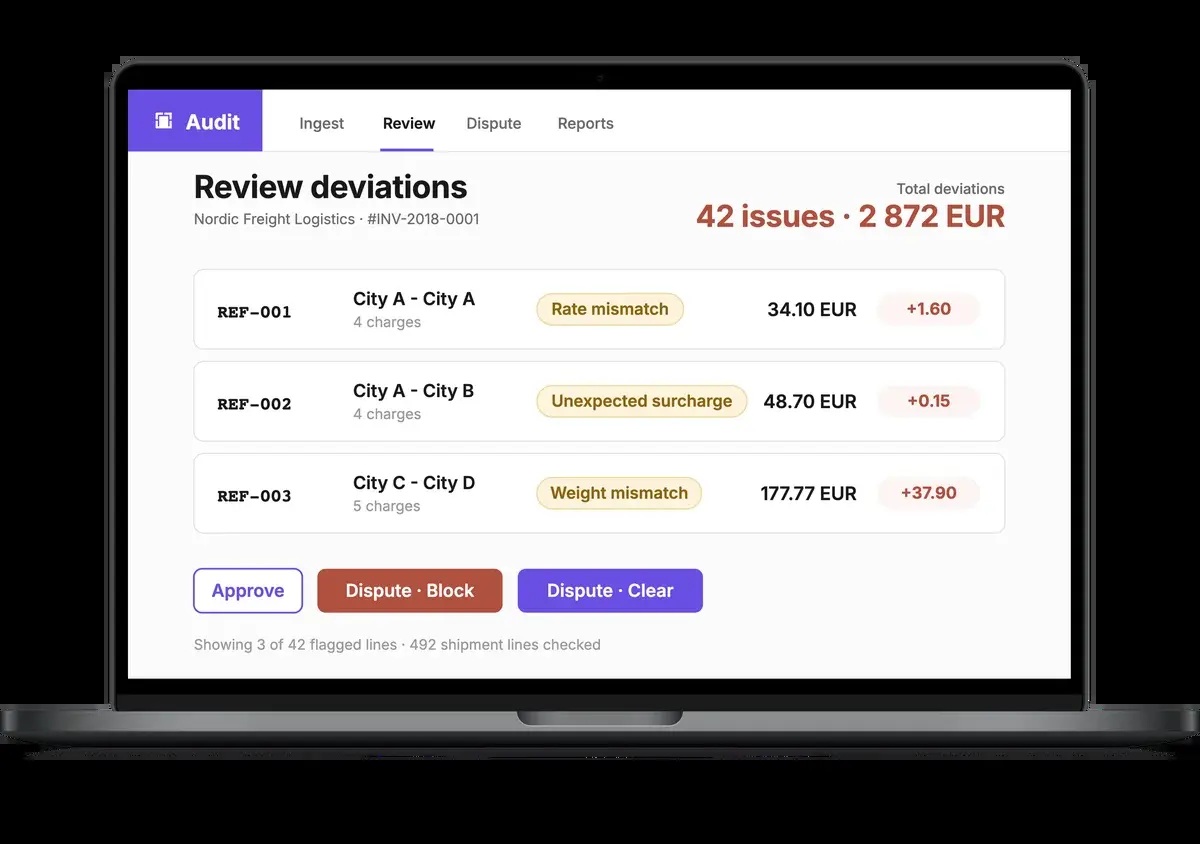
AI reads the varying invoice layouts; fixed rules perform seven checks. The first invoice in a new format is validated by a person. Reviewers receive explanations for flagged lines and decide what to dispute. Audit can also prepare evidence and track the dispute while allowing payment to proceed. The human decision remains an explicit part of the workflow.
The product requirements give the idea useful boundaries. Image-only scans are unsupported. Shipment records must reach nShift’s portal, either through its shipping products or an API. Expected prices require a configured rate card; without one, five of seven checks still run. Better software does not remove the need for trustworthy records.
Audit follows other 2026 releases: ETA delivery predictions for Checkout and Companion guidance inside Track. The pattern is to reuse delivery knowledge in additional decisions. For customers, the test is whether these features reduce uncertainty in the actual operation, from selecting a delivery date to challenging a charge.
06The price depends on the plumbing
nShift earns money through business software subscriptions. Its 2026 terms describe transaction allowances, functionality and support scope, with professional services and applicable support charged separately. Going over a tier can trigger higher charges and a subsequent upgrade. Buyers need to model peak volumes as well as an ordinary month.
One visible price is the official Shopify Checkout app: US$20 a month, with a 14-day trial, as checked in September 2026. The listing allows for separate nShift charges. An enterprise implementation therefore needs its own calculation covering modules, integrations, support and the carrier operation. Audit is quoted according to the size of the freight operation.
The sensible buying exercise starts with an awkward order: oversized, international, returned or incorrectly billed. Run it through the proposed setup and examine each handoff. A merchant using one carrier and a straightforward store may have little need for this breadth. A business with several warehouses, countries and service promises has more places for coordination to pay for itself.
Granit’s furniture is a useful place to finish. A retailer could spend heavily attracting a shopper and still offer a delivery choice that damaged the margin. Fixing that menu required knowledge of the parcel, the carrier and the customer. nShift’s business is bringing those facts together while there is still time to make a better decision.