In 1920, an office could have a perfectly good letter and a surprisingly tedious problem: paying to send it. Somebody had to handle the stamps. Arthur Pitney had worked on a machine that printed postage; Walter Bowes brought a complementary machinery business and the talent to sell it. Together, they founded Pitney Bowes. Their Model M printed two-cent postage. The proposition was wonderfully specific: make one small, repeated task easier.
- Remove the repetition. Meters, software and presort services make sending less laborious.
- Pay for the detour. A loss-making ecommerce operation led to a costly 2024 exit.
- Return to the customer. The latest mailing devices answer requests for speed and simplicity.
A two-cent beginning
The Smithsonian records a detail that punctures any tidy invention myth. The early meter-stamp design looked so much like existing permit stamps that it lasted only sixteen months and twelve days. Even after official approval, the design needed changing. A useful invention still had to be legible to the system receiving it.
That distinction runs through the company today. An envelope or parcel crosses several systems: the sender’s office, a payment mechanism, a carrier’s rules, a delivery network. Pitney Bowes sells ways to manage those crossings. Its customers include small merchants, government agencies and large enterprises. Its corporate overview reports more than 600,000 clients worldwide. The work is often invisible precisely when it goes well.
The mail is the network
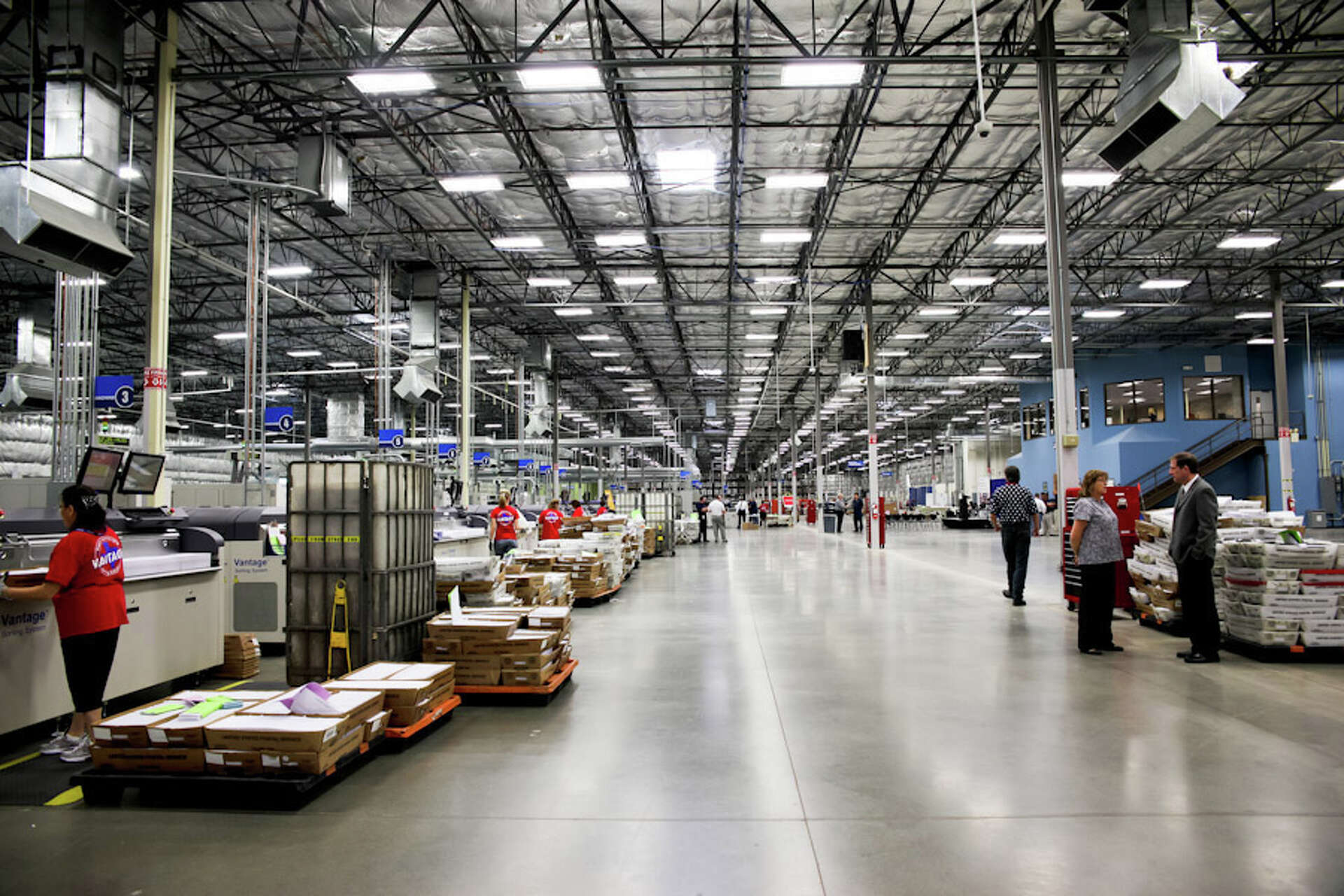
Consider Presort. Businesses produce mail; Pitney Bowes combines and sorts it before handing it into the postal system. Doing that preparatory work helps mailers qualify for postal workshare discounts. The expertise lies in sorting, postal requirements and coordinating enough volume to make the arrangement useful.
Mailpieces, serving 2,000+ clients through 30+ US operating sites.
In September 2026, the company said Presort processes nearly 14 billion pieces annually through more than 30 operating sites. That month it announced automation and facility investments, with plans to add more than 400 associates as competing providers closed. Physical mail can lose volume overall while surviving providers compete for the work that remains. Scale matters, but so does keeping somebody’s statements moving on an ordinary Tuesday.
The expensive detour
The company also tried a much broader role in ecommerce logistics. Its Global Ecommerce segment struggled to become profitable. By 2023, the business was generating approximately $136 million in annual losses. The failure that mattered was economic: handling ecommerce shipments had not become a reliably profitable operation.
After a strategic review, the board chose an exit. On August 8, 2024, Pitney Bowes sold a controlling interest in entities representing most of its US Global Ecommerce operation to a Hilco affiliate for a wind-down involving Chapter 11 proceedings. The subsidiary process should not be confused with a bankruptcy of the entire parent company.
Leaving was expensive too. In its full-year 2024 results, management put expected one-time exit costs at approximately $165 million. It also recorded a $164 million tax asset associated with the reorganization, expecting the cash benefit to offset almost all expected cash exit costs. Those were management’s estimates, with different timing and accounting meanings. Neither figure makes the earlier losses disappear.
2023
reported February 2025
Recurring losses and one-time exit costs are different measures. This is the price of the decision, not a claimed return calculation.
Three carriers. One screen.
Yet September 2024 brought the launch of ShipAccel, a platform for ecommerce shipping. The timing explains the strategy. A company can supply shipping technology without owning the physical operation that moves every parcel. ShipAccel helps merchants manage orders, carrier choices and shipping workflows. In January 2025, the New York Islanders and UBS Arena became a shipping technology partner, using it across their operations.
PitneyShip addresses everyday sending: compare carrier rates, print labels, schedule pickups and track shipments. Its US entry plan currently lists no monthly fee, alongside a 5% label usage fee. Premium lists $34.99 monthly after its trial; enterprise pricing requires a quote. Postage remains an additional cost. A free subscription is therefore an invitation to calculate, rather than permission to stop calculating.
There is hardware too: postage meters, label printers and ParcelPoint lockers for self-service collection. Developers can integrate shipping through APIs. Equipment financing and postage-related financial services extend the relationship beyond a device purchase. Equipment, rentals, subscriptions, usage, supplies, maintenance and processing all contribute to the business model.
The arithmetic of a smaller company
Alternatives depend on the task. Quadient and Francotyp-Postalia compete in mailing equipment. ShipStation, Stamps.com and carrier portals offer alternatives for shipping workflows. Pitney Bowes’s distinction is the combination of physical mailing, software, presort operations and financing. That breadth is useful when a customer’s problem spans several of those activities.
Under CEO Kurt Wolf, appointed in May 2025, the financial question remains uncomfortable. Second-quarter 2026 revenue fell 2% to approximately $451 million, while GAAP net income rose to $50 million from $30 million. Higher earnings alongside lower sales show progress in profitability; they do not establish renewed demand growth.
“Our clients told us they wanted mailing technology that was faster, easier to use, and built for today’s workplace.”
Todd Everett / SendPro CX launch / October 2026
The October 2026 SendPro CX launch gives that discipline a product expression: simplified navigation, faster processing and centralized visibility through Shipping 360. The company says customer feedback shaped the devices. For an office sending letters daily, fewer interruptions can matter more than another feature to learn.
Start with the pile on your desk
The useful lesson is measurable. Audit a month of shipments: destinations, weights, service levels, surcharges and staff time. Compare the full cost of software and equipment against the rates and workflow you already have. A company with strong carrier contracts or very little mail may gain less. Presort savings depend on eligible mail and the service arrangement. Test the ordinary Tuesday before committing to the grand transformation.
Pitney Bowes began by making a two-cent task easier to repeat. Its expensive detour suggests a harder discipline: deciding which part of the customer’s problem belongs inside your own business. There is still plenty of work between a finished letter and the person who needs to open it.