Tanya White made a career out of arriving at the inconvenient moment. A chief marketing officer had left. A company was raising money, buying something, selling something, or discovering that its marketing department possessed plenty of motion and very little direction. White would enter, find the loose wires, give the team a working rhythm, recruit the person who would inherit it, and leave. She called herself a marketing paratrooper. The image was vivid, efficient, and a little theatrical - a useful piece of positioning from someone who has spent more than 25 years positioning things.
Then, in May 2026, the paratrooper declined to return to the plane. White announced that she had joined OpenSesame, the Portland-based workplace learning company, as its permanent Chief Marketing Officer. Her title was conventional. The decision was not. A decade of interim and fractional assignments had taught her to treat departure as part of the design. At OpenSesame, she found a reason to design for duration.
“I want to bring more of who this company actually is into the world.”Tanya White on joining OpenSesame
Her explanation landed on people before products. She described colleagues as sharp, funny, committed, and deeply invested in helping customers build productive workforces. “Humans have always been learners,” she wrote. “We always will be.” For a marketer who has spent years translating software into outcomes, a business built around learning offered a tidy convergence. OpenSesame sells corporate training content and technology, but its larger proposition is adaptation: how people continue to be useful, confident, and capable while work changes around them.
The education of a useful operator
White's professional story begins in Canada. She earned a Bachelor of Arts at the University of Western Ontario, followed by applied information technology training and a project-management designation. Those credentials hint at the combination that recurs through her work: language paired with systems. Before marketing became the center of gravity, she worked in services operations and custom development consulting. She learned how work moves before she learned how to make the movement sound appealing.
Dell supplied the scale. From 2004 to 2011, White moved through customer insights and research, sales operations and effectiveness, and global segment marketing. The Canadian office oversaw what Dell called Americas International - the Americas outside the United States - so her education included markets that refused to behave as one neat audience. Later, in Central Texas, she was close to the enormous company that Austin still remembers as a startup.
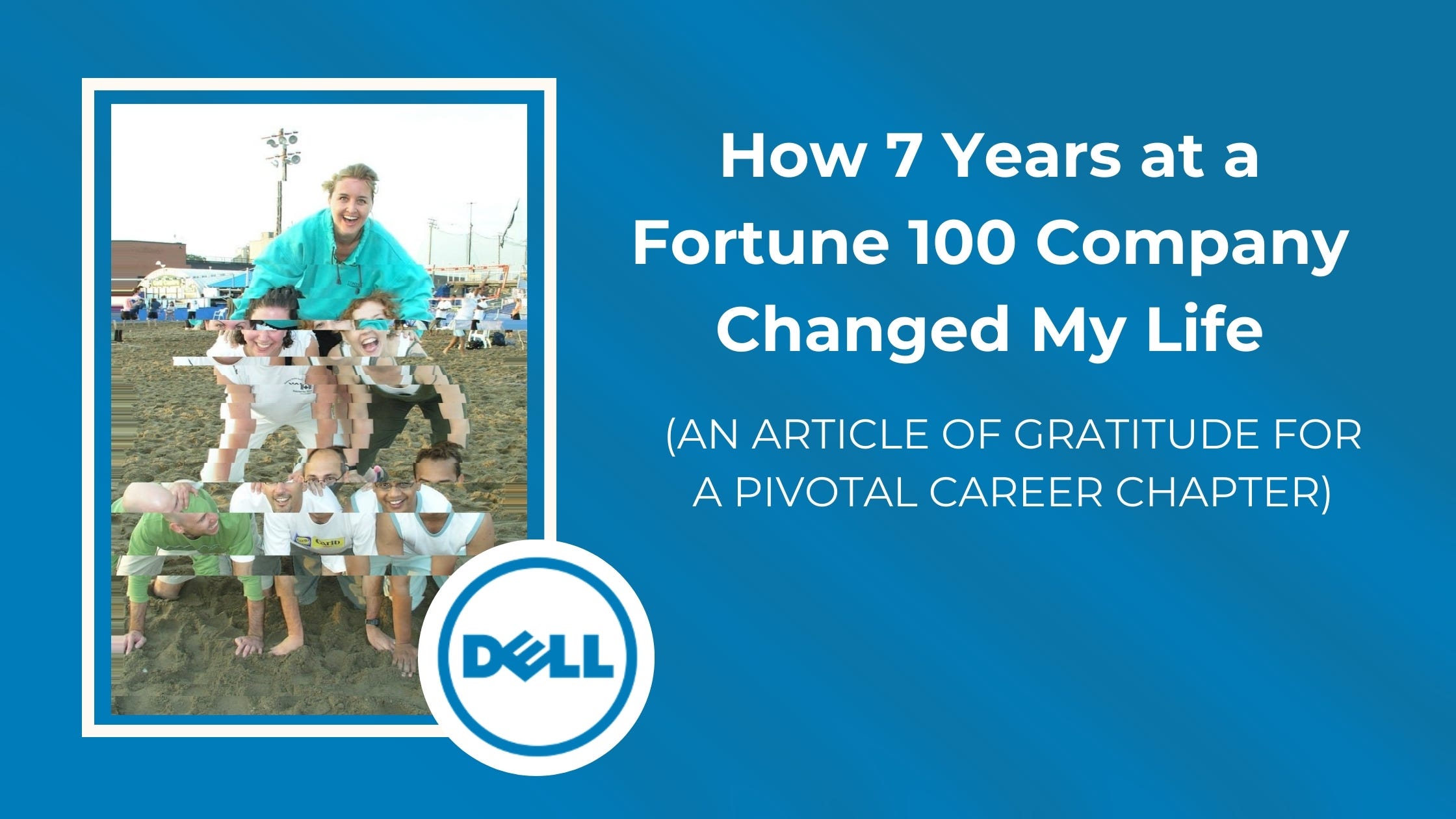
In 2025, an old beach-volleyball photograph brought those years back. The frame showed White and her Dell Canada colleagues away from laptops, arranged in a cheerfully chaotic human tower during an internal tournament. She remembered how badly she had wanted the job and how thoroughly it changed her career. The image makes a useful counterpoint to the tidy résumé. Exposure to international business mattered. So did the experience of trying to win something unserious with ambitious colleagues.
A career in four landings
Learning to enter without taking over
After Dell came a sequence of Austin technology companies: Observint Technologies, Virtual Bridges, Innography, and CPA Global. At Innography and CPA Global she moved across marketing, sales, demand generation, and corporate development. The stretch included two successful exits and a divestiture cycle in the wider Austin venture portfolio. Transactions make PowerPoint look decisive and organizations feel unsettled. White became interested in the interval when the strategy has changed but the daily work has not caught up.
Cantex Consulting, begun in 2017, turned that interval into a practice. Companies hired her to close leadership gaps during executive changes, acquisitions, and funding cycles. She operated as part of the team, pulled the go-to-market levers, helped recruit the permanent staff, then transferred the reins. Recommendations from former colleagues describe a leader who could stabilize an underperforming function, install a data-and-outcome operating model, build bridges to other departments, and improve the team without flattening its culture.
“Lead with empathy, generosity, and kindness throughout the process - for those who remain and those departing.”Tanya White, on managing restructures
Her writing about corporate restructures is revealing. White compares the announcement day to a wedding: important, complicated, and vastly overplanned relative to the marriage that follows. Once the talking points have been delivered, customers still need owners. Prospects still submit forms. Sales territories need remapping. Managers need enough context to lead. Recruiter agreements, technology licenses, approval lines, and meeting cadences all survive the dramatic slide in the all-hands deck.
A strong temporary leader leaves a functioning system, not a dependence on the temporary leader.
Protect customer coverage, pipeline, recruiting, communication, and the trust of the people who stay.
Technology matters when it reduces friction, mistakes, cost, or uncertainty in someone's real work.
White's POP framework moves from Purpose to Outcomes to Process, in that order.
A CMO with a camera
The corporate chronology tells only half the story. In 2013, White founded BabyBird Guide, a digital publisher with the tagline “Knowledge in Bite-Sized Pieces.” Its practical ebooks were meant to be read in about 30 minutes on any device. The format respected a reader's time and forced the publisher to decide what deserved space. A decade later, she was applying the same instinct to marketing teams: choose the essential, make it usable, remove the ceremonial fog.
White also writes and takes photographs. Between 2022 and 2024, she contributed travel and lifestyle pieces to EASTside Magazine. She reported on intimate Sofar Sounds concerts, seasonal cocktails at an East Austin bar, and a road trip to Caddo Lake. For the latter, she supplied both words and photographs under her In Plain Sight Photos identity. Her itinerary included sunrise through bald cypress trees, the tiny town of Uncertain, and a reminder to take a picture with Bigfoot in Jefferson. Corporate marketing rarely rewards that level of particularity. Good writing depends on it.
The camera offers its own management lesson. A photographer cannot include everything. She chooses the frame, waits for the useful light, and accepts that what is excluded gives the image shape. The same principle runs through White's recent argument about artificial intelligence. She uses AI and believes in its impact, but objects to marketers pasting the label across every headline. Customers, she writes, buy relief and opportunity. They care about faster work, fewer mistakes, lower costs, better decisions, and calmer nights. The mechanism is secondary to the changed Tuesday.
“Customers don't buy technology. They buy relief. They buy opportunity.”Tanya White, “Stop Saying AI. It's Lazy Marketing.”
The ecosystem around the job
White's work has repeatedly extended beyond the company paying her. She joined the SXSW Pitch Qualifying Committee in 2018 and became a co-chair in 2021, helping review early-stage companies for accuracy, completeness, and category fit. She has been a member investor with Pipeline Angels, which works to widen participation in angel investing and access to capital. She advised Living Security, served as an operating advisor to Elsewhere Partners, and sat on the AudiencePlus board.
These roles alter the view from the marketing desk. A pitch qualifier learns how quickly an ambitious story can detach from evidence. An investor learns to ask what growth costs, who benefits, and whether a market exists beyond a persuasive founder. An advisor learns that the correct answer still needs an owner and a sequence. White's public record points to a preference for practical frameworks because frameworks travel. Personal charisma is harder to hand off.
Even the volunteer work fits the pattern of access and attention. She has contributed to the Texas Talking Book Program, which serves readers with visual, physical, or reading disabilities, and walked dogs for Austin Pets Alive! There is no need to stretch these activities into a corporate moral. They simply locate the operator in a city and among people, books, animals, and institutions that do not appear on a funnel report.
Why this landing held
OpenSesame sits at a lively tension. Artificial intelligence is changing jobs while companies try to prepare employees without turning learning into one more tab nobody opens. The company offers training content, curation, creation tools, and integrations. White's assignment is to make that machinery legible as a human outcome: people gaining the skills to keep participating in work as work is reinvented.
Her decision to stay suggests a mature definition of commitment. Permanence is not the absence of change. It is choosing which change deserves longer stewardship. The paratrooper metaphor got White through a decade because it explained her value in a sentence. The more interesting chapter begins after the landing, when the expert in transitions must build for a future she intends to inhabit.
There is a quiet symmetry here. BabyBird Guide compressed knowledge for busy readers. Dell taught her to navigate complexity at scale. Austin software companies taught her what happens during transactions. Photography taught her to frame. Interim leadership taught her to leave systems behind. At OpenSesame, all five lessons meet inside a company devoted to helping other people learn. White has finally unpacked, but she has not stopped moving.