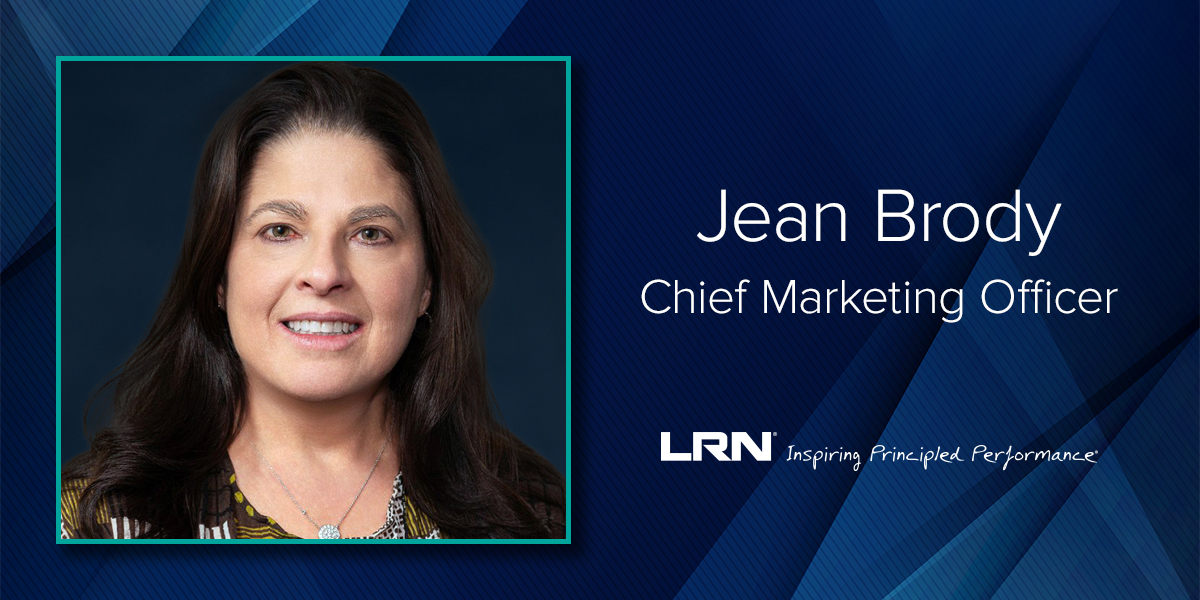
Marketing corporate ethics is a curious assignment. The subject arrives wrapped in policy manuals, annual training, reporting systems and the vocabulary of risk. Yet the moment that matters is usually small and private: an employee notices something wrong, a manager weighs an uncomfortable choice, a team decides whether its stated values have any practical force. Jean Brody's new job is to connect those two worlds. Since February 2026, as Chief Marketing Officer of LRN, she has been responsible for explaining how technology, education and advice can help a vast organization behave like the organization it claims to be.
That sounds lofty until one looks at Brody's resume. Her career is less a sequence of dramatic reinventions than a long apprenticeship in making intricate businesses legible. She has marketed retail technology, corporate communications, print services, legal analytics and outsourced professional services. These are not impulse purchases. They are bought by committees, scrutinized by specialists and judged over years. The pitch must survive contact with procurement, operations and the people who will actually use the thing.
At LRN, the scrutiny is more interesting because the company sells into ethics and compliance. Its products include training, program-management technology, analytics and advisory work. The promise is not simply that a dashboard will load faster. It is that better tools and better learning can support better judgment. A marketer in this category cannot sprinkle purpose over a campaign like parsley. The message has to be credible enough for the compliance officer and clear enough for everyone else.
A psychology graduate enters the machinery
Brody studied psychology at Barnard College, Columbia University, graduating magna cum laude in 1988. She also served as president of Alpha Phi. It would be tidy to claim that psychology predetermined a career in marketing, but careers rarely respect such clean plotting. What can be said is that her later work repeatedly returned to the same human puzzle: how people receive information, how organizations build belief and why a proposition that makes sense internally may arrive as fog outside the building.
Her early marketing roles were at Vestcom, a business built around technology and communications at the retail shelf. She moved from marketing manager to marketing director, developing strategy, creating branded products and helping launch a new brand intended to position the company as a technology leader. It was practical work at the point where data, operations and customer attention meet. The shelf edge is a severe editor. A message either helps a decision or becomes part of the scenery.
At Bowne, Brody became Director of Corporate Marketing, with responsibility across brand management, online marketing and the corporate website. Then came RR Donnelley, where her remit included helping manage the transition from the Bowne name to the RR Donnelley brand. Brand transitions are often described with the language of unveilings. In practice, they are closer to plumbing: thousands of small connections must be rerouted without flooding the house.
The long route to LRN
A consulting role at CT TyMetrix sharpened the theme. Brody developed marketing and go-to-market strategies for legal data and analytical products. Legal analytics does not reward vague adjectives. The buyer wants to know what the data reveals, how it changes a decision and whether the claim can withstand a lawyer's raised eyebrow. By the time Brody joined Williams Lea Tag as Americas Marketing Director, she had learned several dialects of complexity.
Her recurring craft is translation with consequences.
The Williams Lea years get larger
An archived corporate release identifies Brody as Williams Lea's Americas Marketing Director in 2014. By 2019 she was Global Head of Marketing. In 2022 she became Chief Marketing Officer and joined the executive committee. The expansion in titles matters less than the expansion in scope. Her eventual portfolio spanned brand, demand generation, digital, sales enablement, communications and product marketing. That is nearly the full journey from what a company says to what a potential client does next.
Williams Lea serves legal, financial and professional-services firms, businesses that tend to purchase expertise carefully. Its work sits behind other people's work: presentations, documents, administrative operations and the systems that keep professional teams moving. Marketing such a company means giving visibility to services designed to be unobtrusive. When they work, the client's attention stays on its own clients. When they fail, everybody suddenly notices.
Brody's public comments offer small glimpses of how she approached that assignment. When Williams Lea launched a new website, she called the colleagues behind it a “small but mighty” marketing team and named them individually. It is a compact bit of management style preserved in a social post: pride in the output, credit distributed to the people who made it and no attempt to pretend the work emerged from the C-suite by spontaneous generation.
Recommendations on her professional profile repeat a similar pairing. Colleagues describe someone able to see the strategic picture, translate it into an organized plan and then join the execution. One calls her creative and resourceful; another emphasizes measurable campaigns and an eye for detail. Recommendations are testimonials, naturally warm by design. Still, the consistency is useful. Brody's professional persona is not the distant brand oracle. It is the strategist who remains interested when the spreadsheet opens.
The Brody brief, in plain language
technology · advice · learning
understand · trust · act
Now the product is principled performance
LRN announced Brody's appointment on February 17, 2026, one day after she assumed the job. She joined a leadership team being remade under CEO Bob Lemmond, following the arrival of Chief People and Culture Officer Patsy Doerr. Brody's mandate covers global marketing strategy, brand positioning and go-to-market work. Lemmond framed her value as an ability to connect purpose with performance and to build trusted brands.
Brody's own statement was characteristically centered on partnership. “I’m thrilled to join LRN at such a pivotal moment,” she said. She described a foundation built from expertise, tools and client relationships, then set out the ambition: amplify LRN's impact and help clients strengthen workplace ethics and compliance in pursuit of values-based growth.
The phrase “values-based growth” is easy to admire and hard to operationalize. Growth has a dashboard. Values tend to appear in a framed list near reception. LRN's business rests on closing that distance through training, reporting, benchmarking, behavioral insight and the routines of a compliance program. Brody's challenge is to tell that story without turning morality into software copy or software into a moral hero.
She arrives with a useful instinct for the human side of technology. In a public post promoting a colleague's discussion of AI-powered marketing, Brody emphasized the balance between automation and authenticity and wrote that she learned from her colleague every day. That is not a grand theory of artificial intelligence. It is a grounded stance: tools can extend the work, while judgment and learning remain social.
When the promise is ethical culture, the brand must behave before it can persuade.
This is where marketing and compliance quietly resemble each other. Both fail when treated as annual performances. A campaign cannot repair a product that disappoints, just as a yearly course cannot compensate for leaders who punish candor. Both depend on repetition, signals and what happens after the formal presentation ends. Brody's portfolio gives her access to those connections: product marketing can inform the promise, demand generation can find the audience, sales enablement can preserve the argument and communications can keep the company accountable to its own language.
The interesting work begins after clarity
LRN's reach gives Brody a large canvas. The company says its work reaches more than 30 million learners each year and serves more than 2,500 organizations. Scale can make a brand feel important; it can also make it abstract. Thirty million is impressive but difficult to picture. One employee recognizing a conflict of interest, one manager responding fairly to a report, one team refusing a convenient shortcut - those are the units that give the number meaning.
Brody has spent her career in organizations where the product lives partly in expertise and partly in systems. That background suits a market now crowding around AI-assisted insights, automated workflows, analytics and personalized learning. Every new capability creates a fresh marketing temptation to put the machine at center stage. Her more durable opportunity is to show what changes for a person making a decision.
The career arc from Vestcom to LRN is not a leap from commerce into conscience. It is a steady movement toward harder forms of explanation. First came technology at the retail shelf, then corporate identity, legal analytics and the invisible operations of professional services. Now come ethics, compliance and culture - subjects everyone recognizes and few companies find easy to measure.
Brody's work will be visible in positioning, campaigns and pipeline. Its more revealing measure will be coherence. Does LRN describe its technology in language clients can use? Does its brand make room for the messiness of human behavior? Do the company's claims about principled performance agree with the experience it creates? Those are marketing questions with unusually sharp edges.
A career of translation has brought Jean Brody to a category where words carry weight. The task now is not to make ethics sound fashionable. It is to make an old business truth feel specific again: culture is built in choices, trust is earned in practice and clarity is only valuable when it helps someone act.