Wine of the Month Club had a problem that sounded like a website problem. Its buying experience needed to catch up with customers who expected more from online shopping. But follow the work for a moment. There was the design. There was the old content. There were the systems behind the purchase. A customer sees a bottle and a button. The company sees a procession of specialists who must somehow agree.
- Catalyst combines strategy, creative, technology and operations.
- Its teams work inside a client’s existing routines.
- The offer suits companies that need several skills without hiring every specialist.
The website was only the beginning
Catalyst’s account of the wine-club project describes 125 page designs, six connected technologies and 500 migrated content items. The team built a WordPress commerce experience linked to fulfillment, retention and automation. This was a collection of dependencies wearing the friendly face of a website.
Figures reported in Catalyst’s project account. Scope counts, not sales results.
That distinction explains why an integrated agency might get the call. Hiring a designer addresses design. It leaves someone to connect design to the content inventory, the technical implementation and the business that must keep selling throughout. The coordination bill arrives whether or not it appears on the proposal.
Four kinds of work. One working relationship.
Catalyst Marketing Agency organizes its offer around strategic, creative, technical and operational capabilities. Its point of difference is how those capabilities meet: an embedded team, working through the client’s existing workflow. Branding, content, digital communications and public relations become parts of a shared assignment.
Co-founders Rion Haber and Doug McIntyre lead strategy and operations respectively. The company’s own chronology runs through Vox Digital in 2005, 1205 Marketing in 2013 and Catalyst in 2017. The recurring theme is a growing appetite for specialist work inside organizations that want to keep their teams compact.

There is an appealing economic idea here. A business might need a developer intensely during a rebuild and occasionally afterward. Its communications needs may run every week. Paying for access to both disciplines can make more sense than turning both into permanent positions. The useful question is how much of each skill the work consumes.
An editorial diagram of Catalyst’s described process.
This also clarifies the competitive choice. A freelancer can supply a skill. A channel agency can concentrate on one route to an audience. Catalyst asks the client to buy the relationship between disciplines as well. That proposition becomes more useful as the assignment crosses boundaries. It also makes coordination something a buyer should evaluate directly: who owns the brief, who resolves disagreements and who notices when a deliverable no longer serves the objective?
The buyer needed an explanation
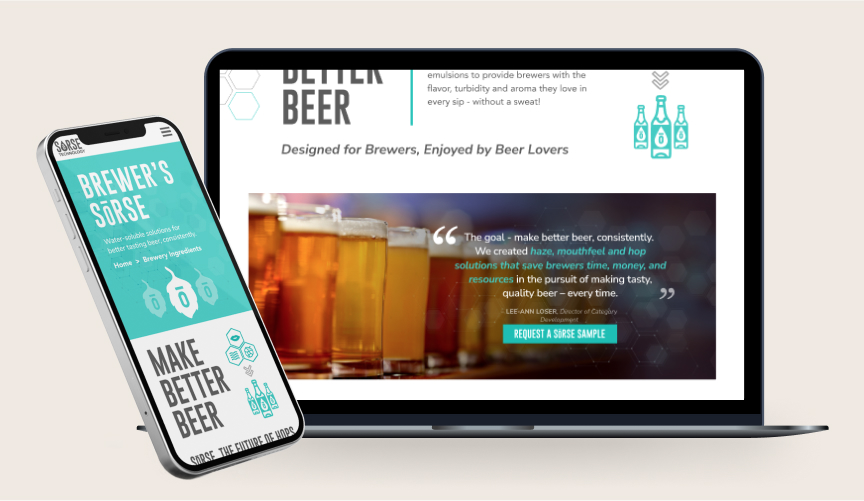
Consider SōRSE Technology, a maker of functional cannabis ingredients. Business buyers had questions about cost, process and legalities. In Catalyst’s telling, the obstacle was getting enough informed buyers into the conversation. The response combined a business-facing identity, a 25-page website, sales materials and an explainer video.

The small internal team retained direction while Catalyst supplied additional capabilities. Shared task management, sprint calls and everyday messages held the work together. Diana Eberlein, the client’s marketing vice president, put the benefit plainly:
“That helps us stay lean and flexible while we grow.”
Diana Eberlein / SōRSE Technology
The transferable idea is simple: list the questions a buyer must resolve before buying, then make the website and sales material answer them together. Education can become commercial infrastructure. It gives a salesperson somewhere useful to send the next person who asks the same question.
A search engine hiding in the data
SCRIPTS Asia presented another version of the problem. It supplied investor-event information from Asia Pacific, but needed marketing infrastructure to support its sales effort. Catalyst describes using the company’s event data to generate search-oriented landing pages. Access to individual event information was gated, creating a route from a specific search to a potential buyer.
Catalyst reports more than 250 leads from long-tail event content and listings. The interesting mechanism is the reuse of something the client already produced. Each event could become a relevant entrance to the business. The lesson for another company is to inspect its existing information before commissioning another general-purpose campaign.
In February 2023, JPX Market Innovation & Research completed its acquisition of SCRIPTS Asia, K.K. That subsequent transaction is part of the client’s history; it does not establish how much marketing contributed to the outcome.
Read the small print on staying small
Catalyst offers ongoing managed support alongside tactical, consulting and longer-term partnership models. Its Clutch listing gives a $5,000-plus project minimum and a $100-$149 hourly range. Those are directory benchmarks. The managed offer is customized, with recurring billing and a published twelve-month contractual basis. Its terms request at least 60 days’ notice before moving to alternatives after the term.
The fit has a condition: Catalyst explicitly calls for an internal marketing leader or executive who can give direction and feedback quickly. A company that cannot approve work may simply move its bottleneck outside. A business needing one isolated task may find a specialist a cleaner purchase. Consistent, full-time demand for a particular skill can also strengthen the case for hiring.
Its September 2025 essay on AI extends the same argument. Catalyst anticipates a role for tools that improve information flow, preserve campaign decisions and make client data easier to question. These are proposed directions, rather than a catalog of released products. The emphasis is revealing: faster production still leaves the practical business of agreeing what to produce. For a buyer evaluating the agency, a demonstration of that everyday working relationship may be more informative than another presentation of finished creative.
The small team can copy the operating idea immediately. Choose an outcome. Identify the required skills. Put decisions and work in a shared routine. Review what happened. The org chart can wait until the workload earns it.