Christina Mautz once answered a fashionable interview question with two risky letters. Asked whether she was a growth marketer, she said no. This was not an ideal way to flatter a hiring committee in a business climate feverish for growth. Then she explained what she was: a marketer who starts with the customer, learns the customer's pains, and builds the organization from that understanding. The answer landed. So did the job. In retrospect, the exchange looks less like interview bravado than a neat little model of her career. Mautz has spent three decades moving through technologies, titles, and companies while declining to confuse the prevailing vocabulary with the actual work.
Her route is pleasingly untidy. She worked as a professional writer early on, spent time in the nonprofit world, ran a consultancy, joined Yahoo in 2007, moved to Amazon, entered the Seattle startup circuit, and eventually ran both marketing and sales at Moz. Later came the top marketing job at Panopto, another consulting chapter, an executive role at the financial intelligence company Valid8, advisory work, and a seat on Skyword's board. On a résumé, it is a sequence of logos. In her own telling, it is a “wonderfully winding journey.” The winding matters because it gave her one problem in many disguises: how does an organization notice the human being on the other side of its machinery?
A writer enters the machine
Before the dashboards, Mautz studied words. She graduated cum laude from the University of Arizona and earned a master's degree in professional writing from the University of Southern California. That background is more than charming biographical garnish. Writers learn that an audience can leave at any moment. They learn to distrust abstraction, look for motive, and ask whether a sentence has earned the next one. Those habits transfer rather well to marketing, provided nobody buries them beneath a tower of acronyms.
In 2007 she joined Yahoo's global B2B marketing team. She stayed for five years, a stretch she has called transformative. Yahoo's corporate weather was famously unsettled, yet the larger digital climate was changing even faster. Marketing automation was emerging. Companies could observe customers with a granularity previously unavailable. Mautz has said that she “grew up” as a digital marketer at the same time those capabilities took shape. A writer trained to imagine an audience was suddenly surrounded by systems that could reveal one.
The temptation, then as now, was to mistake more data for more wisdom. Mautz took another lesson. Technology could help marketers understand where customers were in their journey and offer relevant information at scale. The useful standard was not reach for its own sake. It was whether the person receiving the message might genuinely benefit from it. Her preferred future for the industry was “helpful versus annoying,” a modest phrase with considerable work hidden inside it.
“Technology startups should choose their first marketing technology investments as wisely as they choose their first hires.”Christina Mautz
The comparison is exact. A first hire shapes the habits and culture of a young team. A first system shapes what the team can see. It determines which behavior earns a green arrow, which customer becomes a segment, and which invisible assumption acquires the dignity of a report. Software is never merely installed. It quietly teaches a company what deserves attention.
The customer ignores the org chart
After Yahoo, Mautz led merchant marketing for Amazon Local, then joined Koru as vice president of marketing in 2015. Koru was building a marketplace designed to make college graduates more workplace-ready and connect them with employers. By the time Mautz arrived at Moz in 2018, she had seen the customer's path from the vantage points of a vast consumer platform, a marketplace, and an early-stage company. Moz added a particularly apt instrument: search.
Search data is a record of desire expressed in oddly clipped sentences. People tell the box what they want, what has failed, and what they cannot name. Mautz argued that SEO therefore deserved attention from CMOs and CEOs. It was a driver of brand awareness and revenue, not a clean-up exercise to assign to one person once a month. Search followed people through voice assistants, maps, phones, bakeries, and moments of urgency. For a customer-centered marketer, it was less a channel than a listening post.
At Moz, this logic escaped the marketing department. Mautz became acting chief revenue officer in 2019, taking responsibility for direct sales as well as marketing. The change was organic rather than a grand plan. Much of the SaaS company's revenue was already driven by online conversions owned by marketing; other purchases passed through account executives. Customers experienced the two routes as one relationship. Internally, however, they belonged to different teams. Mautz's response was to bring the work closer together.
She did not pretend that a new title instantly made her a sales expert. Sales was a different craft, she acknowledged, and a difficult one. Her confidence lay elsewhere: looking at the whole system from the customer's perspective, then organizing people around that view. Marketing directors and the sales director reported to her. The direct channel became more seamless. The experiment made the expanding CMO brief concrete. If a marketing leader is judged on revenue and the customer moves digitally across departmental borders, accountability cannot stop politely at the border.
“Remember, this is not an MQL; it's a person.”A principle Mautz shared with fellow marketing leaders
Growth without the costume
This is why Mautz's refusal to call herself a growth marketer was more substantive than semantic. She had no quarrel with growth. Her career has been devoted to it. She objected to the idea that a collection of accelerated tactics could substitute for understanding. She has said that “growth hacking” does not go deeply enough or meet the customer where they are. The objection sounds almost quaint in a culture that rewards speed. It is also practical. A shortcut that misunderstands the customer is a fast route to the wrong place.
During the strange management test of 2020, she described empathy as a leader's best tool. Teams were changing plans rapidly, customer needs were moving, and polished certainty was often impossible. The useful response was not rigidity but intentional experimentation: small tests, close contact with customers, and a willingness to iterate. Her comments on executive teams followed the same pattern. The senior table should contain the people responsible for products, people, customers, and technology, plus opportunities for emerging leaders to enter important strategic work. A brain trust is strongest when it is treated as a working group, not a ceremonial arrangement of titles.
Moz was acquired in 2021. Mautz, by then senior vice president of revenue, helped steer the announcement and its story for employees, customers, and partners. She next joined Panopto as chief marketing officer, responsible for global demand generation, brand, communications, content, and product marketing. The video platform was expanding after institutions had rushed into hybrid work and learning. Even here, amid another surge of technology and scale, the work was human: capturing institutional knowledge and helping people find it.
The second act is plural
In 2022 Mautz founded Mautz Marketing, returning to consulting for a second time. The fractional model fits the shape of her career: enter a company, study the customer and market, connect strategy to results, build the engine, and leave the organization more capable than it was. She joined Cloud Campaign's advisory board in 2023. In 2024, Valid8 Financial hired her as executive vice president of marketing after raising an $8.5 million Series A. The product serves lawyers, accountants, government customers, and enterprises that need to analyze the flow of funds. It is a world where trust is not brand decoration. It is the merchandise.
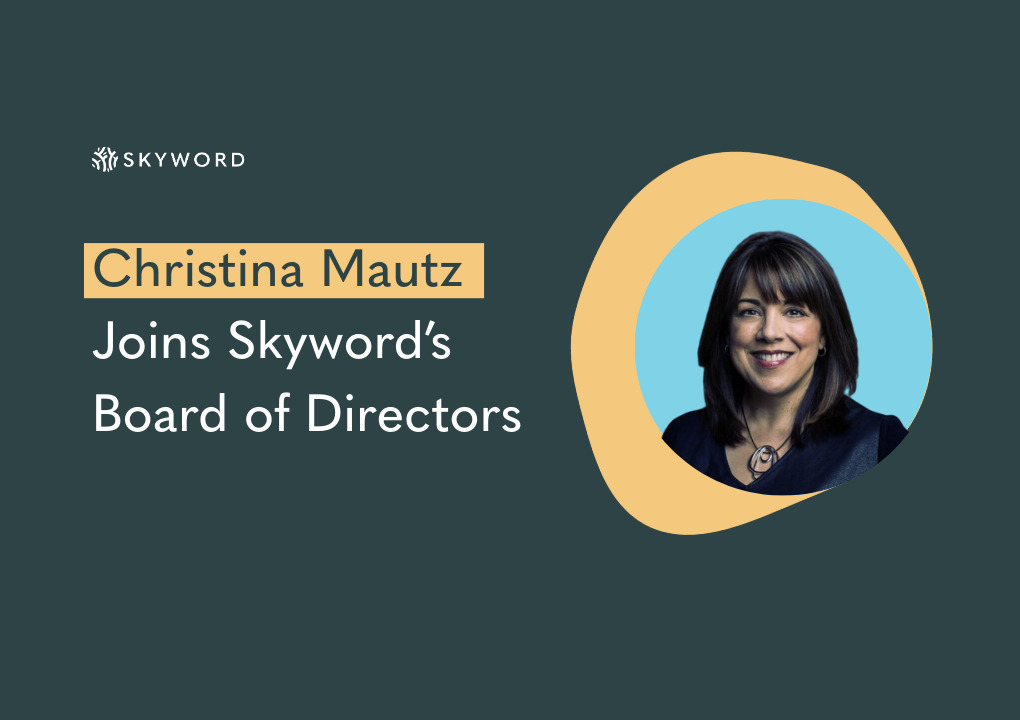
Then, in April 2025, Skyword appointed her to its board. The company's question is one Mautz has been preparing to answer since Yahoo: how can technology expand what marketers can do without diminishing what makes the work valuable? Skyword's platform combines live data, generative AI, automation, and expert storytelling. Mautz framed the challenge precisely: scale high-impact content without sacrificing quality. The machine can now produce language in industrial quantities. The scarce goods are judgment, genuine expertise, brand consistency, and something worth saying.
Her public comments on responsible marketing add weight to this assignment. “Marketing is powerful,” she said in 2020, because marketers can influence what people see and understand. She praised peers who used that power to bring attention to human rights. In another forecast, she described business as humans serving humans and urged marketers to treat each person with kindness and respect. These are ethical claims, certainly, but also commercial discipline. Trust is accumulated in individual encounters and squandered by automation that treats people as inventory.
Mautz's story resists the easy drama of reinvention. The writer did not disappear when the executive arrived. The marketer did not vanish when sales entered her remit. The operator now informs the adviser; the adviser now informs the director. Even her favored off-hours pursuits have a tidy symmetry: a Panopto biography placed her deep in a novel or deep in a forest, often with her husband and two sons. Both reward attention. Both punish the hurried observer.
The modern marketing department has accumulated more tools, more data, more names for growth, and more ways to produce noise than Yahoo's marketers could have imagined in 2007. Mautz's durable contribution is a standard for deciding what any of it is for. Begin with the person. Listen hard enough to understand the need. Put the teams around the same journey. Choose technology that sharpens attention rather than replacing it. Then connect the strategy to a result somebody can recognize. Fashion will move on. The customer, mercifully, remains.