The revealing line on Lisa Horner's résumé is not Chief Marketing Officer. It is customer care. For roughly a decade, before demand-generation targets and boardroom strategy entered the picture, Horner worked where corporate promises arrive to be tested by actual people. Customer care is the coat check of commerce: everyone remembers when the ticket goes missing. Spend long enough there and a brand stops looking like a logo. It becomes the sum of expectations a company creates and keeps.
That apprenticeship explains the practical streak running through Horner's public conversations. She speaks about marketing as a service, customer closeness as a discipline, and technology as a way to remove dreary work rather than add fashionable clutter. Her career has crossed hospitality technology, web collaboration software, and real estate software. The products changed. The governing question did not: what useful thing is the customer trying to accomplish?
Today Horner is Chief Marketing Officer at AppFolio, the Santa Barbara software company whose platform serves more than 20,000 real estate customers and supports more than eight million units. She joined in 2014, when the company was still private. A year later AppFolio went public. Over the years that followed, she helped build a marketing organization of more than 100 people and helped guide a brand growing alongside the business.
A philosopher enters the funnel
Horner earned a bachelor's degree in philosophy from the University of California, Santa Barbara. It is tempting to make this sound like an eccentric detour before the sensible business began. The opposite may be closer to the truth. Philosophy trains a person to inspect definitions, expose assumptions, and ask what a thing is for. Those are useful habits when a roomful of smart people has begun discussing “brand” as though everyone means the same thing.
Her working life began at InfoGenesis, a hospitality technology company, in customer care services. From 1997 to 2007, she learned the less romantic grammar of a commercial relationship: listen, diagnose, respond, follow through. In 2007 she moved to Citrix Online, eventually becoming Senior Director of Demand Generation for the GoTo family of products. Customer understanding now had to travel through campaigns, events, content, and a measurable sales process.
InfoGenesis
Customer care services: a decade spent close to users and consequences.
Citrix Online
Demand generation across media, social business, content, campaigns, and global events.
AppFolio
From marketing leader to CMO through the company's public-market growth.
Scale Venture Partners
Go-to-market adviser to growing software companies.
At a 2011 marketing conference, Horner gave a talk about webinars with the cheerfully culinary title “Using Webinars to Generate Spicy New Business.” The lasting idea was not a recipe for better slide decks. She argued that a webinar belongs inside a larger story and must connect to revenue. For a Citrix campaign built around “The Entrepreneur,” her team invited Adaptive Path co-founder Lane Becker to speak. Attendees produced more questions than the session could hold, so the team recorded Becker answering the leftovers and published the follow-up on YouTube. The event ended; the conversation did not.
“The value of your storytelling will drive the rate of conversions in your funnel or tunnel.”Lisa Horner, 2011
There is a useful lack of romance in that sentence. Storytelling matters, and so does the cash register. Horner was connecting content, search, social media, lead nurturing, and sales outcomes at a time when many companies still kept those functions in separate little kingdoms. In 2012, TopRank Marketing included her among its “25 Women Who Rock Social Media,” citing the breadth of her remit at Citrix and her work on the GoToMeeting brands.
The promise has to survive the campaign
Horner arrived at AppFolio in 2014. The company sold cloud software into a business full of stubbornly physical realities: buildings, repairs, leases, payments, keys, complaints, and communities. Property management may be digitized, but nobody lives in a dashboard. The marketing challenge was to explain software in terms of what it returns to the people doing the work: time, clarity, fewer repetitive tasks, and better service to residents and owners.
Her published executive biography describes a marketer with roots in both technology and services, intent on delivering marketing that feels like service. This phrasing carries more weight than the usual promise to be “customer-centric.” A service has to do something. It must answer a question, reduce uncertainty, or help a person make a better decision. Promotion can survive briefly on attention. Service has to earn a return visit.
The service loop
That loop also runs inward. In a 2022 conversation about people-first property management, Horner argued that work occupies too much of a life to be stripped of meaning. Companies often create real value, she said, but fail to articulate it to their own people. The remedy begins with staying deeply connected to customers, then showing employees how their daily effort participates in that value.
She is realistic about the arrangement. No one loves every task. “The goal is to love a whole lot about your job,” she said. Operational efficiency, in this view, is not merely management squeezing more output from a calendar. Employees also want tools and processes that make competent work easier. Friction has a human cost. Remove enough of it and people gain room for judgment, craft, and the satisfying parts of the job.
Horner has said that some of a company's best ideas can come from its newest employees. They have not yet learned which inconveniences everyone else has agreed to stop noticing.
AI, with the humans left in
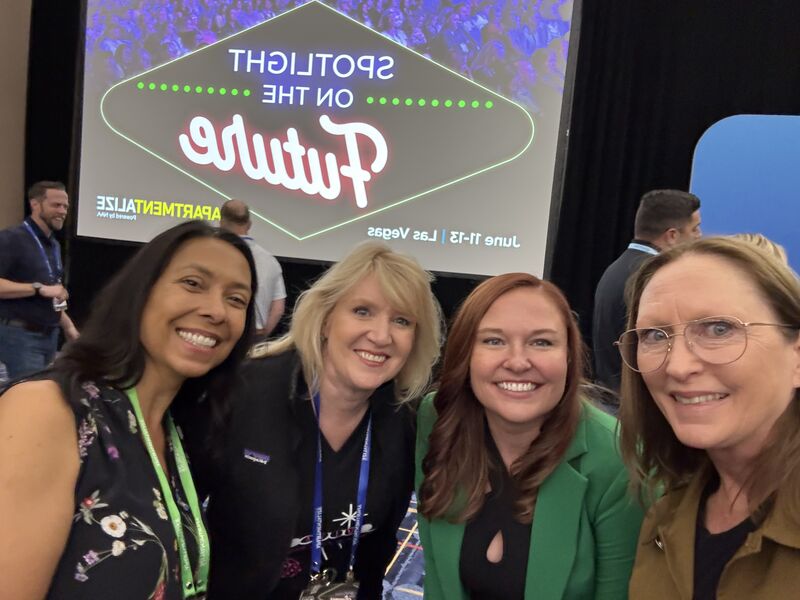
By 2025, Horner's subject had widened from marketing automation to agentic AI. In a live interview at AppFolio's FUTURE conference, she described an industry moving beyond the old “pane of glass,” where people sit typing into property software all day. The point of agentic capability, as she framed it, is to move routine interaction to the machine and return higher-order work to the human.
She was equally blunt about the competitive timing: businesses that do not begin putting agentic capability to work risk falling behind those that do. Yet her larger argument resisted the usual machine-will-save-everything pageantry. Technology earns its place when it helps operators spend more time doing what people do well. The aspiration remains recognizably human: build thriving communities and give employees more opportunity to do consequential work.
The same interview returned to the foundations of brand. Before channels, campaigns, or AI-generated variations, Horner starts with two short questions: “Who are we?” and “What do we care about?” They sound almost embarrassingly simple. They are also expensive questions, because honest answers impose constraints. A company that declares what it cares about has fewer places to hide when behavior and language disagree.
Constraints appeal to Horner as a source of sharper strategy. Knowing a customer deeply limits the audience, the promise, and the useful next move. That discipline matters more as AI makes the production of plausible words nearly free. When everybody can manufacture more, discernment becomes the scarce input. The marketer's advantage is not volume. It is a better ear.
A long local orbit
Horner's career is also unusually rooted in one place. UC Santa Barbara, InfoGenesis, Citrix Online, and AppFolio all anchor her to the Santa Barbara technology community. Rather than treating geography as a backdrop, she has extended her work into the region's civic and startup networks. She has mentored and coached through StartupSB, advises venture-backed companies through Scale Venture Partners, and sits on three startup advisory boards.
In 2025 she joined the board of the Santa Barbara South Coast Chamber of Commerce. She also serves on the executive committee of the Scholarship Foundation of Santa Barbara. These roles form a neat circuit: education created an entry point; local technology companies provided a career; advising and civic work send experience back into the place that produced it.
That year also brought recognition from Ragan and PR Daily, which named Horner a Team Leader in its Top Women in Marketing class. Her own response redirected attention to the team and restated the principle: marketing should listen, learn, and act so customers and communities can thrive. Awards encourage a little trumpet music. Horner used hers to talk about listening.
The through-line is not difficult to spot. Customer care taught her to hear the problem. Demand generation taught her to connect a story to an outcome. AppFolio gave her a long canvas on which to build a team and brand through public-company growth. Advising and civic service widened the circle. Even the philosophy degree, that apparent outlier, fits nicely: inspect the premise before polishing the answer.
Good marketing begins before the message. It begins with the quality of attention.The pattern across Horner's career
There is no shortage of software promising to help marketers speak. Horner's career makes a case for the complementary skill: learning what is worth saying. Stay close to the customer. Let engineers meet operators. Notice what new employees notice. Use automation to clear space for judgment. Ask what the company cares about, then behave accordingly.
This is not a glamorous operating system, which may be why it endures. It asks marketing to carry its share of the service, not merely decorate the promise. The campaign ends. The customer still has to live with what was sold.