Karen Dixon works in the part of technology that disappears when it succeeds. A bill goes out without ceremony. A client signs without printing. A lawyer finds the right matter without asking where the file went. A small business registers a name and begins. Nobody applauds the plumbing. They simply notice that the day contains fewer irritating little leaks.
That makes her career an unusually coherent tour of invisible infrastructure. Dixon is now chief marketing officer of ProfitSolv, a company whose software sits underneath the daily routines of law firms, accountants, consultants, engineers, and other professional-services businesses. Its portfolio deals in the nouns that rarely improve a dinner party but often improve a workday: billing, payments, practice management, client intake, trust accounting, documents, projects, and time.
Her task is not merely to make those nouns sound exciting. It is to translate them into what they return: attention, confidence, a cleaner handoff, an hour not spent entering the same address twice. Dixon arrived at that task by a long route through advertising, legal-services marketing, domain marketplaces, website tools, and SaaS. The products changed. The essential question stayed put. Why should a busy person care?
The internet had shelves before it had shopkeepers
Dixon earned a Bachelor of Science in psychology from the University of Vermont. It is tempting to force a neat parable from that degree to marketing, but the simpler observation is enough: her working life has been spent studying decisions. What makes a customer trust a promise? Which detail reduces uncertainty? When does a feature become a reason to act?
Her early experience included agency and client-side work associated with Hill Holliday and Sokolove Law. In 2011, she appeared publicly as a product manager at Sokolove, giving her an early view of legal services as both consequential work and a demanding communication problem. A professional service can be difficult to explain because the customer often arrives with urgency and very little appetite for jargon. Clarity is not decoration there. It is part of the product.
By 2012 she was director of marketing at NameMedia, working in a younger kind of marketplace. Domain names had become digital property, but finding and buying one still required explanation. NameMedia's Afternic business was trying to connect inventory with distribution through registrars. New products such as NameFind and DirectDomains attempted to make that market easier to browse.
A small exchange under an industry article captures Dixon's manner better than an executive biography can. A commenter complained that NameFind showed weak alternatives instead of the exact domain extensions he wanted. Dixon replied in the comments with instructions: click the first result, open the domains tab, and the other extensions were there. No trumpet. Just directions to the shelf.
“Behind every deal, every pipeline, every quota is a team of people who genuinely care.”Karen Dixon, after ProfitSolv's 2026 revenue kickoff
The moment is tiny, which is why it matters. Product marketing is often presented as a grand exercise in category creation. Much of the real job is less glamorous: noticing where a person is stuck, answering the actual question, and carrying the friction back into the next iteration. The poetry arrives later, if at all.
A career built in useful layers
Twelve years inside the small-business web
The longest chapter came at Newfold Digital and its predecessor organization. Dixon spent twelve years leading marketing teams for Web.com and Domain.com, two brands built around the practical anxieties of small businesses online. Pick a name. Claim the address. Build the site. Attract the customer. The verbs sound simple only because thousands of technical decisions have been concealed beneath them.
Over that stretch she rose to senior vice president of marketing. She worked across a period when a website moved from optional brochure to operating necessity, and when a domain registrar could no longer stop at registration. The category sprawled into design, hosting, search, commerce, security, and marketing. Customers did not want a lecture on the stack. They wanted the shop open.
In 2023, Dixon welcomed AI-powered tools for Web.com customers: a domain-name generator and a writing assistant. She called them the future of web presence. The enthusiasm fit the older pattern. A machine capable of generating a hundred names is interesting; a first-time owner escaping the blank page is useful. Her career had moved from helping customers search a domain marketplace to helping them invent what to search for.
Former colleagues describe a marketer who combines creative thinking with analytical legwork, watches details, and treats the budget with personal care. Those qualities are less contradictory than they sound. Good creative work is not rescued by vague measurement; careful measurement does not have to produce bloodless work. Dixon's public record suggests a taste for both the idea and the spreadsheet, then another look at the idea.
The long way back to legal tech
ProfitSolv brought Dixon back toward legal services, now through software. She joined as senior vice president of marketing and became chief marketing officer. The company describes her remit in familiar performance language: demand, qualified lead volume, multi-channel programs, value for clients and shareholders. The more interesting challenge sits underneath. ProfitSolv is a collection of established products serving different professional niches. A portfolio needs a common story without sanding every brand into the same beige rectangle.
Recent launches show the balancing act. CosmoLex and Rocket Matter added automated workflows aimed at reducing repetitive administrative work. TimeSolv unveiled a redesigned site around time tracking, billing, and project management. Tabs3 refreshed its website and released features for automated payments, tighter integrations, and controlled access to sensitive financial records. Each product has history and a particular audience. Together they promise a less fragmented practice.
Her progression from senior vice president of marketing to chief marketing officer makes that portfolio challenge more than a communications assignment. It is an operating role. Demand generation has to meet sales. A redesigned site has to reflect the product a customer encounters after the demo. A campaign for a solo lawyer cannot simply be copied over to an engineering consultancy and fitted with a different photograph. The umbrella matters, but so do the rooms beneath it.
Dixon also appears at the public edge of the business when the news is deliberately technical. She has served as the media contact on releases about workflow automation and product upgrades. That placement is easy to overlook. It puts marketing beside the fine print: which repetitive actions disappear, which integrations connect, which permissions protect a financial record. The message has to survive specifics. For someone whose earlier work involved explaining where a user should click to find another domain extension, it is familiar territory on a larger map.
Dixon's own posts tend to distribute credit outward. When the TimeSolv redesign launched, she congratulated the marketing team and thanked everyone who touched the project. When CosmoLex introduced a new site, she amplified the work. After the 2026 Revenue Kickoff in Raleigh, which she co-hosted with chief sales officer Brendan Peregrine, she wrote about shared mission, candid conversations, and the people behind the machinery of revenue.
She left, she said, with a full notebook. It is a wonderfully analog object to carry out of a meeting about modern software. The notebook implies unfinished thinking. Pages for what the customer said, what the team noticed, which promise needs sharpening, and which plan should survive contact with Monday.
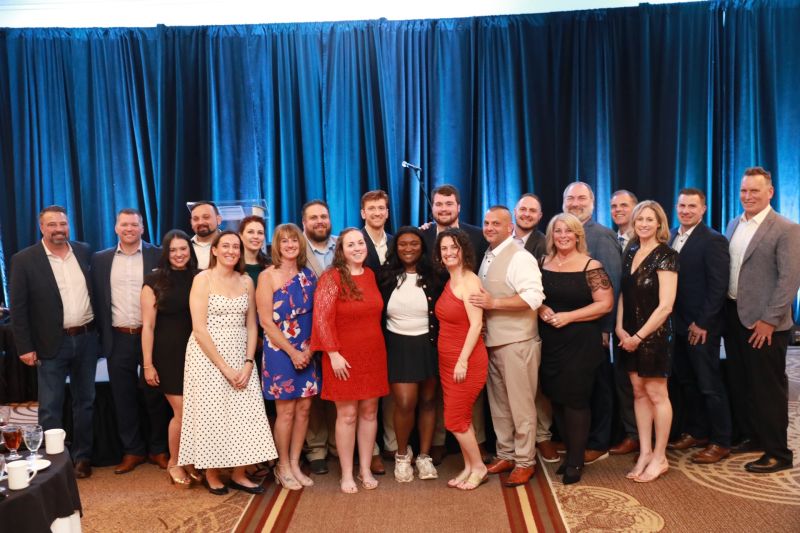
The photograph from Raleigh supplies the part a pipeline chart omits. Colleagues stand shoulder to shoulder in front of a blue curtain, some dressed for the stage and some for the trip home. Revenue kickoff is corporate language for a gathering with a fairly human purpose: decide what matters together, then return to separate screens and remember the decision. Dixon's account dwelled on the conversations between sessions. Strategy, in this telling, is not only what appears on the slide. It is what people repeat after the projector goes dark.
What the customer gets back
There is a fashionable way to describe professional-services software. It involves transformation, intelligence, platforms, and a fog machine. Dixon's career points to a plainer vocabulary. The attorney gets fewer disconnected workflows. The accountant gets cleaner billing. The consultant gets a project view. The business owner gets a name, a site, and somewhere for a customer to arrive.
This is not small ambition. Administrative drag compounds. Five unnecessary minutes repeated across a firm become an expense, a delayed answer, an evening interrupted. Software earns its keep by returning those minutes in a form people can feel. Marketing earns its keep by making that return credible before the purchase and recognizable afterward.
Dixon has occupied both sides of that bargain for more than twenty years. She has marketed legal services, digital real estate, small-business websites, AI-assisted creation, and the software layer beneath a professional practice. Across all of it, her strongest theme is not novelty. It is usefulness, expressed clearly enough that a busy person can picture tomorrow running a little better.
The work behind the work rarely gets a spotlight. Perhaps it should not. If the intake flows, the invoice lands, the file opens, and the client gets an answer, the system has already made its argument. Dixon's job is to help people see that future before it becomes ordinary. Then she opens the notebook and starts on the next version.