knowledge-graph
(44)
Contify and the art of paying attention
Two analysts. Four markets. Too much to read. Contify’s bet is that competitive intelligence gets better when people spend less time collecting it.

IMO: The words between care and cash.
A doctor’s words have to survive a journey through charts, claims, and research databases. IMO Health built a business keeping their meaning intact - and is now offering that expertise to AI developers.
Cognite makes the factory readable
Before an AI can help run a plant, it needs to know which pump is which. Cognite built a business around that deceptively difficult task.

Govini and the expensive art of finding a missing part
A missile can outlive the company that made its components. Govini built a business tracing those hidden dependencies - and, as Air, is taking on the larger problem of keeping defense ready.

data.world and the trouble with knowing too much
A company can own mountains of data and still struggle to answer a simple question. data.world built a business around the missing connections - and ServiceNow bought it for the age of AI.

Sayari and the Art of Following the Paper
A company can have a spotless name and a rather inconvenient family tree. Sayari connects corporate records and trade routes to show banks, businesses, and investigators who is really on the other side of a deal.
The $500 Company That Outlived the Lisp War
Franz began in a spare bedroom with enough money for incorporation and an embosser. Four decades later, its graph database is making an old promise of AI useful again: show how the answer connects to the evidence.
Ultipa and the Case for Following the Money
A graph database vendor found its sharpest test inside banking: tracing relationships fast enough for a decision, and clearly enough for someone to explain it.
Arango and the Missing Relationships in Enterprise AI
A database company built for connected data now wants to supply the context behind enterprise AI. The interesting part is what its customers have stopped stitching together.

Prevalent AI spent nine years fixing the data. Then came $22 million.
The London company built its business untangling enterprise security data. Now it is betting that the same knowledge graph can give AI agents a more reliable picture of the world they work in.

Golden Tried to Map Everything. Its $59.5 Million Lesson for AI Builders Was Knowing What Mattered.
Golden wanted to organize the facts Wikipedia missed. Seven years and $59.5 million later, its broad knowledge graph found a pointed job inside financial-crime intelligence - a useful lesson in turning ambitious AI infrastructure into something customers will buy.

The startup teaching AI to hire humans
A former DeepMind scientist and a SoftBank operator built voice AI that interviews people about what they are actually good at - then sells that expertise to hedge funds, AI labs and consultancies. Andreessen Horowitz just put in $22.75M.
The AI that reads every medical paper so pharma's scientists don't have to
Medical teams at drug companies read maybe 10% of the evidence that matters. Sorcero built AI agents to read the other 90% - and about a third of the top 30 global pharma companies are now paying for it.

The $3.7 Billion Bet on Giving Big Business a Better Memory
o9 Solutions wants to replace the monthly spreadsheet séance with a living model of the enterprise. Its wager: the company that remembers why a plan failed can make the next decision faster - and waste less along the way.
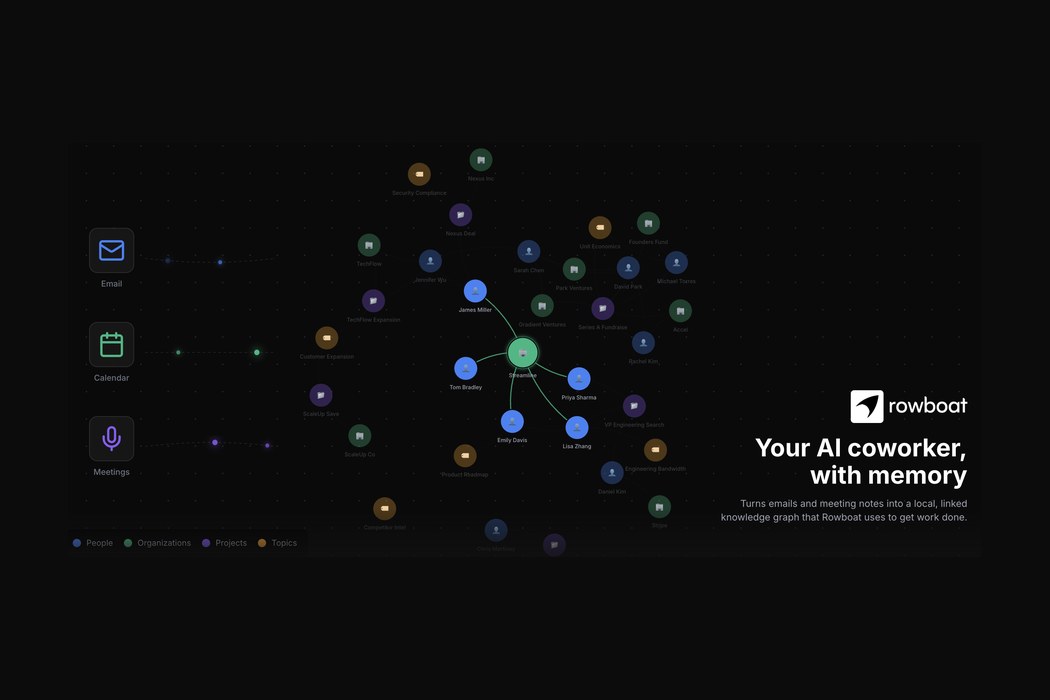
Rowboat
Rowboat (YC S24) is a San Francisco and Bengaluru startup building open-source AI agent software. It began as a pre-trained customer-support LLM agent, grew into a widely starred open-source IDE for building multi-agent systems on the OpenAI Agents SDK, and is now 'your AI coworker, with memory' - a local-first desktop app that turns your emails, meetings, and notes into an editable knowledge graph so agents can actually get work done. Founded by the team behind Agara (acquired by Coinbase in 2021).
Trace
Trace is a workflow orchestration platform that gives AI agents shared context about how a company actually works, then routes each task to whichever worker fits best - human or AI. Founded in 2025 by Tim Cherkasov and Artur Romanov and backed by Y Combinator's Summer 2025 batch, Trace connects to tools like Slack, Jira, and Notion, builds a knowledge graph of the organization, and turns plain-English process descriptions into visual workflows with AI-automated steps and human approval gates. It raised $3M in seed funding and was the most upvoted startup in the YC S25 cohort.

Autonomize AI
Autonomize AI is an Austin-based healthcare technology company building an AI-native platform - the 'Autonomize Intelligence Platform' - that embeds governed, agentic AI directly into clinical and operational workflows for health plans, providers, and life sciences organizations. Founded in 2022 by Ganesh Padmanabhan and Kris Nair, the company turns mountains of unstructured healthcare data into structured intelligence, deploying pre-built AI agents and copilots for tasks like utilization review, prior authorization, care management, and clinical chart review. It says its systems save roughly 36,000 clinical hours per month across Fortune 100 healthcare customers, and it raised a $28 million Series A in June 2025 led by Valtruis, The Cigna Group Ventures, and Tau Ventures.

Flume Health
Flume Health is a New York-based healthcare technology company building operational infrastructure that connects the fragmented data ecosystem behind health plans. Founded in 2017 by Cedric Kovacs-Johnson and Vineeth Bhuvanagiri, Flume gives payers, third-party administrators, and vendors a way to move, translate, and make sense of healthcare data. It started as a plan administrator, pivoted to the Relay integration platform, and has since evolved into an AI-native data platform - mapping enterprise data estates into a living knowledge graph and running domain-specific AI agents so non-technical teams can query and act on healthcare data in plain language.

Spire.AI
Spire.AI is an enterprise AI company whose full-stack SaaS platform is powered by a single, domain-intelligent Generative Skills AI engine. Built on a live knowledge graph with more than 14 million skill-adjacency edges, it helps large organizations acquire, deploy, reskill, mobilize and retain talent in a skills-first way. Founded in 2007 by Saurabh Jain and Shweta Jain and headquartered in Bengaluru, India, the company has evolved its research into OpenKnowra, a context-intelligence layer that pairs enterprise understanding with autonomous execution.
Cognizer Inc
Cognizer is a Pleasanton, California enterprise AI company that turns messy contract documents into structured, queryable intelligence. Its patented Genius technology pairs natural language AI with a knowledge graph so legal, sales, procurement, finance and compliance teams can discover, classify and analyze contracts at scale - detecting clauses, mapping parent/child document families and answering plain-language questions across millions of documents.
Collate
Collate is the company behind OpenMetadata, the fast-growing open source project for unified data discovery, observability, and governance. Founded by Apache open source veterans Suresh Srinivas and Sriharsha Chintalapani, Collate layers AI agents, automation, and enterprise support on top of an open metadata 'context layer' so data teams - and the AI models they feed - can find, understand, trust, and govern their data. The company raised a $10M Series A led by Venrock in July 2025.

Sumble
Sumble is a San Francisco AI startup building a knowledge graph of the world's external company data. Founded by Kaggle creators Anthony Goldbloom and Ben Hamner, it crawls job boards, company sites, social media, and regulatory filings, then uses large language models to surface technographics, org charts, and active projects for go-to-market teams. It emerged from stealth in October 2025 with $38.5M in funding and covers roughly 2.6 million companies worldwide.
Tana
Tana is an AI-native workspace that turns messy notes, meetings and voice memos into structured, queryable knowledge. Its signature feature, Supertags, lets any bullet point become a database record with defined fields, so notes double as a living knowledge graph that AI agents can read, summarize and act on. Founded in 2021 by ex-Googlers and productivity builders and based in Palo Alto with an engineering hub in Oslo, Tana raised a $14M Series A in February 2025 (led by Tola Capital), reaching $25M total funding after emerging from a stealth beta with a 160,000+ person waitlist.
Corvic AI
Corvic AI is a Mountain View startup building an Intelligence Composition Platform - the logic layer that turns messy, multi-structured enterprise data (PDFs, tables, sensor logs, images, time series) into reliable, production-ready AI outcomes without bespoke pipeline engineering. Founded in 2023 by engineers from Intel, Katana Graph, and Determined AI, it uses proprietary techniques like Mixture of Spaces embeddings and agentic, auditable orchestration to deliver explainable enterprise intelligence for manufacturing, industrial, financial services, and life sciences customers.

Datalign Advisory
Datalign Advisory is a Cambridge, Massachusetts fintech that uses an AI-enhanced platform to match everyday Americans with vetted, fiduciary Registered Investment Advisor (RIA) firms. Consumers answer a short questionnaire and get one personalized advisor match at no cost; advisory firms pay Datalign a referral fee for qualified introductions. Founded in 2022 out of the Link Ventures / Cogo Labs orbit, the company referred roughly $40 billion in assets to RIA firms in 2024 and raised $9M in total seed funding at a $75M post-money valuation.
DeepVu
DeepVu (legal entity Vufind Inc.) is a San Ramon, California startup building AI planning agents for supply chain teams. Its platform pairs a supply-chain knowledge graph (VuGraph) enriched with macroeconomic and trade signals, a digital-twin simulator (VuSim), and reinforcement-learning decision agents (VuDecide) to make demand planning, inventory, procurement, production and logistics decisions more resilient to shocks - while trimming cost and carbon. Founded in 2016 by Moataz Rashad and Prof. Walid Aref, the company pivoted from computer-vision roots to focus on autonomous, shock-resilient supply chain planning for manufacturers and retailers.

Louisa AI
Louisa AI is a New York-based relationship intelligence platform, spun out of Goldman Sachs in 2023, that maps who-knows-who and who-knows-what inside an organization. By reading daily market news against a firm's internal relationship graph, it proactively nudges the right colleague with the right warm lead at the right time - what founder Rohan Doctor calls 'systematizing serendipity.' It sells mainly to investment banks, private capital, consulting and law firms as a cross-sell and deal-origination engine.
Memorang
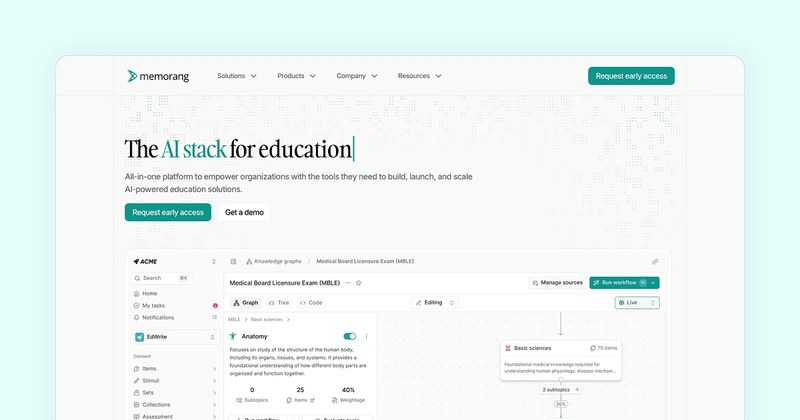
Memorang is a Los Angeles-based education-technology company building what it calls the AI stack for education - an all-in-one, agentic platform that lets testing providers, publishers and training organizations create standards-aligned content, assessments and branded learning apps at scale. It began as a consumer flashcards-and-quizzes app for medical and professional exams and has since pivoted into a B2B platform that pairs knowledge graphs with AI agents and human-in-the-loop workflows. After winning first place among roughly 1,500 startups in the Vercel AI Accelerator, the bootstrapped company says it has delivered hundreds of millions of assessments and serves tens of millions of annual test-takers.

Parsnip
Parsnip is a New York-based consumer AI startup building the "Duolingo for cooking" - a personalized learning engine that teaches people to cook through short, gamified lessons instead of just handing them recipes. Founded by PhDs Andrew Mao and Dan Sosa, the app maps cooking into a knowledge graph of 400+ skill levels and uses a human-in-the-loop LLM system to generate lessons, teaching the hows and whys behind food so novice cooks gain confidence in the kitchen.

Primepoint
Primepoint is a San Mateo-based construction intelligence company whose AI reads and understands construction drawings the way an experienced project team does. Founded in 2024 by computer-vision pioneer Lubomir Bourdev and product veteran Hamid Palo, it builds a proprietary knowledge graph that links every drawing element - down to the tag level - to its schedule, specification, and related documents, then layers a natural-language assistant named Marvin on top so teams can ask project questions in plain English. The platform automates the manual, error-prone work of constructability reviews, RFI drafting, submittal comparison, and drawing overlays, flagging conflicts before they become field problems. Primepoint closed a $10M seed round in April 2026.