The Picks-and-Shovels Company
Feature · The Story
Memorang sells something most edtech companies would rather you didn't notice: not the course, but the factory that builds the course.
Here is a useful way to think about the education-technology business. There are companies that sell you a thing to study, and there are companies that sell the machinery other companies use to make the thing to study. The first kind is crowded, loud, and mostly commoditized. The second kind is quiet, harder to explain at a dinner party, and - if you get it right - considerably stickier. Memorang, a Los Angeles company that began life squarely in the first category, has spent the last several years relocating itself into the second.
The origin is the kind of story venture capitalists claim to love and rarely fund. Yermie Cohen studied mechanical engineering and biology at MIT, then went to medical school at UCLA, where he discovered the specific hell of being asked to memorize thousands of discrete facts per week. The tools available to him were, in his telling, either too simple to be useful or too expensive to justify. So he did the thing engineers do when annoyed: he built the tool he wished existed. It was a flashcards-and-quizzes app, and it covered the alphabet soup of professional exams - USMLE, MCAT, NCLEX, CFA, CPA, the SAT.
That app worked. It also, over time, revealed a more interesting business hiding underneath it. The genuinely hard part of a good study app is not the flashcards. It is the content pipeline - the machinery that turns a sprawling, ambiguous curriculum into a structured set of questions that are correct, fair, and defensible. Memorang had built that machinery for itself. And it turned out the people who administer high-stakes exams for a living wanted to rent it.
So the company pivoted, in the good sense of the word. Not the flailing kind of pivot, but the kind where a business notices what its customers keep asking for and decides to sell that instead. The consumer app didn't fail; it graduated into infrastructure. Today Memorang describes itself, with admirable lack of poetry, as "the AI stack for education."
"A rare applied AI startup that has figured out how to generate immediate and durable value."
— Hans Yang, GM, Microsoft for Startups
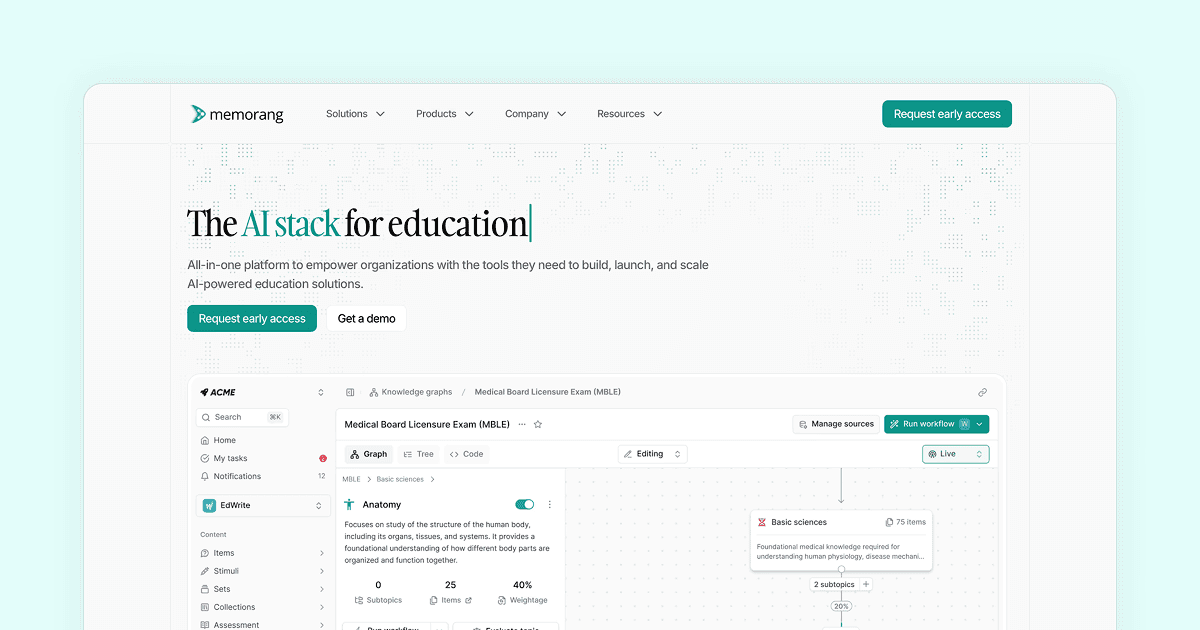
The stack itself is where the amusement lives, if you find infrastructure amusing, which you should. Instead of treating content as a pile of PDFs, Memorang models it as a knowledge graph - a structured map of how the concepts in a subject relate to one another. On top of that sit AI agents trained to learn from human experts, which is a polite way of saying the software drafts questions and a person who actually knows the material checks them. This human-in-the-loop arrangement is not a compliance afterthought. On a licensing exam, a hallucinated answer is not a cute bug; it is a lawsuit, or worse, a nurse who doesn't know something a nurse should know.
Which brings us to the least glamorous and most important word in the whole enterprise: guardrails. Everyone in AI says the word "transform" a great deal. Memorang's actual pitch is closer to "we will not embarrass you." It is SOC 2 Type II certified. It talks about content quality control and role-based access the way other startups talk about growth. For a testing body deciding whether to hand its intellectual property to a piece of software, boring reliability is the entire product.
And the numbers are the sort that make the boring case for you. The platform reports delivering more than 200 million assessments and serving roughly 28 million annual test-takers. In 2024 it entered the Vercel AI Accelerator, a program that screened on the order of 1,500 startups, and won the top spot - adding, by its own account, more than a million dollars of annual recurring revenue during the program alone. Then it did the genuinely unusual thing: instead of converting that trophy into a nine-figure raise, it stayed bootstrapped and, it says, profitable. In a field where the standard move is to trade the P&L for a bigger story, Memorang kept the P&L.