There is a quiet, expensive problem hiding inside every large drug company. The people responsible for turning science into evidence - medical affairs teams, drug-safety analysts, scientific writers - are drowning. The world publishes new research faster than any human team can read it, and by most industry estimates those teams meaningfully process only about a tenth of the evidence that touches their products. The rest sits unread, in journals and conference posters and safety databases, quietly shaping decisions no one has time to double-check.
Sorcero, a Washington, DC company founded in 2017, exists to close that gap. It builds what it calls medically-tuned AI - software trained specifically on the language and rules of life sciences - and points it at the mountain of literature its human customers cannot reach. In November 2025 the company raised a $42.5 million Series B led by NewSpring Growth, taking its total funding to roughly $59 million. It says it now works with about a third of the top 30 global pharmaceutical companies.
01 / THE JOBWhat Sorcero actually does
Not a chatbot for doctors - a research engine for the people behind the drugs.
It helps to be precise about who Sorcero serves, because the phrase "medical AI" usually conjures a chatbot answering a patient's symptoms. That is not this. Sorcero's customers are the internal science functions at pharmaceutical, biotech and medical device companies - the teams that write manuscripts, brief physicians, track competitors at medical congresses, and watch the literature for signs a drug is causing harm.
The platform ingests hundreds of fragmented sources - published papers, congress abstracts, field reports, advisory-board notes, CRM records, surveys, even social media - and turns them into structured, searchable intelligence. Crucially, every claim it produces is attributed back to a source, and the system is built with controls meant to reduce the hallucinations that make generic AI a liability in a regulated industry.
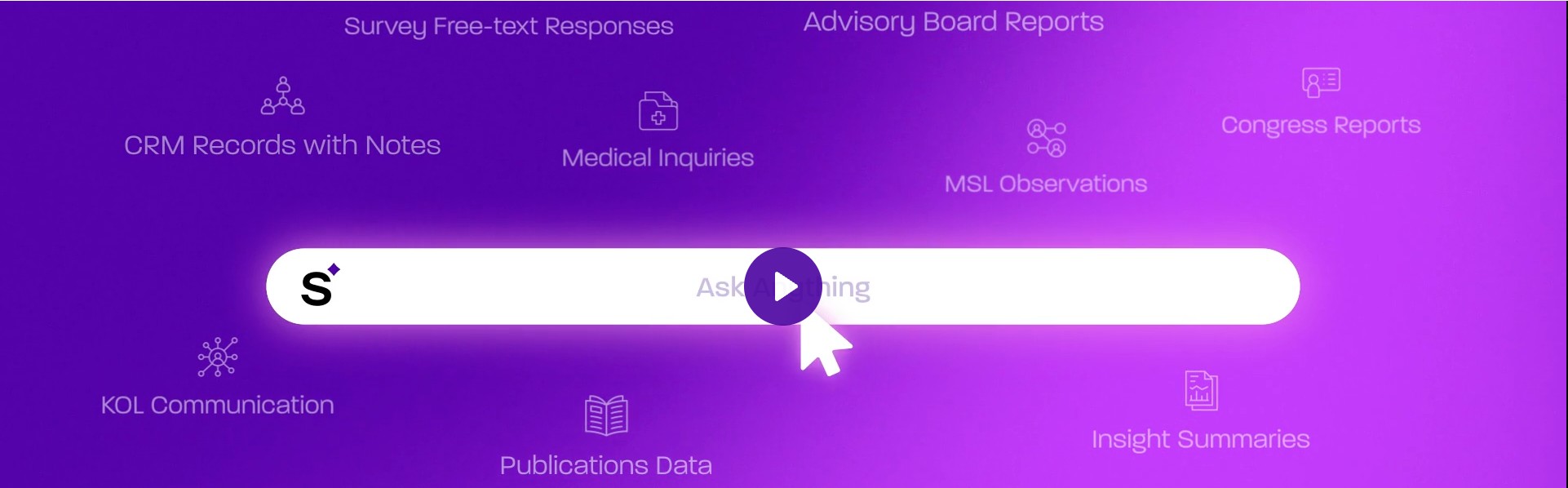
The pitch, stripped down, is time. Sorcero says its tools cut medical data-analysis time by up to 72%, lift productivity on generating scientific evidence by as much as 92%, and deliver manuscripts, value dossiers and published evidence two to five months faster than manual work. Where a human team samples a slice of the literature, Sorcero claims to analyze the whole set.
In practice, that looks like concrete tasks getting shorter. A medical science liaison preparing to meet a key physician can pull an attributed brief on that person's recent work in seconds. A safety team can be alerted to an adverse-event mention buried in a new paper the day it appears. A scientific writer can hand the machine a pile of trial data and get a first-draft plain-language summary to edit rather than start from a blank page. None of it removes the human expert - it removes the hours of manual searching that used to sit in front of the expert.
Our vision is to create a unified intelligence platform for the precision medicine era.Dipanwita Das - CEO & Co-founder
02 / THE NUMBERSReading at a scale humans can't
263 million papers, 1.3 billion citations, and a 60-day debrief cut to a day.
The scale is the point. Sorcero says its platform monitors around 263 million publications and 1.3 billion citations, and holds data on roughly 40 million healthcare professionals and 100 million published scientists. One of its newer solutions, Congress Intelligence, is a good illustration of the value: instead of the 60-plus days it typically takes to compile a debrief after a major medical conference, Sorcero generates a synthesis of the competitive shifts and scientific trends more or less as the event ends.
That last bar is the whole argument in one line. The old way samples; Sorcero reads everything. And in an industry where a missed adverse-event signal is a genuine safety issue, "everything" is worth paying for.
03 / THE PRODUCTSFour tools on one platform
Medical, SciComms, Safety, Medtech - plus a team of AI agents underneath.
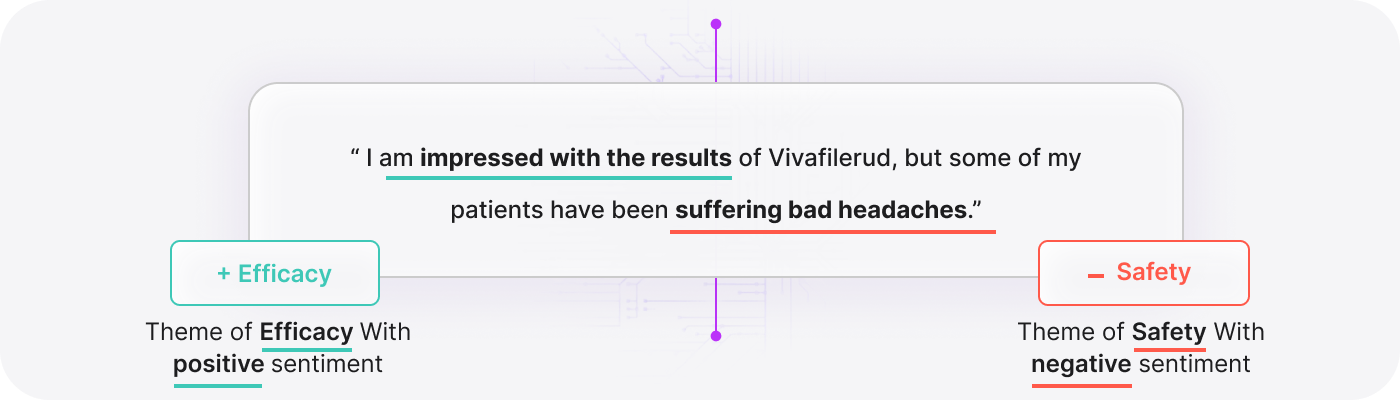
Sorcero packages its platform into named products aimed at specific teams. Sorcero Medical turns fragmented global data and real-world evidence into unified, attributed intelligence. Sorcero SciComms drafts manuscripts and plain-language summaries at speed. Sorcero Safety scans the literature for adverse-event reports in minutes rather than months. Sorcero Medtech extends the same machinery to medical device companies.
In March 2025, at the MAPS Americas meeting in New Orleans, the company launched an agentic framework underneath all of it: a team of specialized AI agents that validate, summarize and prioritize information rather than relying on a single model to do everything at once. It is a bet that in a regulated field, dividing the work among narrow, checkable agents is safer than one general-purpose black box.

We're pioneering vertical AI innovation in life sciences. Medical affairs can now quickly deploy sophisticated AI agents.Dipanwita Das - CEO & Co-founder
04 / THE MOATWhy "medically-tuned" is the whole strategy
General AI is cheap and impressive. In pharma, being wrong is the expensive part.
Sorcero's competitors are not really consumer chatbots. They are other life-sciences and medical-affairs players - names like Huma.AI, OKRA.ai, Within3, ArisGlobal and ZS - and, at the edges, the big content and CRM suites such as Veeva. Sorcero's answer to all of them is accuracy under regulation. It reports 96.1% clinical inclusion accuracy, above the FDA's 95% threshold, and it positions itself as literature and safety intelligence that sits alongside a client's CRM rather than trying to replace it.
That focus is the moat. A general model that is right 85% of the time is a fun demo and a compliance nightmare. In a world where regulators, lawyers and patients are all downstream of the output, the boring virtues - attribution, validation, accuracy you can defend - are the product.
05 / THE PEOPLEFrom Al Gore's team to Big Pharma
A social-impact operator, an MIT Media Lab veteran, and a shared mission.
Sorcero was co-founded by CEO Dipanwita Das, Chief Scientific Officer Walter Bender and COO and President Richard Graves. Before Sorcero, Das ran 42 Strategies, handling digital work for Al Gore's Climate Reality Project, Richard Branson's Virgin Unite and Bloomberg Philanthropies. She is a Y Combinator Female Founders alum and a Sir Edmund Hillary Global Impact Fellow. Bender is a longtime figure at the MIT Media Lab, associated with the One Laptop Per Child project.
The company is a Certified B Corporation and organizes itself around four stated values - Mastery, Empathy, Growth and Drive - with a stated mission "to transform lives through the most effective use of the world's scientific knowledge." It is a roughly 72-person team, small for the size of the customers it serves.
06 / THE ROADHow it got here
07 / THE MARKETWhere it fits, and where it might not
The unglamorous end of AI is where the durable money tends to be.
Sorcero is a clean example of vertical AI: instead of chasing a general audience, it solves one specific, costly problem for customers who cannot afford to be wrong. Its business model is straightforward B2B enterprise SaaS - recurring subscriptions to large life-sciences firms, layered on top of the systems they already run. Its infrastructure runs on Google Cloud, using tools like Vertex AI and BigQuery, a partnership that earned it a 2025 Partner of the Year award.
There are honest limits. This is enterprise software sold to a small number of very large, cautious buyers, so growth is a function of long sales cycles and trust rather than viral adoption. The accuracy and time-savings figures come from the company, and the deepest value shows up for organizations with the scale - and the evidence backlog - to justify it. For a small biotech with a handful of papers to track, the calculus is different. But for the giants racing to get therapies approved, buying back two to five months is a number a CFO understands.