Every large company has a room where the numbers go to disagree. Sales arrives with an ambitious forecast. Supply chain brings factory constraints. Finance translates both into margin. Someone opens a spreadsheet with 47 tabs, someone else opens a newer one, and the meeting becomes an archaeological dig through assumptions. By the time the group agrees on a plan, the market has moved. o9 Solutions was built for this room.
The Dallas-based software company sells what it calls the Digital Brain, a cloud platform that connects demand, supply, inventory, pricing, merchandise and financial planning. The name risks sounding theatrical. The mechanism is more concrete: o9 builds a graph of an enterprise - its products, customers, suppliers, plants, stores, constraints and targets - then lets people forecast, optimize and run scenarios against the same model. A decision about a promotion can be traced into demand, capacity, working capital and margin before anybody orders the cardboard displays.
That shared context is the product's center of gravity. A machine-learning forecast alone cannot tell a planner whether a factory can make the extra units, whether a supplier has capacity or whether the expected revenue is worth the expedited freight. o9's pitch is that these questions should not live in separate systems. The company has raised about $536 million, was valued at $3.7 billion in 2023 and says its platform now serves more than 30 industry verticals.
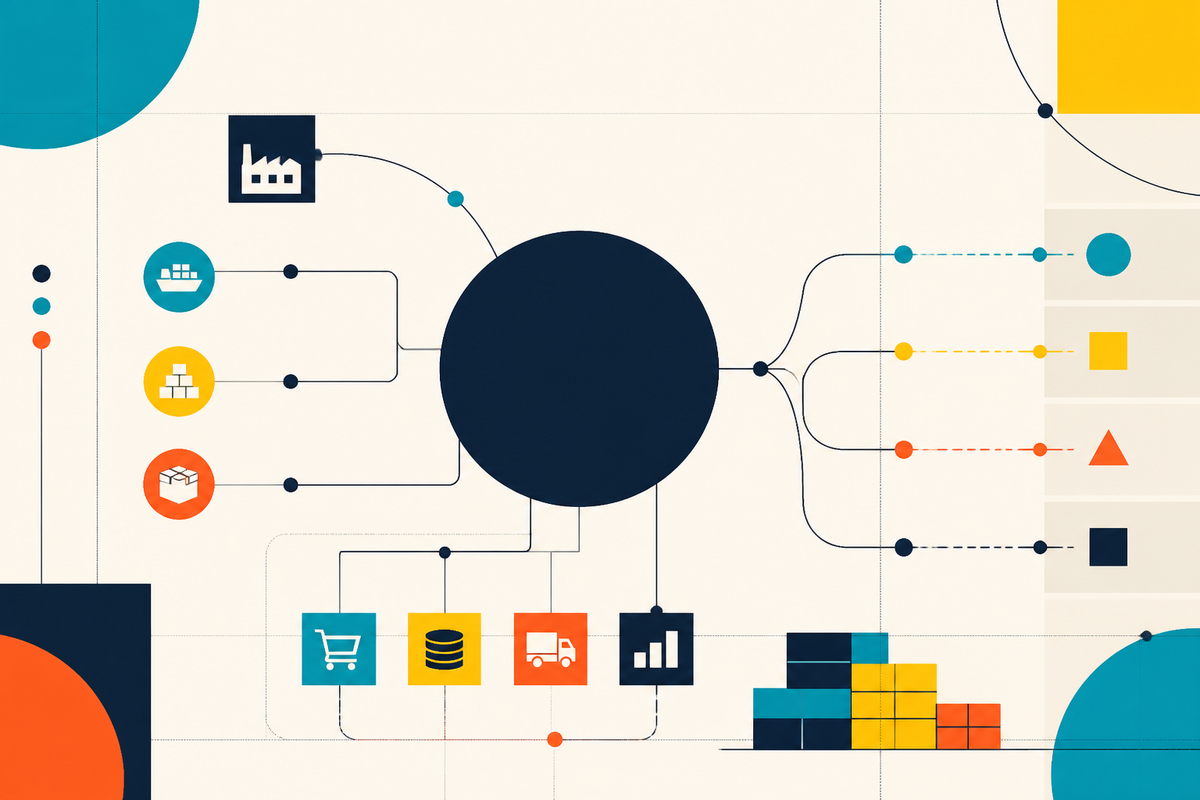
One model, fewer diplomatic incidents
Co-founders Sanjiv Sidhu and Chakri Gottemukkala started o9 in 2009. They were not newcomers to the problem. Sidhu had founded i2 Technologies, one of the defining supply-chain software companies of the 1990s, and Gottemukkala had worked there. Their second act began with a view that older planning suites were too rigid for a world of faster signals, cloud-scale data and constant disruption.
The pair's useful observation was organizational rather than purely technical: companies do not lack plans. They have too many of them. Demand planning, sales and operations planning, budgeting, assortment, replenishment and supplier commitments often run on different calendars and definitions. When one plan changes, the others learn late. o9 puts these functions on an Enterprise Knowledge Graph, a model of entities and relationships that behaves like a continuously updated digital twin.
weather
capacity
prices
Knowledge
Graph
trade-offs
actions
That architecture matters when the object being planned is absurdly complicated. One o9 telecommunications case study describes a network build in which roughly 1,000 new cell towers each involved about 32,000 components. A missed forecast is not one missing box; it is a chain reaction across locations, suppliers, phase-outs and maintenance. The platform connected tower demand to component inventory and supplier decisions, replacing a mixture of Excel, SAP and homegrown tools.
“Organizations with superior planning and decision-making capabilities are better stewards of the Earth's precious resources.”Sanjiv Sidhu, co-founder and chairman
What customers actually buy
The broad label is integrated planning, but customers can enter through a narrower door. A retailer might begin with merchandise financial planning and assortment. A consumer-products company might start with demand forecasting or revenue growth management, using the system to test pricing and promotions. A manufacturer might prioritize supply planning, inventory optimization and supplier collaboration. Finance teams can connect annual plans and long-range scenarios to operational reality.
The buyers are generally large enterprises, not small teams looking for a better dashboard. Publicly referenced customers include PepsiCo, Philips, Pirelli, T-Mobile, Comcast, Keurig Dr Pepper, Marks & Spencer, Coca-Cola Bottlers Japan, adidas, Barilla and Hormel Foods. The daily users range from planners and merchandisers to procurement, sales, finance and executives. Deployments can span hundreds of users, multiple regions and years of process change.
The company behind those deployments has roughly 3,400 employees and offices across North America, Europe and Asia-Pacific, with a substantial engineering and delivery base in India. o9 describes its culture in the same vocabulary as its product: customer focus, continuous improvement, social impact and individual ownership. One published value asks employees to act as the CEO of their initiatives. That language fits an implementation business, where software teams must understand the peculiar physics of tires, beverages, apparel or wind turbines and then persuade veteran planners to change a process that may have outlived several CIOs.
This is why o9's business model looks like classic enterprise SaaS with a transformation project attached. Pricing depends on scope, users, complexity and deployment. Subscriptions can expand as a customer adds planning domains. Implementation work is handled by o9 and partners including Accenture, Microsoft, AWS, Google Cloud and other consultancies. In 2024, o9 recognized Accenture for leading roughly 30 active client implementations - a reminder that the product is software, but adoption is choreography.
The practical benefits are familiar: fewer stock-outs, less excess inventory, faster scenarios, better forecast accuracy and fewer hours spent reconciling files. The more interesting benefit is alignment. When finance and supply chain evaluate the same promotion with the same constraints, disagreement can move from whose number is correct to which trade-off the company prefers.
The wedge is supply chain. The market is decisions.
o9 competes on crowded ground. SAP and Oracle bring enormous installed bases. Kinaxis and Blue Yonder are established supply-chain specialists. Anaplan is associated with connected planning; E2open and ToolsGroup cover adjacent terrain. The stubborn incumbent is still the spreadsheet, loved for its flexibility and blamed for nearly everything that happens after version 12-final-final.xlsx.
o9's distinction is breadth on top of one graph-based model. It presents supply chain, commercial, retail, financial and sustainability planning as connected expressions of the same business. Its architecture is also solver- and cloud-flexible, allowing customers to combine o9's models with infrastructure and algorithms from partners. The risk is the mirror image of the advantage: a platform this broad can be complex to implement, and a common model requires departments to agree on definitions they may have avoided for years.
The funding history shows investors buying that thesis. KKR invested $100 million in 2020 at a valuation above $1 billion. In 2022, General Atlantic, its climate fund BeyondNetZero, Generation Investment Management and KKR put in $295 million at $2.7 billion. Existing investors added $116 million in 2023, lifting the valuation to $3.7 billion. The presence of climate investors is not decorative. Better planning can mean less obsolete stock, fewer emergency shipments and more productive use of materials and capacity.
From prediction to memory
In 2024 and 2025, o9 added generative-AI assistants, specialized agents and self-learning models. In March 2026 it bundled the direction into APEX, short for Agile, Adaptive, Autonomous Planning and Execution. The model uses what o9 describes as neuro-symbolic AI: language models and pattern recognition paired with the structured business context of the knowledge graph.
The important feature is not that a planner can chat with a forecast. It is the proposed feedback loop. o9 wants a system to preserve the assumptions behind a decision, compare the plan with execution, locate value leakage and recommend what should change. The company calls part of this post-game analysis. Sports teams review film; businesses often retain the equivalent only in email, slide decks and the memories of experienced employees.
That ambition also sets a sensible test for enterprise AI. A confident answer is cheap. A useful decision must respect capacity, lead times, contracts, costs and company policy. It needs permissions and an audit trail. It must show why a plan changed and how the change affected other functions. The knowledge graph gives o9 a plausible base for that work, though autonomous planning will earn trust one bounded workflow at a time.
Commercially, the company continues to grow its footprint. o9 reported more than 130 successful client go-lives in 2025 and 28 consecutive quarters of annual recurring revenue growth by March 2026. In the first half of 2026, it reported more than 80 deployments, including more than 40 in the second quarter. It also cited record booking growth in the first quarter and expanded leadership around the APEX push.
The useful lesson hiding in the machinery
There is a product idea here that travels beyond supply chains: find the recurring meeting where smart people spend their time reconciling context, then build the shared model that makes the argument productive. The interface is not the moat. The accumulated map of relationships, constraints, decisions and outcomes is.
For a customer, o9 can be used to rehearse a tariff change, decide where inventory should sit, determine whether a promotion is profitable, localize a store assortment or connect a five-year capacity investment to next quarter's cash. The value appears when the answer survives contact with another department. A plan that improves sales but ignores supply is a wish; a supply plan that ignores margin is an expensive hobby.
o9 is positioning itself between systems of record and the people accountable for results - a decision layer that senses, models, recommends and learns. That is an appealing place in the enterprise stack and a demanding one. It requires clean data, patient implementation and executives willing to expose how choices are actually made.
The monthly meeting will not disappear. Companies are social organisms, and trade-offs remain political even when the data is excellent. But the room can improve. Fewer files. Clearer assumptions. Faster counterfactuals. A memory of the last miss. For o9, that modestly better meeting is the gateway to a very large market.