The most expensive moment in enterprise software often arrives after the software has done its job. The dashboard flashes red. A shipment will miss its date. A component is about to run out. Demand has moved, inventory has not, and twelve people are invited to a call. The data is visible. The decision is still homeless.
Aera Technology has spent nearly a decade trying to give that decision somewhere to live. Its product, Aera Decision Cloud, sits above a company's existing systems, gathers operational data, models the available choices, recommends an action and, when permitted, sends that action back into the systems where work happens. Then it records the decision and its outcome. The ambition is not a more eloquent chart. It is a closed loop.
That distinction explains why Aera now calls itself an agentic decision-intelligence company. Plenty of software can summarize a supply problem. Aera wants to notice the problem, calculate options, ask for approval when the rules require it, change the order, and remember whether the intervention helped. In a market stuffed with copilots, its pitch is closer to an air-traffic controller with a logbook.
The pivot hiding inside the rebrand
Aera's origin is a useful lesson in choosing a wedge. Shariq Mansoor founded FusionOps in 2005 to make supply-chain data usable. By 2017, former Anaplan chief executive Frederic Laluyaux had joined, New Enterprise Associates put in $50 million, and FusionOps reappeared as Aera Technology. The new name came with a bolder proposition: move from business intelligence that describes performance to prescriptive software that can improve it.
What failed first was not analytics. It was the handoff. Large companies already had ERP systems, planning tools, spreadsheets and reports. Their friction lived between the alert and the response: reconciling different records, finding the responsible person, weighing trade-offs, and updating the system. Aera's answer was to leave those expensive systems in place and crawl across them. It cleans and harmonizes the data into what it calls a Decision Data Model, then applies rules, optimization and machine learning on top.
The company did not abandon its supply-chain roots as its language grew grander. That is still where the product is easiest to understand. A planner faces the same costly decisions every day: which orders to expedite, where to move stock, how to respond to a forecast miss, whether a supplier risk is tolerable. These choices are frequent, measurable and constrained. They are good material for automation.
The clever bit is not finding the stockout. It is earning permission to fix it.YesPress analysis
A product made of four unglamorous parts
Aera packages the system as four connected layers. The Decision Data Model connects transactions, plans, outside signals and unstructured information. The intelligence layer applies analytics, forecasting, optimization and business rules. The automation layer orchestrates workflows and writes approved actions back. The engagement layer gives people a web, mobile, voice and chat interface. In 2024, Aera added Workspaces for scenarios and collaboration, plus a Control Room that tracks what decisions were made, automated or escalated.
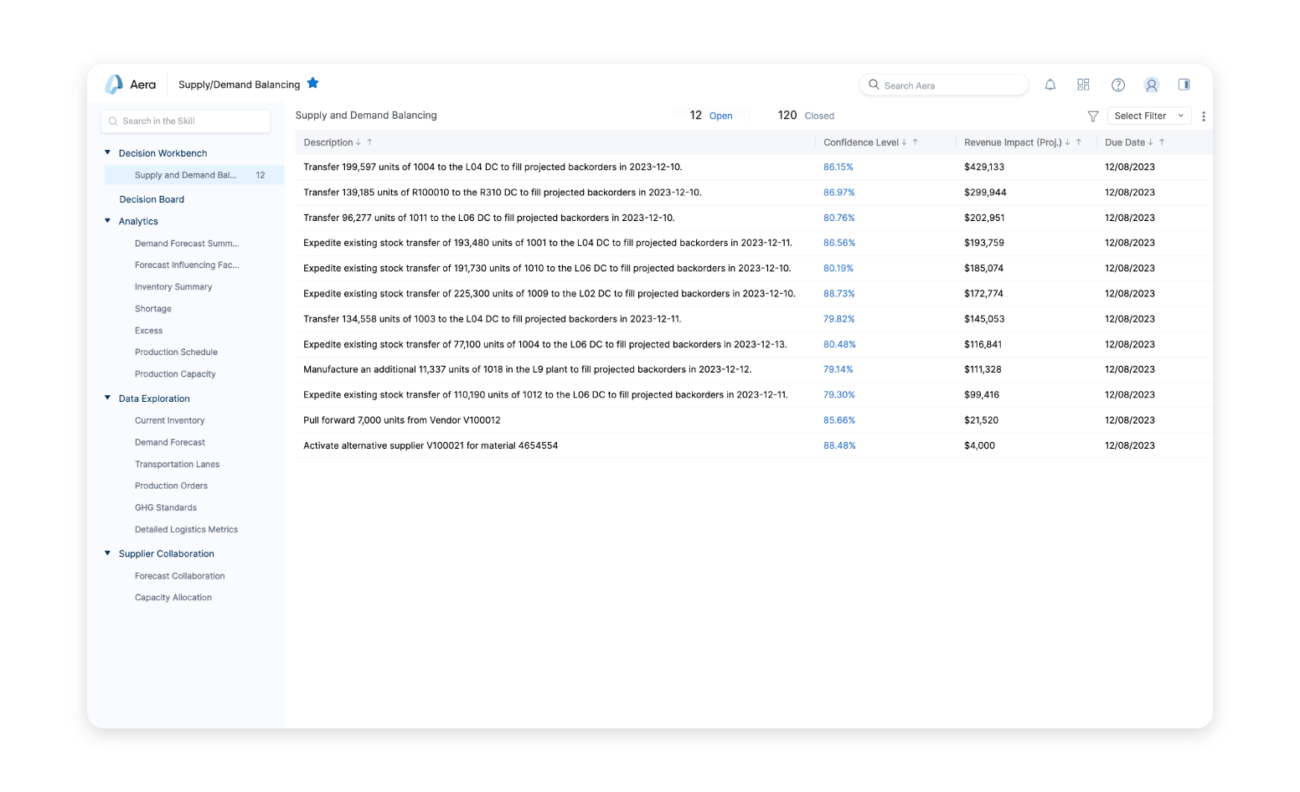
Reusable decision applications are called Aera Skills. The name makes operating knowledge sound installable, which is exactly the point. A Skill can encode a job such as inventory balancing, order management, demand forecasting, supplier-risk response or revenue optimization. In 2025, the company released a Tariff Mitigation Skill designed to watch more than 20,000 tariff codes, estimate exposure, simulate sourcing changes and help route a response. It is a better example of agentic software than a general-purpose mascot: narrow problem, changing inputs, explicit actions, visible economics.
The generative-AI additions sit on top of that machinery. Aera Chat lets a user question business data in natural language. Newer agentic tools can generate decision logic from a prompt, coordinate steps across people and systems, and reason from a situation toward an action. In May 2026, Aera added a governed reasoning flow intended to keep permissions and traceability intact. That qualifier matters. A confident answer is tolerable in a brainstorm. A confident purchase-order mistake is a finance meeting.
The buyers have warehouses, factories and scar tissue
Aera publishes customer work with Unilever, Kraft Heinz, Mars, Gallo, AstraZeneca, GSK, Alcon, Avantor, BP-Castrol, Deacero, Mitsubishi Chemical Group and Merck Animal Health. These are not businesses waiting for their first database. They run mixed estates of SAP, Oracle, planning systems and custom applications. They also have enough volume for a small improvement to matter.
For Mexican steel producer Deacero, Aera built an AWS-hosted order-management solution intended to catch service risks and improve communication across an order's life. A public GSK discussion emphasizes the ability to identify risks and opportunities, then write actions back to systems of record. Other customer stories concentrate on inventory, logistics, fulfillment and forecast accuracy. The shared problem is operational latency: the company knows something, but not soon enough to act cleanly.
The user is usually not a data scientist admiring a model. It is a planner deciding whether to expedite a truck, a procurement lead reviewing a supplier exception, or an executive testing a demand scenario. That shapes the interface. Recommendations need a reason, an expected impact and a clear next action. High-risk choices need approval; ordinary choices can run inside limits. The Control Room gives managers a view across both. Aera is therefore selling two products at once: automation for the repetitive work and confidence for the person whose name remains attached to the outcome.
Aera reports that selected deployments have improved inventory performance by up to 20 percent, cut supply-chain waste by up to 20 percent, and reduced planner workloads by up to 40 percent. Those are vendor-reported outcomes, not universal promises. Still, they reveal how buyers should score this category. Count the planner hours returned, working capital released, waste avoided, service level protected and decisions safely automated. Do not count the number of times someone chats with the bot.
How Aera gets paid, and what the money bought
Aera is an enterprise SaaS business with negotiated subscriptions, implementation work and partner-assisted deployments. There is no public menu price. Its sales motion offers a clue to the economics: the company advertises four-to-five-week AI Test Drives that prove one use case inside the customer's environment, then maps additional Skills. This is land-and-expand for operations. Start with one decision, show the cash or time it changes, and widen the loop.
The company raised $12 million in 2015, $25 million in 2016, $50 million alongside the 2017 relaunch, and $80 million in 2019. That is about $167.6 million in disclosed financing before Accenture Ventures made an undisclosed investment in May 2026. Accenture also became a strategic route to market, pairing its supply-chain practice with Aera's software for consumer goods, high tech, life sciences, mining, and oil and gas. Other listed partners include EY, Deloitte, Kearney and Bristlecone.

The crowded field, and the thing worth copying
Aera now competes in a category large enough for Gartner to publish its first Decision Intelligence Platforms Magic Quadrant in 2026. The field includes o9, FICO, Quantexa, SAS, IBM, Oracle, Pegasystems, Rulex and others. In a supply-chain deal, Aera can also meet Blue Yonder, Kinaxis, SAP or a custom stack. Celonis approaches the problem through process intelligence. Palantir approaches it through an operating data layer. Microsoft can bundle pieces into an estate the customer already owns.
Aera's difference is the opinionated loop: unify decision context, generate or model alternatives, govern the choice, execute it and preserve the outcome as memory. Its focus on existing systems is commercially sensible because few global manufacturers want to replace the core before improving a decision. Its long supply-chain apprenticeship supplies the rules, edge cases and vocabulary that a generic agent lacks.
The copyable idea is not “build an autonomous enterprise.” That phrase is too large to test. Pick one recurring decision with a named owner, reliable inputs, bounded actions and a result visible within weeks. Run in recommendation mode. Compare the model's choice with the human's. Automate only the low-risk cases, route exceptions to a person, and keep the decision history. The smallest useful unit is not a workflow. It is a decision with a feedback loop.
When it will not work: when the decision is rare, the data is stale, the objective changes by department, the action cannot be safely encoded, or nobody owns the result. Automation magnifies an operating model. It does not repair one.
That is the sober version of Aera's grand claim. The company is not removing judgment from business. It is trying to make judgment explicit enough to repeat, monitor and improve. If it succeeds, tomorrow's enterprise software will look less like a wall of charts and more like a quiet queue of decisions: some handled automatically, some waiting for a human, all leaving a receipt.