Two people were trying to keep up with four markets. They worked for an industrial manufacturer, watching competitors and customers across specialized businesses. Their tools were familiar: Feedly, Excel, and a collection of websites. So was the problem. Each morning’s information had to be found, sorted, tagged, and passed along before anyone could consider what it meant.
In Contify’s account of the project, the team’s difficulty was relevance and scale. Adding another market meant adding another reading assignment. The company adopted Contify to automate collection and filtering, then distribute findings through dashboards, newsletters, and Microsoft Teams. The case study reports a 60-70% reduction in manual gathering and formatting time. That is a vendor-published result from an unnamed customer, rather than an independently audited benchmark. Still, it identifies a recognizable bottleneck: the preparation was eating the thinking.
- Contify tracks companies and markets, then filters and organizes the updates.
- Its platform serves enterprise teams; its News API feeds other software.
- Athena AI extracts facts, connects developments, and answers research questions.
The expensive part is attention
Competitive intelligence sounds faintly cinematic. In practice, it can involve noticing that a rival changed a product page, opened a regional office, or started recruiting a particular kind of engineer. A single update rarely tells the whole story. The useful work is connecting developments over time, then deciding whether a product manager, salesperson, or strategy director needs to hear about them.
Contify addresses that work with a shared intelligence system. Teams define companies and topics, organize content with their own taxonomy, and send different outputs to different readers. A salesperson can consult a battlecard; a strategy team can follow a market dashboard. The premise is appealingly practical: the same underlying evidence should support several jobs without requiring several people to rediscover it.
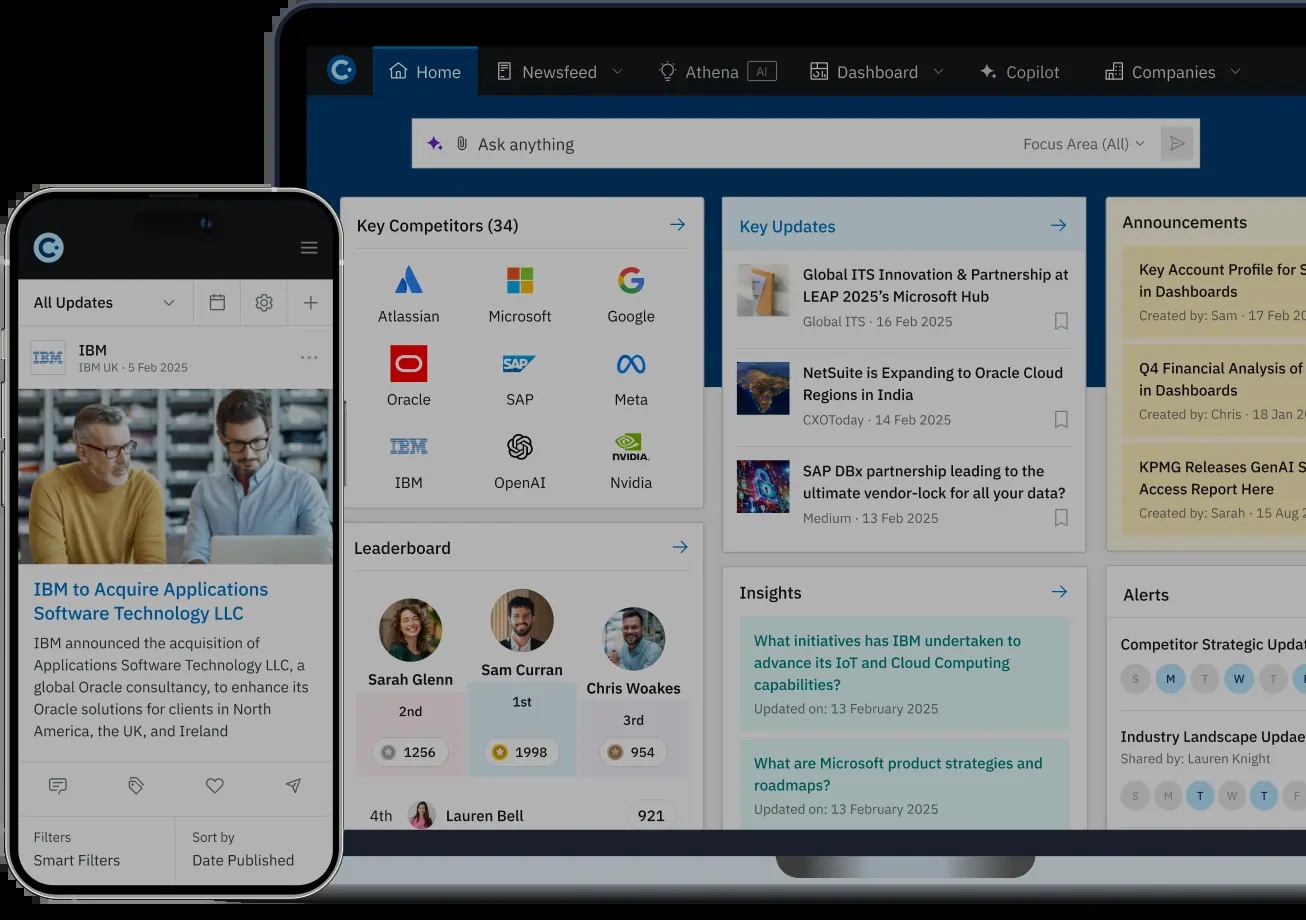
An aggregator learns to answer
Founder and CEO Mohit Bhakuni started Contify in 2009. His background includes consulting at Deloitte and internet operations at Indian newspaper businesses. The company describes its beginnings as business information aggregation, followed by an industry intelligence platform and a customizable enterprise product. That sequence matters. Contify had a reason to organize business information long before generative AI made answering questions fashionable.
The company’s published mission centers on making intelligence part of strategic decision-making. Its values provide an unusually readable companion to that ambition. Under teamwork, it says, “We believe in collaboration, not heroism.” Elsewhere, it calls for plain writing and checking work with data. Those are stated expectations, rather than proof of daily office life. They fit a product whose usefulness depends on many small acts of information housekeeping.

First the evidence. Then Athena.
In June 2025, Contify introduced Athena, its agentic AI insights engine. It is designed to extract business facts from unstructured material, connect those facts into insights, and answer questions against curated intelligence. A launch announcement also described a considerable commitment beneath the interface: more than half the workforce, including data engineers and analysts, was dedicated to the data engine. That is Contify’s own description of its staffing priorities.
Athena’s architecture uses an enterprise knowledge graph and retrieval techniques to ground generated answers in collected information. Internal documents and external updates can be considered together. The distinction is useful: a market announcement and a sales-call observation might illuminate each other. Grounding makes evidence easier to inspect; it does not make every interpretation correct. For a buyer, the revealing demonstration is an answer followed back to its supporting material.
- 01CollectWeb + internal material
- 02StructureFilter, tag, extract
- 03ConnectFacts become context
- 04DeliverDashboards + workflows
Two doors into the same business
The platform is one product. The Business News API is the other door: structured news for developers building applications, CRM features, dashboards, or AI workflows. It handles tasks such as deduplication, company identification, event classification, and translation, then delivers machine-readable results. A developer can use that prepared feed without building a news-gathering operation. This places Contify in both the enterprise software and business-data markets.
Delivery extends beyond Contify’s own screens. Its October 2025 Snowflake integration brings company and market intelligence into customers’ data environments. Its broader integration set includes SharePoint, Salesforce, Slack, and Teams. The commercial logic is straightforward. A finding becomes more useful when it reaches the place where a decision is already being made. Asking every recipient to visit another dashboard adds friction.
Another Contify case study, involving a management consulting firm, describes monitoring more than 5,000 URLs and saving each analyst ten hours a week. The interesting detail is the unit of work: websites, languages, industry categories, and recipients all had to be coordinated. Its reported benefit came from building a repeatable process around those pieces. A clever summary alone would have left much of that coordination untouched.
What the buyer is really buying
Website testimonials identify customers including Lenovo, Colart, Digital Realty, Biocatalysts, and EY. Contify also offers managed analyst support for research and intelligence assets. Its subscription business combines software with help configuring and maintaining the work. Current platform materials advertise unlimited user access and a seven-day trial. Enterprise buyers request a quote; a budget decision therefore requires a conversation about the actual proposed scope.
Alternatives include Crayon, Klue, and Kompyte, alongside the manual monitoring stack the manufacturer was already using. Contify’s case rests on combining broad market coverage, configurable organization, analyst support, and an API. The sensible comparison is a working task: can each system find the updates your team needs, explain their relevance, and deliver them in a usable form?
“We believe in collaboration, not heroism.”Contify’s published teamwork value
The transferable lesson is to write down the question before collecting the feed. Choose the sources, decide who needs the answer, and assign someone to act on it. That is an inference from the workflow, not a promised outcome. Automation will struggle when the evidence is inaccessible, the question is vague, or nobody uses the result. The two-person team’s predicament offers a useful test for any intelligence purchase: after the updates arrive, is there finally time to think?