The assignment was to help bring the next billion users onto Google’s platform. Travis Jarae was working on digital identity for Google payments, including Google Wallet, and the question reached into developing markets such as India. Before someone could use a service, the service needed a way to establish who that person was. At that scale, the small print becomes the main event.
The obstacle was partly organizational. Banks, governments and commerce companies were tackling related identity problems in separate conversations. Even inside a company as large as Google, useful knowledge could remain on the other side of a departmental wall. Cameron D’Ambrosi, who later worked with Jarae at One World Identity, would trace the business’s origins to this realization: the industry needed ways to collaborate across those boundaries.
Jarae’s response included a conference. In 2017, KNOW Identity brought the identity industry together in Washington, D.C. It was a practical answer to an awkward situation. Organizations were trying to recognize their customers while struggling to recognize how much they had in common with one another.
That is a useful place to begin with Jarae, now Liminal’s co-founder, CEO and board chair. His career has repeatedly returned to the problem of information that exists but fails to reach the person who needs it. First came identity verification. Then came a meeting place for the people building it. Today, the question occupies a software company.
Who needs to know this - and what can they do with it?
A finance degree, then the identity desk
Before Google, there was the University of South Florida, where Jarae studied finance. His listed university activities include the rugby football club, the student finance association and the CFA global investment research team. The combination puts a team sport beside two exercises in financial judgment. It is a pleasingly specific alternative to the usual founder biography, which often seems to begin at the airport lounge.
His early professional work was in financial services. At Citi, he held analyst and senior analyst roles. At Deloitte, his work included payments, banking and securities engagements, with attention to business processes, compliance programs and risk controls. He subsequently led identity verification strategy and operations at Google, including know-your-customer work.
Those jobs gave him several views of the same transaction. A customer wants access. A business wants the customer. The institution also needs to understand whom it is admitting and what risks it is taking. The resulting decisions involve product design, operations and commercial judgment as well as verification technology. Jarae’s route into identity passed through the places where those interests meet.
His ventures have reached beyond identity research: Power Mailers Direct, described as direct-mail automation for financial advisers; Power Auto, offering direct consumer access to auto auctions; and Canon, a private-company ratings platform. These are quite different propositions. Each deals with access to a market, a customer or information about a business. It is a varied set of businesses for someone whose later work would involve making sense of markets.
From checking identities to connecting decisions.
- 2010Citi
Financial services - 2012Deloitte
Consulting & controls - 2015Google
Identity verification - 2016One World Identity
Research & gatherings
An industry needs a room
One World Identity, founded in 2016, combined research, advisory work and events. Its premise treated digital identity as a problem that crossed industry boundaries. Jarae had met D’Ambrosi at Deloitte; when he started the firm, D’Ambrosi was among the people he called to join. A former colleague became part of the attempt to make an industry behave more like a connected community.
By 2019, Jarae was participating in an Experian fintech panel alongside Experian’s David Britton, Joust co-founder George Kurtyka and Airbnb product manager Filip Verley. The discussion paired fraud risk with customer experience, convenience and trust. Verley would later become Liminal’s chief innovation officer. The careers overlap in a way that makes the industry’s abstract talk of networks rather concrete.
Jarae was writing about the consumer side, too. In a 2018 essay, he explored the prospect of biometrics replacing tickets and other access credentials. Convenience was part of the appeal; whether consumers would accept the exchange remained a question. His interest extended beyond whether a system could recognize a face to whether people would welcome the system.
Then, in March 2023, CyberRisk Alliance acquired the KNOW Identity conference assets from Liminal and announced a partnership around Identiverse. Jarae outlined contributions in areas including brand strategy, startups, policy and fintech. Selling the event changed ownership of a meeting place he had helped create while preserving a role in the conversation. It also placed a clear marker between the conference business and the work Liminal was developing elsewhere.
Putting the research to work
The software chapter asks a related question: once an organization has gathered useful information, how does it make that information available at the moment of a decision? Liminal’s products address markets including identity, fraud and cybersecurity. Its customers are making choices about products, competitors, customers and investment. Knowing that something happened is only the beginning of that work.
In April 2025, Liminal announced an $8.5 million Series A led by Noro-Moseley Partners, with participation from existing backers and strategic customers. The funding supported data infrastructure, product development and expansion of the team. At the time, the company described Link as its core platform and Sales Hub as a recent addition bringing competitive intelligence into commercial workflows.
Jarae’s ambition was to move research closer to the decisions it informed. That ambition helps explain the progression from advisory work into products. A research assignment can answer a question for one client at one moment. Software offers a way to keep the underlying information available as new questions arrive. It also raises the less glamorous question of keeping that information current.
By April 2026, Jarae and product and technology chief Andrew Bowden were describing Team Spaces, a shared research environment. Their examples were ordinary office frustrations: a competitive landscape left in a document, useful sales observations trapped in a chat channel, an important signal buried in an email. The product proposal was to connect a team’s thinking with changing market information so that its work could remain useful after the first presentation.
In another April article, Jarae described an Insights Agent intended to connect multiple market signals into a finding, with a traceable path back to the underlying events. A funding announcement, a partnership and a patent filing might be related; the work lies in establishing the relationship. His argument placed the emphasis on interpretation. A longer list of events is still a list.
Capital for Liminal’s intelligence platform.
Led by Noro-Moseley Partners.
A smaller room, with fewer cameras
The gatherings have continued alongside the products. At the 2025 Liminal CEO Summit, the program included Renee DiResta on disinformation and Billy Beane on decisions informed by data. Jarae thanked Liminal president and co-founder Jennie Berry for putting the event together. His account also highlighted discussions of passkeys, AI risks, payments and technology investment.
For the 2026 summit in Palm Springs, his public invitation described 100 seats, two and a half days and no recording or livestream. His test for speakers was disarmingly straightforward: would the organizers pay out of their own pockets to hear them? It is a useful question in a business where the word “content” can conceal a multitude of conference sins.
The format suggests a continuing preference for conversation among people doing the work. There is a connection to the original KNOW idea, though the scale and setting differ. Research software can preserve information and distribute it. A room can give people space to question each other, compare experiences and discover which assumptions they do not share. Jarae has kept both forms in the business.
“Spreadsheet jockey”
Travis Jarae, describing his Citi work
The team cannot all be you
Asked about strategy and execution in a May 2026 Friday Five interview, Jarae argued for teams that combine the two. He also pointed toward AI becoming part of the tools people already use. Then came a smaller, firmer conviction: he hates mustard. The interview left room for both organizational judgment and a condiment grievance.
His public descriptions of earlier jobs have a similarly dry streak. He has described his Citi years with two words: “Spreadsheet jockey.” It is a compact acknowledgment of the work beneath the title. Much of the career that followed concerns what happens after the spreadsheet: who reads it, what it means and whether anyone changes a decision.
The humor is useful because the subjects can become airless. Identity, competitive research and enterprise software all invite formidable vocabulary. Jarae’s practical questions are easier to grasp. Can people gain access? Can companies learn from each other? Can a team use what it already knows? Those questions give a human scale to a career spent around systems and markets.
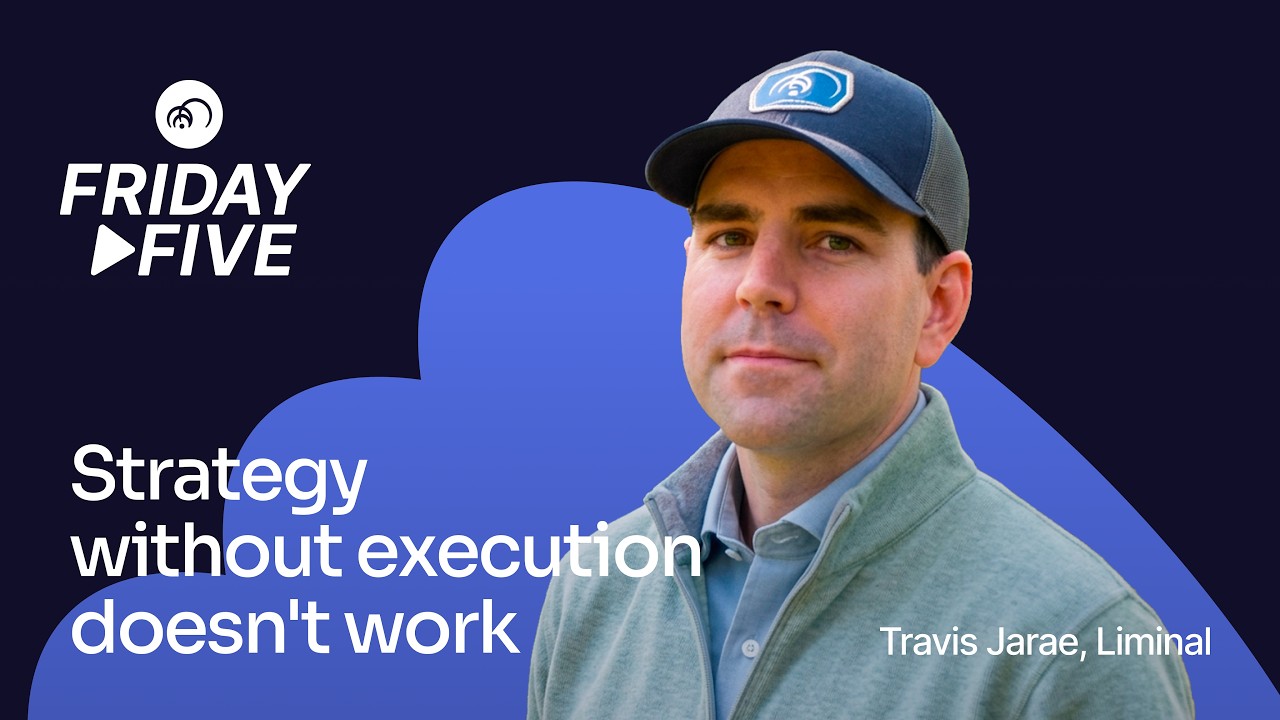 Watch the conversation ↗
The map now has another reader
In August 2026, Liminal announced an MCP connection allowing compatible AI systems to query its market intelligence. The interface gives the company’s information another route into a customer’s work. The intended reader may now be an AI agent as well as a strategy executive or product manager. The need to understand the market survives the change in interface.
That month also brought Liminal’s No. 564 placement on the 2026 Inc. 5000. Inc. listed 618 percent growth over three years, measuring the company’s revenue expansion. The ranking adds a commercial measure to a career whose earlier milestones were job changes, conference programs and research projects.
In October, discussing Liminal’s transaction-monitoring research, Jarae emphasized buyers’ demand for explainability, real-time detection and tools that fit existing systems. The vocabulary has changed since the Google Wallet problem. The practical concern is familiar: a technology has to work within the institution and the decisions already there.
The next billion users were a question of access. Liminal’s next chapter is a question of judgment. Jarae has spent the intervening years arranging meetings, building research and turning parts of that work into software. The thread is the distance between knowing something and being able to use it. There is plenty of room for a business in that distance. Mustard, apparently, can remain outside.