Randy Guard arrived in Sydney after a red-eye from the United States and declined the coffee. This is a risky little decision in Australia, where coffee can feel less like a beverage than a point of national honor. Yet he was, by the account of the interviewer waiting at Appian's office, bright-eyed, smiling, and speaking in a soft Southern drawl. The scene is useful because Guard's career has required much the same trick: land in a complicated place, resist unnecessary stimulation, and start making sense.
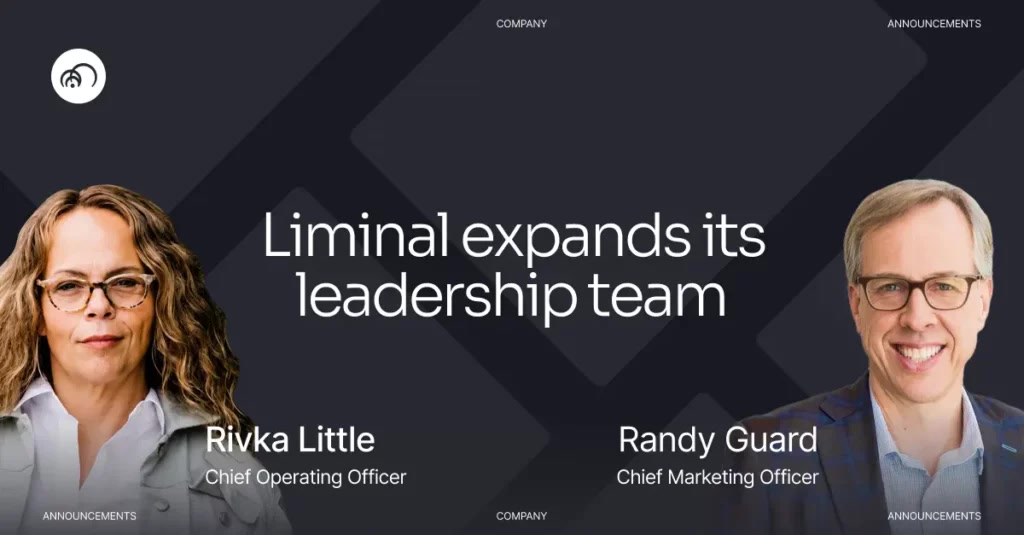
He now has another place to decode. In August 2026, Liminal named Guard its Chief Marketing Officer, giving him responsibility for the company's brand, positioning, demand generation, messaging, and audience strategy. The markets in his brief are identity, fraud, and cybersecurity. Each comes with a crowded vocabulary, fast-moving threats, regulatory consequences, and buyers who cannot afford a charming approximation of the truth.
Guard's response sounds like the engineer he was trained to be. The winners, he said when the appointment was announced, will be decided by who knows the market best. His stated aim is to help customers turn that knowledge into action and growth. The emphasis is not on louder intelligence. It is on usable intelligence.
The engineer inside the marketer
Guard earned a degree in electrical engineering from Duke University's Pratt School of Engineering. He began his working life at Andersen Consulting, now Accenture, and has said he has been in technology since leaving college. The path into marketing came through technology and product work, not around them. He is openly proud of that route.
“I am proud of coming from a technology and a product background to move into marketing.”Randy Guard, 2024
That sentence explains an unusually durable career. Enterprise software is full of products that matter greatly and describe themselves terribly. The code may detect fraud, optimize a locomotive, route a payment, or automate a case. The buyer still needs a story with a beginning, a consequence, and some evidence that the machine will behave on Monday morning.
At SAS, Guard spent 20 years building and leading product and marketing teams. For the final five, he served as Chief Marketing Officer. His remit grew well beyond advertising: product management, global marketing, sales enablement, communications, creative services, and customer experience all sat within the wider territory he oversaw. He was responsible for explaining a portfolio that stretched across analytics, data visualization, data management, business intelligence, artificial intelligence, cloud, cybersecurity, and the Internet of Things.
The work could be futuristic without floating away. In 2017, discussing connected industrial equipment, he offered a neat mechanical metaphor: data was the fuel and analytics the engine that produced value. Two years later, a SAS conference program paired him onstage with physicist Michio Kaku to discuss how AI and machine learning might change industries. Guard also wrote about customer experience in decidedly earthbound terms. Feedback from SAS users led to a starter kit, free training and support, and a community where newcomers could ask basic questions of experienced users. The future, apparently, still needs an instruction manual and a patient neighbor.
His essays from that period show a marketer trying to move an audience from spectacle to application. On the Internet of Things, he urged customers to stop waiting for the buzz to subside and examine what streaming analytics could do at the edge, where machines actually generated information. On AI and work, he resisted the gloomy prediction that automation could only erase jobs. The opportunity, as he framed it, was to pair changing technology with skills and roles that people could grow into. Both arguments follow the same pattern: acknowledge the disorientation, then give the reader somewhere practical to stand.
There was also an institutional lesson in his long SAS tenure. Product direction and customer engagement were not separate ceremonies. When SAS promoted Guard to CMO in 2015, chief executive Jim Goodnight pointed to his influence on both. Guard had previously been Vice President of Products, Marketing and Enablement, a title that sounds cumbersome until one notices the useful sequence inside it. Decide what the product should do. Explain it. Help the field carry that explanation into a customer's context. Many companies divide those activities with organizational walls, then spend meetings wondering why the story arrived dented.
A deliberate jump into unfamiliar water
After two decades inside a large analytics company, Guard did something less comfortable. In 2020 he joined Spreedly, a payments orchestration company in Durham, North Carolina. A connection through ChannelAdvisor co-founder Scot Wingo helped bring him to the opportunity. Payments were not Guard's established specialty, and the company was far smaller than SAS. Those were attractions.
He described the move as a chance for personal growth and liked the prospect of being close to nearly everything happening in the business. This is the kind of curiosity that is easy to claim after a promotion and harder to practice after 20 years of accumulated expertise. Guard chose a field where he needed to learn the pipes.
Payments orchestration is an excellent test of a translator. The value rests in an invisible network of gateways, service providers, loyalty programs, fraud tools, tokens, and regional payment methods. At Spreedly, Guard explained that this connectivity spared aggregators from building and maintaining the entire stack themselves. Their developers could spend their energy differentiating the business rather than becoming reluctant payments experts.
He eventually held both marketing and product responsibility and helped architect Spreedly's rebrand as an enterprise provider. The double title made explicit what his career had long implied. Product decides what a company can truthfully promise. Marketing decides whether anybody understands the promise. Putting the two close together reduces the chance of an expensive game of telephone.
One career, five kinds of complexity
Consulting
Analytics
Payments
Processes
Intelligence
Marketing after the sale
Appian appointed Guard Chief Marketing Officer in October 2023. He was asked to lead global marketing around process automation, low-code software, and enterprise AI. He had returned to a larger public software company, but carried the product intimacy of the startup role with him.
His view of the customer journey is revealing. Nobody buys enterprise software and is simply done, he has argued. Needs evolve. Products evolve. The sale creates a relationship full of new touchpoints rather than ending a funnel. For a CMO, that turns customer acquisition into an organization-wide design problem involving product, service, sales, education, and communications.
Guard applies the same both-and thinking to geography. He favors global campaigns and a global approach, but insists that the work be localized. Consistency without local judgment becomes bland or clumsy. Local freedom without a common idea becomes a collection of unrelated campaigns. The job is to hold the center while allowing useful variation.
Then there is AI, the subject that has followed him from SAS to Appian and now into an intelligence platform. Guard's position is practical. In one regular Friday forum, he and other CMOs compared notes on how AI could help their teams, with the important qualification that help did not mean replacement. The technology might improve efficiency or encourage new forms of work. It was not, by itself, a strategy.
“AI can help with what we do, not replace what we do.”Randy Guard on marketing teams
At Appian, that pragmatism became a product argument: AI is strongest when embedded within governed processes rather than left to operate in isolation. A model can produce an answer. A business still needs permissions, data, handoffs, review, and accountability. Operationalizing AI is less theatrical than announcing it, which may be precisely why the phrase suits Guard.
The new intelligence brief
Liminal brings the themes together. The company sells market intelligence to teams building and selling products in identity, fraud, financial crime, and cybersecurity. Guard's own writing there argues that generic competitive frameworks are too blunt for specialized markets. A quarterly snapshot can be stale before it is distributed. What teams need is continuous intelligence that understands the domain and notices the relationships between buyers, vendors, policies, products, and emerging threats.
This is recognizably the payments lesson at a different layer. A customer does not want to maintain hundreds of payment connections; another does not want to spend each week reconstructing a market from scattered signals. The useful company absorbs difficult infrastructure and returns a clearer choice.
Guard joins alongside Chief Operating Officer Rivka Little, whose own background spans fraud, identity, and payments. Liminal's leadership is pairing category expertise with go-to-market and operational experience as it puts its evidence and software into the hands of strategy, product, and revenue teams. Guard's piece of that work is to make the category legible without sanding away what makes it consequential.
His career has now crossed consulting, analytics, connected machines, payments, workflow automation, and market intelligence. The industries change; the intellectual posture does not. Learn the system. Stay close to the product. Listen after the customer buys. Treat AI as a tool that must earn its place inside the work. And when the vocabulary begins performing for itself, quietly ask what decision it is supposed to improve.
There is wit in that restraint. Enterprise technology regularly arrives wearing a cape and speaking in acronyms. Guard's job has been to persuade it to sit down, explain itself, and be useful. He has been at it for more than 35 years. The coffee, apparently, remains optional.