The first useful thing to know about Liminal is that it does not sell identity verification. It sells the map used by companies deciding which identity products to build, buy, partner with or beat. Its customers sit in the nervy corners of technology - fraud prevention, financial crime, cybersecurity and digital trust - where a neat answer can be expensive if it is wrong.
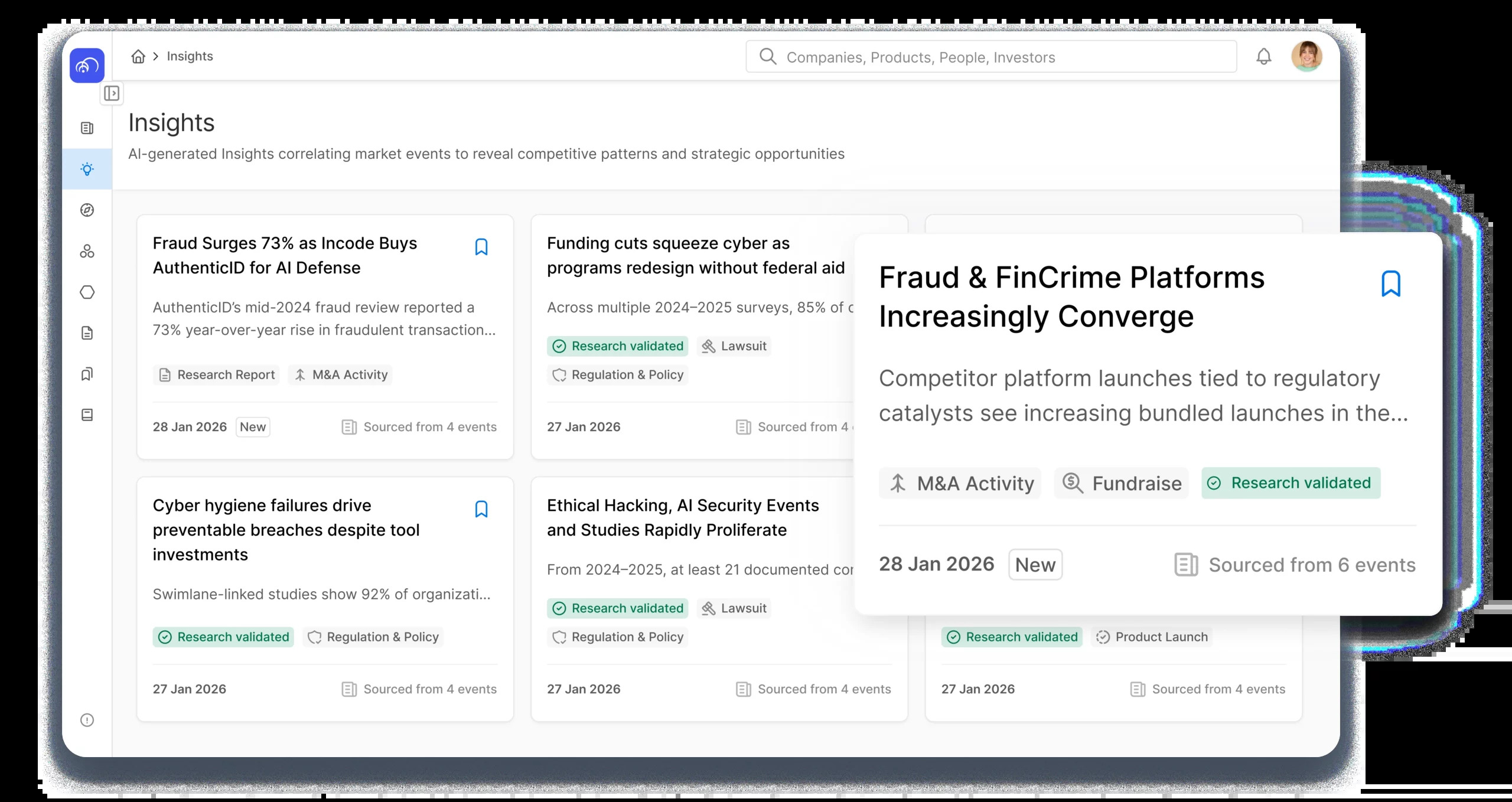
Today the New York company calls itself an actionable intelligence platform. Strategy and product teams use Liminal Command to inspect markets, buyers, regulations, products and competitors. Revenue teams use Liminal GTM to turn that same context into target accounts, battlecards, campaign plans and sales coaching. Under both sits a proprietary “Living Graph,” a taxonomy that connects companies, products, use cases, personas, funding, regulation and market events. Over both sits the Expert Desk, a group of domain specialists charged with checking the machine’s work.
That architecture sounds like a software diagram. The more interesting version is a company biography. Liminal’s roots reach back to One World Identity, which began gathering the digital-identity industry in 2016 through research, advisory work and the KNOW Identity conference. The current company dates its founding to 2022. In 2023 it sold the KNOW event assets to CyberRisk Alliance, which folded the relationship into Identiverse. Liminal gave up the stage it owned and kept the market memory it had accumulated around it.
The intelligence loop
The first thing that failed was the report
Liminal’s founding complaint was not that executives lacked information. It was that the information arrived as static PDFs, isolated dashboards and sales anecdotes. A quarterly report can describe a category just as a new regulation redraws it. A competitor tracker can catch a pricing-page edit without knowing whether the product now covers the use case a bank actually cares about. Generic AI makes the presentation faster, but it can produce a confident synthesis from the same thin material.
Advisory work exposed the failure up close. By October 2022, the business said it had advised on more than $8 billion in mergers and acquisitions, supported more than 55 product launches and helped generate over $500 million in new-product revenue. Those engagements produced recurring questions and repeated evidence. The consultancy did not simply have a pile of reports. It had the beginnings of a language for describing the market.
“Anyone can build a dashboard on top of scraped data. What you cannot shortcut is three years of mapping how 2.5 million entities actually relate to each other.”Jennie Berry, co-founder and president
What changed the company’s mind about the product was the gap between research and action. Link, its original flagship platform, made market and competitor intelligence searchable. Sales Hub pushed the output into go-to-market work. By 2026 those ideas had been reorganized as Command and GTM - two interfaces reading from the same underlying graph. Strategy is supposed to update the field; evidence from the field is supposed to sharpen strategy. The report became a loop.
The $8.5 million bet on better context
Noro-Moseley Partners led Liminal’s $8.5 million Series A in April 2025. The company earmarked the money for data infrastructure, product development and go-to-market expansion. The amount matters less than the costly behavior it hopes to prevent. Liminal says it has found that 35 percent of roadmap features examined with its system had no verified buyer demand. Its public product material says a roadmap can be checked in about two hours and that useful signals appear, on average, 14 days before public disclosure.
These are company-reported figures, not a universal promise. They do reveal the sales logic. Liminal is not asking a product chief to compare its subscription with the price of another news feed. It is asking the chief to compare it with an unwanted feature, an ill-timed market entry or a competitive deal lost because the rep walked in carrying last quarter’s story.
The funding also accelerated a wider product surface. In March 2026, Liminal introduced Team Spaces, an Insights Agent, target-account matching and Coach AI. In June, it expanded its taxonomy into AI governance and digital trust. In August, it added Company Compare and an MCP endpoint that lets Enterprise customers query Liminal’s intelligence from compatible AI systems, including alongside their own internal material.
The humans are not a concession
The fashionable version of this company would hide the analysts. Liminal puts them in the product description. Its Expert Desk maintains the taxonomy as categories change, reviews incoming events, checks generated analysis, adds interpretation and handles questions that the software cannot answer cleanly. Every correction is meant to feed back into the graph. Automation supplies reach; the humans supply the reason a compliance, product or revenue leader might trust the result.
That is its cleanest difference from broad research platforms such as AlphaSense, CB Insights and PitchBook, and from competitor-monitoring products such as Klue, Crayon and Kompyte. The horizontal tools cover more territory. Sales databases such as ZoomInfo, Apollo and 6sense offer more familiar prospecting depth. Consultants can go deeper on a bespoke assignment. Liminal’s bet is narrower: one connected model of identity, fraud and cyber, carried from an executive decision into the work of the seller who has to execute it.
“In identity, being wrong isn’t an embarrassing email. It’s a failed product bet or a lost enterprise deal.”Pat Kinsel, CEO of Proof
The customer list reflects that high-stakes pitch. Liminal publicly names Visa, Mastercard, Google and JPMorgan Chase, along with identity and fraud companies including Proof, Microblink and Socure. Great Hill Partners represents the investor side of the audience. In 2024, the company said its research and membership programs had grown past 60 enterprise clients. The same ecosystem reappears at the Liminal Exchange, a peer network of executives, curated dinners, demo days and an annual CEO Summit. More than 100 CEOs and senior leaders attended the 2026 summit.
It charges for work, not just logins
Liminal sells Essential, Professional and Enterprise access without publishing list prices. In 2026 it began describing the model as a platform fee plus consumption credits. The fee covers access to the research, verified data and expert network. Credits meter agent-produced outputs such as campaigns and enriched contacts. Professional and Enterprise plans add progressively deeper expert access and organizational controls; MCP access is an Enterprise feature.
That structure follows the product’s evolution. A per-seat license makes sense when value is measured by how many humans open a dashboard. It becomes awkward when an agent assembles a target list or drafts an account strategy while nobody is clicking. Liminal’s phrase for the switch is “meter the work, not the worker.” It is elegant, though customers will still need good cost visibility as agent activity grows. The platform now shows credit balances, projected depletion and per-user consumption.
What a smaller company can steal
The lesson is not “build a graph with 2.5 million entities.” It is to resist beginning with a generic interface. Liminal began with a community and advisory work that exposed repeated decisions. It organized those decisions before automating them. Its taxonomy is a product specification, a research method and a distribution advantage at once. A founder in another regulated niche could copy the sequence at a smaller scale: convene practitioners, record the recurring questions, define the category’s objects and relationships, and build the tool around the moment money or risk changes hands.
The second copyable idea is to connect planning with execution. Market intelligence often dies in a slide deck because the people choosing a segment are not the people calling the account. Liminal’s Command-to-GTM loop forces both groups onto the same model. Even a spreadsheet-based business can copy that discipline by making roadmap evidence, positioning, target lists and win-loss feedback use the same definitions.
Where the model earns its keep
High-cost product bets, regulated markets, frequent competitive change, specialist buyers and teams willing to connect research with operating workflows.
Where it is too much machine
Companies outside Liminal’s mapped verticals, low-stakes questions, basic website-change alerts and teams that will not maintain or act on the intelligence.
Those conditions are the boundary of the idea. A vertical model loses its edge outside the vertical. Human review adds cost and may not be worth paying for when the only question is whether a competitor changed a headline. And no intelligence platform fixes an organization that rewards intuition, leaves research outside the CRM, or ignores inconvenient buyer evidence. The loop works only if the team closes it.
A market memory, now available to machines
Liminal entered August 2026 with an MCP launch, two new senior operators and a No. 564 ranking on the Inc. 5000, including sixth place in Business Products & Services. Randy Guard became chief marketing officer and Rivka Little chief operating officer. The appointments suggest the next challenge is less about proving that the graph can answer questions and more about distributing those answers without diluting the specialized context that made them worth buying.
The company’s original asset was a room full of people who knew how digital identity actually worked. It sold the room. It retained the relationships, the questions and the peculiar structure of the market, then made those things legible to software. Now outside AI agents can query that memory through a standard connection. The interface has changed several times. The product underneath it remains unusually human: a shared account of what is happening, checked by people who know when the machine has mistaken confidence for truth.