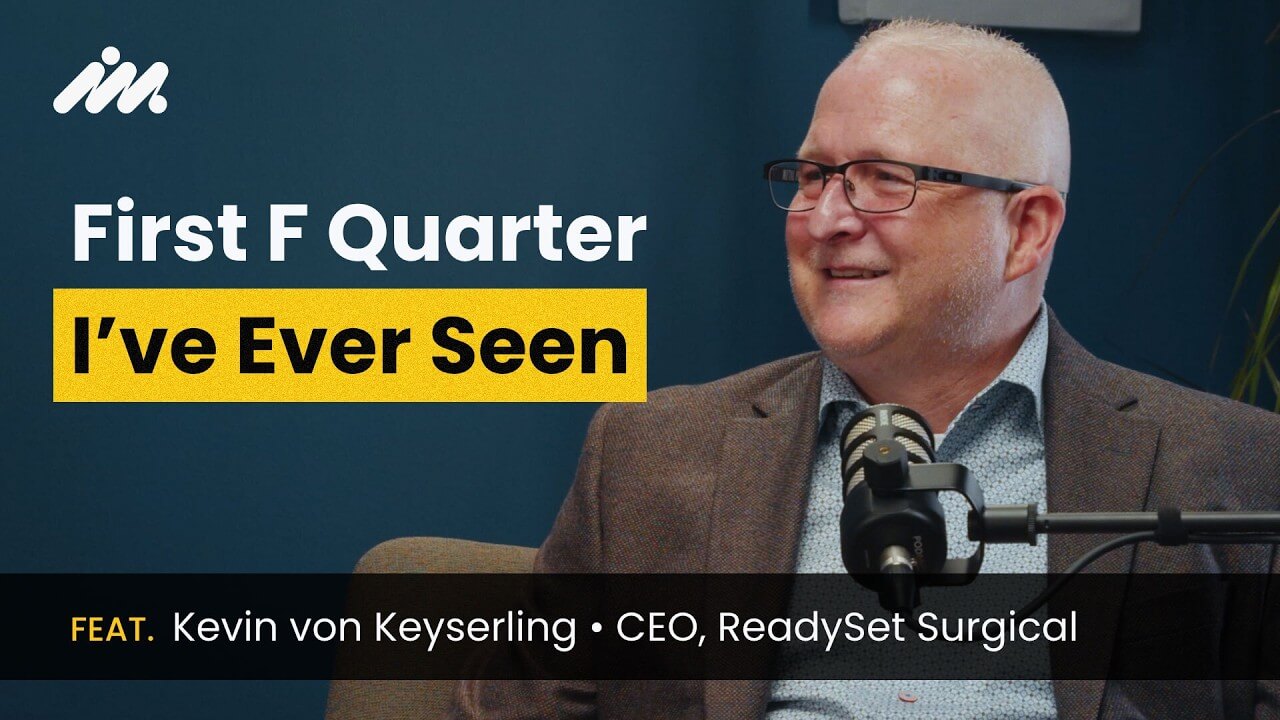
Kevin von Keyserling gave the quarter an F. The Keyfactor co-founder was recalling a review at his next company, ReadySet Surgical, where the team had missed its targets. He treated the failure as a leadership problem shared across the business. It is an arresting place to begin a founder’s story: with the grade he was willing to give himself.
His route there runs through sales territories, a security consultancy, a change of business model and a CEO succession. Along the way, the meaning of a good result kept changing. Selling more consulting time and building a software company require different habits. So does helping a successor take charge of something you helped create.
Before the certificates, a sales territory
Von Keyserling began his career at Kinko’s, eventually becoming director of sales for the Southwestern and Mid-Atlantic United States. Later came a vice presidency covering Midwest sales and operations at Merrill Corporation, followed by a vice president of sales role at Relera, a venture-backed internet data-center provider. The early career is a succession of commercial and operating responsibilities.
That background matters to the kind of founder he became. There is an unglamorous vocabulary underneath a technology business: territory, customer, engagement, expansion. Before the software can renew a certificate, somebody has to understand why a buyer would pay for it. His experience included the work of finding customers and the responsibility of running the operation that served them.
At CSS, he helped develop the company’s Midwest business. His approach included a qualification that sales biographies do not always advertise: declining engagements when lasting value for the client could not be delivered. A contract can look agreeable on the day it is signed and considerably less agreeable afterward. That distinction runs through his commercial story.
The company changed before the sign did
Certified Security Solutions began in 2001. Von Keyserling and fellow co-founder Ted Shorter built a business around helping large enterprises with public key infrastructure, or PKI. The work brought them close to a recurring difficulty: organizations needed a manageable way to oversee expanding populations of cryptographic keys and digital certificates. More connected systems meant more credentials to look after.
The move toward software began in 2014. Consulting had exposed the problem. A platform offered a way to address it repeatedly. That is the consequential turn in von Keyserling’s Keyfactor career: taking a pattern encountered in client work and helping turn it into something the company could sell as software.
On November 1, 2018, CSS announced that it had become Keyfactor. Von Keyserling connected the new identity to the company’s changed business. The name drew on public and private keys, authentication factors and the mathematics of cryptography. A fair amount of technical vocabulary had been persuaded to share one business card.
He also wanted the company’s message to give customers room to expand. Security spending can turn into a series of choices about what an organization can afford to protect. Von Keyserling argued that the economics should support broader coverage. His 2018 explanation put the ambition plainly.
“You shouldn’t have to choose what you secure based on economics.”
Kevin von Keyserling, 2018
A car outlives its first cryptography
The future he was discussing could be quite physical. In April 2018, while the company still used the CSS name, it announced a partnership with ISARA on quantum-safe public key infrastructure. One focus was automotive software delivered through over-the-air updates. The practical challenge was how to keep updating vehicles as the cryptography protecting those updates changed.
A connected car presents an awkward timetable. Equipment remains in service; the security assumptions around it can move on. Von Keyserling’s argument for crypto-agility addressed that mismatch. Customers needed a workable path to replace aging cryptography. The partnership made the idea concrete through a familiar object with wheels, a purchase price and years of expected use.
His broader digital-identity thinking followed the same lifecycle. Discover the credentials. Understand where they are used. Issue, renew or revoke them as required. In discussing the platform, he emphasized integration with existing systems and the ability to change security over time. The appeal depended on making continuing maintenance manageable. The original installation was only the opening engagement.
The money arrived with a bigger map
In January 2019, Keyfactor announced $77 million in growth funding from Insight Venture Partners. At the announcement, the company said it secured more than 500 million certificates worldwide and had doubled revenue year over year. These were company-reported measures of a business that had moved well beyond its consulting origins.
January 2019 snapshot - historical figures
Von Keyserling put global expansion high on the list of priorities. Capital gave that ambition a different scale. The funding announcement connected the investment to market expansion and the company’s certificate-management and device-identity products. The software transition now had financial backing for its next stage.
The sequence is useful to keep straight. The software effort started years before the rebrand. The funding followed the new name. Each announcement marked work already underway as well as work still ahead. Reading the milestones together gives a less instantaneous account of company building than the usual photograph of executives celebrating a round.
The favorite rule was learning
Von Keyserling also wrote the company’s Ten Principles of Leadership. His favorite was creating a learning environment. That preference appears repeatedly in his professional biographies, alongside the responsibility of caring for company culture. It is a revealing emphasis for an executive whose company was asking people to adapt to a different business.
In September 2019, he received a Top Manager award in SC Media’s Reboot Leadership Awards. The recognition included his work developing the company and supporting its people. Shorter credited his attention to culture and customers. In a separate colleague assessment, the co-founder described a workplace where taking risks was permitted and mistakes could become opportunities to learn.
The commercial advice von Keyserling published carried a similar impatience with comfortable routines. In writing for retailers in 2018, he argued that compliance checks alone could not do the work of managing security risk. He pressed for ongoing attention to digital identities and automation. A completed checklist could leave plenty of unfinished work.
Inside the company, people called him KvK. His attention to professional development included encouraging employees to keep learning and pursue further education. That gives the leadership principle a practical expression: the people doing the work needed opportunities to develop alongside the products. A company moving into software was also asking its workforce to build a future there.
Another name on the CEO’s door
In 2019, the CEO job changed hands. Jordan Rackie’s appointment was publicly reported in June; von Keyserling became chief strategy officer and remained on the board. The founder stayed involved while another executive took charge. The change gives his story a clear boundary: later chapters of Keyfactor’s growth belong to the people leading it then, too.
Rackie later remembered von Keyserling’s support during the transition. “He was very gracious,” he said. For a succession announcement, it is an unusually human detail. A title can be reassigned in a document. A welcome has to be supplied by a person.
“He was very gracious.”
Jordan Rackie on Kevin von Keyserling’s support during the CEO transition
The account puts company culture under a practical light. A founder who has emphasized learning eventually encounters changes in his own responsibilities. Supporting an incoming leader is one way those principles become visible to everyone else. In Rackie’s recollection, von Keyserling helped set that tone.
A puck on the desk
There was another small object in his professional life: a hockey puck on his desk in Cleveland. He followed ice hockey and was known for attending his sons’ games. His volunteer service included the presidency of the Winterhurst Hockey Association from May 2008 to May 2011, supporting youth hockey.
His interests also included swimming, golf and live music. Those details have a welcome lack of corporate ambition. The hockey fan and concertgoer can sit alongside the executive responsible for expansion plans. There is no need to turn every round of golf into a lesson about strategy. Sometimes the personal detail earns its place simply by allowing a person to appear.
When the scorecard remembers the wrong business
Von Keyserling is now CEO of ReadySet Surgical. His involvement in cybersecurity also continues: InnerActiv named him a board director in November 2025. His career has acquired further responsibilities since the Keyfactor handoff.
In July 2026, Kris Snyder revisited an earlier operating lesson from his work: the change in measures during the shift from consulting to software. Hourly bill rates and utilization had made sense for consulting. Monthly recurring revenue and average contract value mattered in SaaS. A business could change while its familiar numbers kept describing what it used to be.
Utilization
Average contract value
The comparison is modest enough to fit on a small card, but it captures the work hidden inside a strategic announcement. Someone has to decide which numbers the team will discuss next week. Someone has to explain why an old measure has lost its usefulness. Those decisions connect the founder’s plans to the ordinary meetings in which a business is actually run.
That is a fitting thread through his story. A sales territory, a software platform and a leadership transition each ask for a different kind of judgment. Past success supplies experience; the next job still has to be assessed on its own terms. Von Keyserling’s willingness to give a quarter a failing grade belongs in that account. The useful result begins with an accurate mark.