It is 2:07 on a Tuesday morning, and an application has stopped speaking to another application. Nobody changed the code. The network is up. The servers are healthy. The culprit is a small digital certificate with a date inside it. It expired, the handshake failed, and a machine that looked trustworthy on Monday now looks like a stranger. This is the mundane calamity at the center of Keyfactor's business.
People prove who they are with passwords, badges, passports, and faces. Machines use cryptographic keys and certificates. Those credentials authenticate websites, cloud workloads, industrial sensors, medical devices, code releases, containers, vehicles, and a growing population of AI agents. A large company may have certificates issued by many authorities and stored across data centers, clouds, laptops, pipelines, and equipment expected to remain in the field for years. Each credential must be found, issued under policy, renewed, revoked, audited, and eventually replaced.
Keyfactor sells the machinery for doing that at enterprise scale. The Ohio-based company began in 2001 as Certified Security Solutions, a PKI consultancy founded by Kevin von Keyserling and Ted Shorter. Today it calls itself a provider of trust infrastructure. The vocabulary has broadened because the job has broadened: from running public key infrastructure to seeing and governing the cryptography underneath nearly every digital interaction.
The certificate nobody put on the calendar
The first problem Keyfactor solves is inventory. Security teams cannot renew or govern credentials they do not know exist. Certificates accumulate through acquisitions, departmental purchases, developer tooling, public clouds, private clouds, appliances, and one-off projects. Some are self-signed. Some use aging algorithms. Some sit in code or binary files. A spreadsheet can describe a tidy estate. A network rarely is one.
Keyfactor Command discovers certificates and brings lifecycle work into one console: issuance, enrollment, renewal, revocation, policy, reporting, and integrations. It is designed to work across certificate authorities rather than forcing every credential to originate from one vendor. The payoff is not glamorous, but it is legible. Fewer manual tickets. Fewer late-night expiry incidents. Faster audits. Developers can request credentials through approved workflows instead of treating the PKI team as a human API.
The most valuable certificate-management feature is the one that quietly prevents a very public outage.YesPress observation
A commissioned Forrester Consulting study, based on five customer interviews and modeled on a composite 40,000-person enterprise, put the argument into finance language: 356 percent return on investment over three years, $12.7 million in risk-adjusted benefits, and payback in under six months. Those are modeled results, not a universal promise. They nevertheless explain the buying motion. Keyfactor is purchased by security and infrastructure teams, but justified in the avoided cost of downtime, labor, and audit friction.
From issuing trust to policing the whole neighborhood
Keyfactor's pivotal move came in 2021. A $125 million growth investment accompanied its merger with Sweden's PrimeKey, creator of EJBCA and SignServer. Command could manage a certificate's lifecycle; EJBCA could operate the certificate authority that issued it. SignServer could protect and automate digital signatures. Bouncy Castle brought widely used open-source cryptographic APIs for Java and C#. The combined company covered more of the chain, from cryptographic building blocks to enterprise operations.
The portfolio expanded again in 2025 with InfoSec Global and CipherInsights. Their technology looks beyond certificates to the rest of the cryptographic landscape: keys, algorithms, protocols, libraries, code, files, and encrypted traffic. AgileSec Analytics inventories cryptography and prioritizes weak or quantum-vulnerable assets. AgileSec Agility is intended to change cryptography in applications without rewriting the underlying source. CipherInsights passively watches network traffic for risky protocols, self-signed certificates, or unencrypted connections.
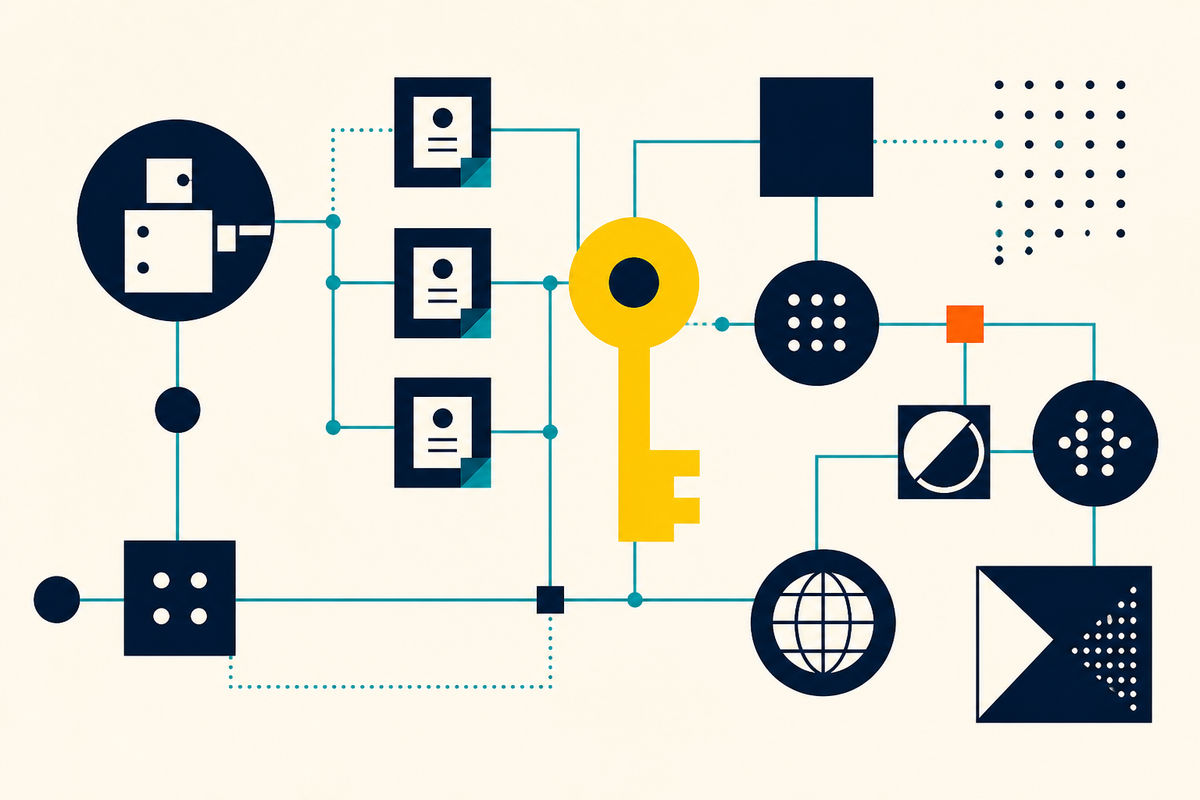
In June 2026, Keyfactor packaged this scope as the Trust Control Plane. The name is marketing, but the loop underneath it is concrete. Observe the estate. Analyze risk. Provision trusted identities. Orchestrate their lifecycle. Govern the result against policy. Discovery should lead to remediation, not another dashboard asking an operator to reconcile five tools by hand.
The trust control loop
AI adds identities. Quantum changes the locks.
Two technology shifts make this old discipline newly urgent. AI agents need credentials to call models, retrieve data, execute tasks, and interact with other systems. Static API keys are easy to copy and difficult to govern. Cryptographically verifiable, short-lived identities offer a cleaner model, but they also create more identities and more rotation. An enterprise that struggled to count certificates for web servers now has workloads appearing and disappearing by the minute.
Post-quantum migration creates a different problem. Future quantum computers may undermine widely deployed public-key algorithms. Nobody can replace what nobody has found. Before a company can adopt quantum-resistant standards, it must locate vulnerable certificates, keys, algorithms, libraries, and protocols; understand which business systems depend on them; test replacements; and move without breaking production. Keyfactor's bet is that cryptographic discovery, PKI, automation, and signing belong in the same operating system for precisely this reason.
Quantum readiness is not a product you install. It is an inventory, a dependency map, and a repeatable replacement process.
The U.S. federal market supplies another forcing function. In May 2026, Keyfactor for Government Certificate Lifecycle Automation as a Service received FedRAMP Moderate authorization. That gives agencies a cloud option for certificate discovery, issuance, renewal, management, and reporting while reducing the burden of operating the stack themselves. In regulated sectors, authorization and compliance templates can shorten an otherwise slow path from interest to deployment.
Who buys it, and what makes it different
The users are PKI administrators, security engineers, identity teams, DevSecOps groups, cloud operators, compliance leaders, and product engineers building connected devices. The customer list spans banks, software companies, manufacturers, health care, telecom, retail, and government. Keyfactor names ServiceNow, RSA, M&T Bank, Schneider Electric, Siemens, Truepic, Phoenix Contact, and EQ Bank in customer stories. Its current site says the software is trusted by 40 percent of the Fortune 100.
This is an enterprise sale, not a credit-card signup. Keyfactor makes money through SaaS, managed PKI, licensed self-hosted software and appliances, support, education, and professional services. Public prices are not posted. Open-source editions of EJBCA and SignServer, the Bouncy Castle libraries, developer tools, and a GitHub organization with nearly 200 public repositories create a lower-friction way for engineers to encounter the technology. Enterprise customers then pay for scale, support, certifications, deployment options, and operations.
Keyfactor's differentiator is the span between those columns. It offers CA software and CA-agnostic lifecycle management; hosted service and self-managed deployment; enterprise support and open-source foundations; certificates and broader cryptographic discovery; signing and IoT identity. The strategy resembles a hardware store built around one stubborn fact: every machine needs a trustworthy way to introduce itself, and every method will eventually need maintenance.
The alternatives are substantial. DigiCert and Sectigo combine public trust businesses with lifecycle software. AppViewX focuses heavily on certificate automation. Venafi, now part of CyberArk, is a mature enterprise machine-identity rival. Cloud providers offer convenient native certificate services, while Vault and Smallstep appeal to developer-centric environments. Buyers will weigh integration depth, CA independence, deployment, support, switching costs, and how much platform breadth they actually want.
A niche becomes a layer
Keyfactor's history is a study in staying with a technical problem long enough for the surrounding world to catch up. It rebranded from Certified Security Solutions in 2018, raised $77 million from Insight Partners in 2019, merged with PrimeKey in 2021, and took a Sixth Street Growth investment at an approximately $1.3 billion enterprise value in 2023. It passed $100 million in annual recurring revenue by early 2024. The 2025 acquisitions widened the product. In July 2026, Summit Partners led a strategic growth investment of more than $1 billion, with existing investors retaining significant ownership.
The money is meant for product development, geographic expansion, hiring, and acquisitions. It also reflects competition for an infrastructure layer that customers cannot casually replace. Once a company entrusts a vendor with certificate issuance, renewal, cryptographic inventory, and signing policy, the relationship becomes embedded in production and compliance. That can produce durable revenue. It also raises the standard for reliability. Trust infrastructure is a category where a provider's own outage or security failure would be painfully on the nose.
Inside the company, the culture is framed with a wink: “crypto-geeks, and no, not the bitcoin kind.” Publicly stated values emphasize trust, customers, teamwork, agility, respect, and innovation. Keyfactor reported 93 percent global employee engagement in 2024, and Inc. placed it on the Best Workplaces list for the sixth consecutive year in 2026. The organization is global and hybrid, with its headquarters in Independence, Ohio, and teams across North America, Europe, and Asia-Pacific.
The larger story is less about certificates than dependence. Digital businesses depend on machines believing other machines, code arriving unaltered, devices accepting legitimate updates, and encryption remaining fit for purpose. Those judgments happen continuously and mostly out of sight. Keyfactor's opportunity is to make that invisible layer observable, automated, and governable. If it succeeds, customers will notice it mainly when nothing breaks - which, in this corner of security, is the most convincing product demo available.