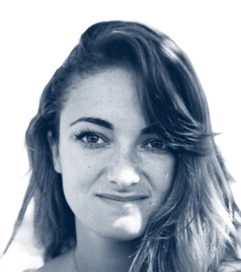
A philosophy major is guarding the U.S. Army from a computer that doesn't fully exist yet
The encryption protecting your bank login, your medical records, and a government's classified cables rests on one wobbly assumption: that no machine can factor enormous numbers fast enough to matter. A large enough quantum computer breaks that assumption in an afternoon. Rebecca Krauthamer built a company around the gap between today and that afternoon.
From a San Mateo office, Krauthamer runs QuSecure as co-founder and CEO. The product is software that lets an organization rip out its old cryptography and drop in quantum-resistant algorithms - across a whole network, without ripping out the network. Her customers are not hypothetical. The U.S. Army, the U.S. Air Force, and Spain's Banco Sabadell have all run her quantum-resilient encryption, the last of which the SEC spotlighted as a model for how a bank should prepare.
The threat has an industry nickname that sounds like a heist plan, because it is one: harvest now, decrypt later. Adversaries scoop up encrypted data today, sit on it, and wait for a quantum machine capable of cracking it open. Anything with a shelf life - state secrets, financial records, genetic data - is already exposed to a computer that hasn't shipped yet. Krauthamer's pitch is uncomfortable and simple: the deadline is not when quantum computers arrive. It already passed.
"The goal isn't another one-time upgrade. It's ensuring our cryptographic foundation can respond as fast as the threats do."- Rebecca Krauthamer
That last idea has a name she helped popularize: cryptographic agility. Most companies treat encryption like a foundation poured once and forgotten. Krauthamer treats it like software that should be patched, versioned, and swapped on demand. When she says QuSecure was an early mover in "orchestrated cryptographic agility," she means the boring-sounding plumbing that lets you change your locks while people are still walking through the doors.
The plumbing is the whole game. Standards bodies like NIST have spent years finalizing the new quantum-resistant algorithms, and that work matters - but an algorithm sitting in a specification protects nothing. The hard part is the deployment: discovering every place your organization uses cryptography, swapping the old for the new across a sprawling network of servers, devices, satellites, and edge hardware, and doing it without taking the whole thing offline. QuSecure's bet is that the migration is an orchestration problem, not just a math problem. The math is solved. The logistics are where companies get stuck.
The Banco Sabadell deployment is the example Krauthamer keeps returning to, and for good reason. When a major bank can demonstrate quantum-resilient encryption running in production - not in a lab, not in a slide - it stops being theory. Regulators noticed. The case became a reference point for how a financial institution can actually prepare for a threat that most boards still file under "someday." For a category that lives and dies on credibility, a real customer doing real work is worth more than any benchmark.
She got here by asking the wrong question
At Stanford she studied Symbolic Systems, the major that braids computer science, neuroscience, AI, philosophy, and psychology into one degree. She took a course called "Truth and Morality" expecting it to hand her answers about what is right and what is true. It did the opposite. The lesson that stuck was that philosophy isn't an answer machine - it's a question machine.
"Philosophy is about asking better questions."- Rebecca Krauthamer
She went into AI first, working as what she calls a "hired gun" - building and training models for startups. Then she hit a wall made of silicon. The models wanted more than classical hardware could give. So in 2017 she did the thing most people only talk about: she followed the limitation upstream.
"I jumped from AI to quantum in 2017 because I truly felt AI advancement was necessarily limited by classical hardware."- Rebecca Krauthamer
The pivot produced two companies. First Quantum Thought, billed as the world's first quantum computing venture studio - a workshop for spinning ideas into quantum intellectual property. Then, in 2018, QuSecure, incubated inside that studio and catalyzed by a U.S. Air Force grant aimed at one job: stopping a future quantum computer from decrypting today's data. The grant was small. The mandate was enormous.
If a willingness to walk into unfamiliar rooms alone seems like a learned trait, it is. Krauthamer grew up in a Northern California town of roughly 800 people, with the kind of childhood independence that scales. From middle school on she traveled solo - helping build a school in Ecuador, a homestay in Japan, medical clinics in Mexico, a skills program for trafficking survivors in Nepal. When her father was laid off during those years, he started his own business. She would later co-found QuSecure alongside Dave Krauthamer. Self-reliance, it turns out, runs in the family.
Cybersecurity, but make it a mission for humanity
Krauthamer is unusual among security executives in that she keeps dragging the conversation back to ethics. She sits on the World Economic Forum's Global Futures Council on Quantum Computing and helped draft its reports on transitioning to a quantum-secure economy and on quantum governance principles. She contributed to Coursera's Certified Ethical Emerging Technologist program. On a 2025 podcast she framed the whole field as "cybersecurity for humanity" - values-driven, not just vendor-driven.
"As long as you have a strong moral compass, it is important to question how things have been done to build a better way to move forward into the future."- Rebecca Krauthamer
She also refuses to treat AI and quantum as rivals fighting over the same headline. To her they are co-conspirators: quantum machines will eventually turbocharge AI's processing, and AI will help quantum systems scale. The two limitations she has spent her career bumping into turn out to be each other's solution. It is a tidy bit of symmetry for someone who started in AI, walked away from it over a hardware ceiling, and now runs a company whose work will eventually loop back to lift that ceiling.
There's a quieter trait underneath all of it that she names directly: a tolerance for the downside. She describes herself as optimistic with a touch of selective forgetfulness, comfortable weighing the upside of a hard problem more heavily than the ways it could fail. For a founder, that is closer to a survival skill than a personality quirk. The quantum threat is the kind of problem that rewards people who can stare at a worst case and still get up to build the fix.
"Take a challenge and turn it into an opportunity. Every major innovation I've been part of started as a limitation."- Rebecca Krauthamer
That conviction shows up in QuForce, the fellowship she co-founded and co-directs. It hands microgrants and mentorship to people from non-traditional backgrounds so they can work on real quantum research projects. The quantum workforce is famously small and famously narrow. QuForce is her bet that the field gets better answers when more kinds of people get to ask the questions.
The recognition has followed. Forbes 30 Under 30 in Science in 2020. A spot on the list of the top 12 women shaping quantum computing. A Stevie Award for Most Innovative Women of the Year in Technology. An Inc. Female Founders 500 nod and a place on the inaugural Techstrong Group Quantum Security 25. She was named CEO of QuSecure as the Series A closed at $28M - a promotion from chief product officer that read less like a title change and more like a confirmation of who had been steering all along.
What makes Krauthamer worth watching isn't that she predicted the quantum threat - plenty of people did. It's that she treated cryptography as something alive, something that should move. Most of the industry is still bracing for one big migration, a single nervous swap from old algorithms to new. Krauthamer already moved past that frame. She is building for a world where the locks keep changing, on purpose, forever - because the people trying to pick them never stop either.
The quantum computer that breaks everything may be five years out, or fifteen. Krauthamer's whole company is an argument that the exact date doesn't matter. What matters is whether you can change your cryptographic foundation faster than someone else can attack it. She started building that capability before most boards had heard the word "post-quantum." The rest of the world is now catching up to someone already mid-stride.