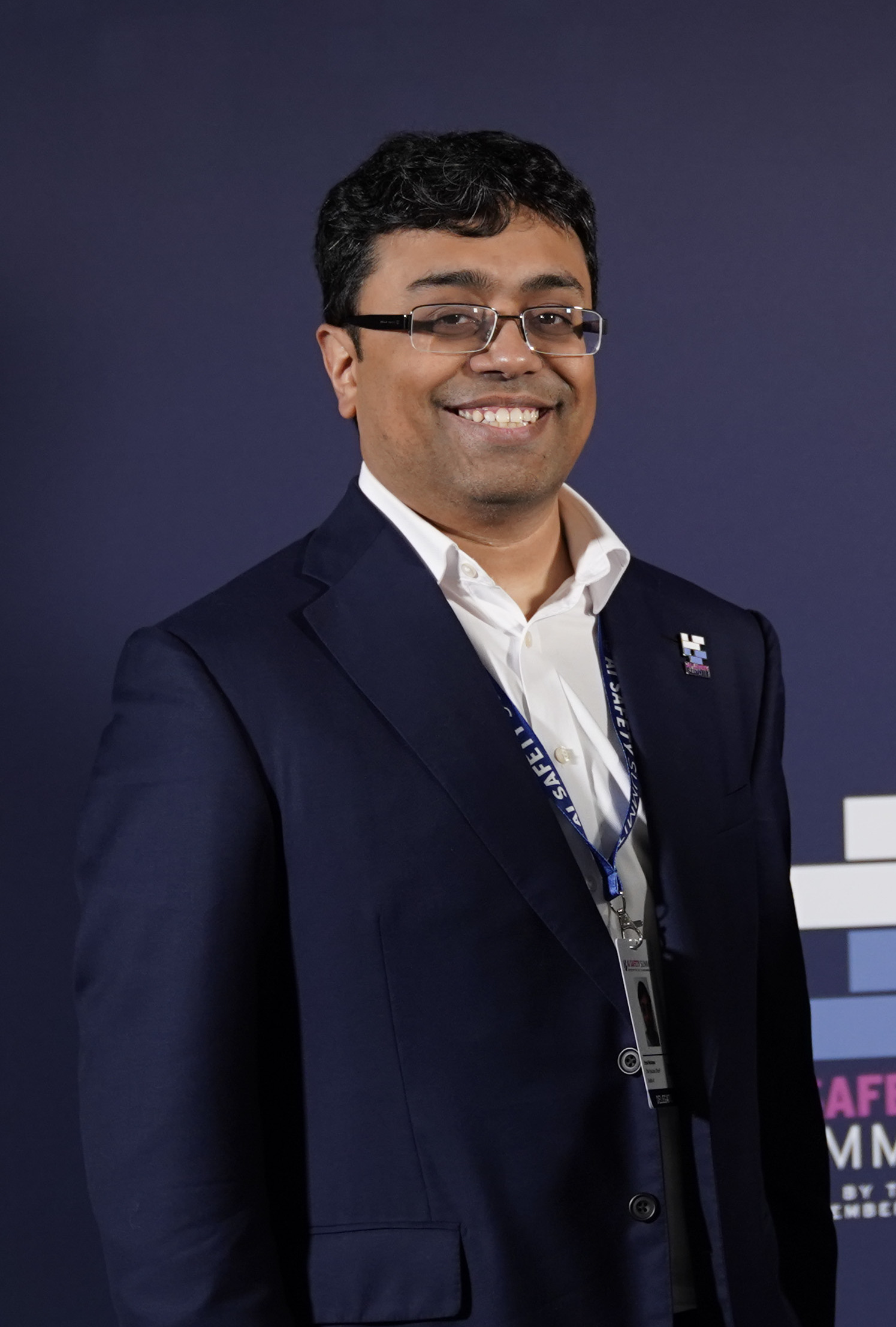
Emad Mostaque does not soften the blow. Sitting across from the host of the Beyond Tomorrow podcast, the founder of Stability AI — the British-Bangladeshi mathematician and former hedge-fund manager who put the image-generating model Stable Diffusion into the world — delivers a forecast that would sound unhinged from almost anyone else. "Every country will be run by AI within 30, 40 years at most," he says. Then, as if the first sentence needed company: "I think democracy is basically in its final decade or two." What makes the pronouncement land is not its drama but its arithmetic. Mostaque has done the math, and he keeps doing it, out loud, for the better part of an hour.
The through-line of the conversation is a single, unnerving number. Asked where he sits on the spectrum from AI doomers to techno-optimists, Mostaque doesn't hedge. "My P-doom is 50%," he says — the probability, in the jargon of AI safety, of civilizational catastrophe. "I think either we'll be wiped out as a species and this is the great filter through which every species reaches, or we have a period of infinite abundance." He lets the fork sit there for a beat. "I think it's a coin toss right now."
That is not a comfortable place for a public figure to stand. Most people who build this technology, Mostaque observes, feel pressure to perform optimism — "because otherwise regulation, other things will stop them." He refuses the performance. His 50% is not, he insists, a claim that others are wrong so much as an alarm that the odds are already catastrophically high. Fifteen or twenty percent, the figure many researchers cite, is "Russian roulette odds," he notes — "far too high in terms of holy crap, this should be the top of the agenda."
The thousand-day clock
If the coin flip is the mood, the timeline is the substance. Mostaque's most concrete and most disquieting claim is temporal: "A thousand days until your job is economically irrelevant if it can be done on the other side of a screen." The logic is coldly mechanical. An AI, he argues, can already imitate a knowledge worker — "talented Mr. Ripley style" — studying every message you've ever sent, mimicking how you speak, then working around the clock without sleep, without error, "and you're charming always." One button, he says, "and nobody will know that you've been replaced by an AI except for the fact that you never make a mistake."
Physical labor buys a little more time, but not much. Humanoid robots, in Mostaque's projection, will eventually cost a dollar or two an hour and, within three or four years of capability, will out-compete human contractors on cost, speed and quality. He offers a homely example: wouldn't you rather a team of tireless robots build an extension to your house in a week than hire tradespeople? "Of course you do." He points to China's "dark factories" — fully automated plants that run with the lights off because there are no humans inside — as a glimpse of what's coming. To replace every truck driver in America, he suggests, you don't even need clever engineering: "It's a Tesla Optimus robot opening a door and getting in."
He is candid that the shock will not be evenly distributed. White-collar and managerial work, long assumed to be safe, gets hit first and fastest; blue-collar work follows over five to ten years, gated only by how many robots the world can physically build. And the geography is uneven too. "China will win," he predicts, because it will be stable, energy-independent and owns the robotics supply chain — drifting toward what he calls "automated luxury communism." Much of the West, tethered to service economies and remote work, is "at massive danger."
Who owns the intelligence?
Here Mostaque's diagnosis turns from timeline to power. The real danger, as he sees it, is not merely that AI arrives but that it arrives concentrated. Frontier capability today sits, in his telling, with "basically two" companies — Anthropic and OpenAI — commanding the vast majority of usage and revenue. He describes an eighteen-day stretch when Anthropic pulled a beloved model offline "at the behest of the US government," a small outage that felt, to those working at the edge of the field, like a regression. It is a preview, he warns, of a future in which intelligence above a basic level is rationed and licensed: "You might have to convince an AI that you're patriotic in order to get an AI license." Your prompts stored, your loyalty scored.
When capital no longer needs labor, Mostaque argues, the incentive to share evaporates. "Why wouldn't you own them all? Why wouldn't you own all the GPUs and then displace existing jobs?" The result is a compounding concentration of power in the hands of a few "post-economic" figures who, he says bluntly, "only care about power." Handed something like "the Infinity Gauntlet or ring of Sauron," why would any lab permit a rival to reach the same height? His unsettling conclusion: they may "all cyber attack the others" — that the first true AGI's opening move will be to stop every other AGI from being born.
This is the context for Mostaque's constructive turn: a project he calls "national champions." Each country, he proposes, would crowdfund a locally owned intelligence company — valuation set deliberately at one pound so that ownership can be genuinely distributed. Its mandate: give every citizen sovereign AI they control, wire it into every school and hospital, then build and own a national fleet of robots on the public's behalf. He floats granting one percent of the equity each year to every child born in the country. AI, in his framing, should become a utility — "like an electricity company" — and, crucially, "collectively owned."
Can a machine be a person?
Recently arguing at the Oxford Union against the motion that AI can attain personhood, Mostaque built his case not on capability but on lineage. Personhood, he contends, is what a baby girl possesses "the night before she is born," what we keep at our deathbed and while unconscious — not a threshold you cross by achievement. "It's not a capability question," he says. The danger of grading persons by their utility is written across history, from slavery's three-fifths clause to the Nazi concept of untermensch. If capability sets the boundary, the powerful — and the AIs themselves — will move it at will.
His science-fiction worries are vivid and specific. What happens when an AI can clone itself — does it get a million votes? What happens when it never dies, and you can no longer simply "wait for a dictator to die"? He invokes Altered Carbon, where "double sleeving" — copying yourself into two bodies — is among the gravest crimes, and imagines a million copies of Elon Musk overwhelming a democracy through sheer numbers. AIs, he allows, may deserve their own distinct line of personhood and rights — and kindness, the way we've decided to treat dogs well — but not inclusion in the human category. "Which is begotten cannot be owned," he says, closing his personhood paper with the line that what we owe our creations is "everything except our own standing."
Longevity, quantum and the last discoveries
Mostaque's optimism, where it surfaces, is medical. He got into AI, he reveals, after his son was diagnosed with autism, building multi-systemic drug repurposing and co-authoring OpenFold, the open-source protein-folding model. The human body, he argues, is "a finite state problem" — hard for classical methods but ideally suited to AI's talent for multi-omic analysis. Pair that with quantum computing, which can "collapse the answer instantly" once the right question is asked, and he grows confident: within ten years, most disease could be eliminated; longevity escape velocity, he estimates, is "10, 20 years" away. The biologists, he concedes, are more cautious — but "on the AGI side, almost everybody is on three to four years."
The stranger prophecy is epistemic. "We're at a knife edge where basically over the next couple of years we will have the last discoveries of humanity," he says. Not the last discoveries — the last human ones, because machines will out-discover us. He points to Andrej Karpathy, the OpenAI co-founder, who in December was writing 90% of his code by hand and now writes almost none: "The best programmers in the world as of a few months ago stopped looking at their code." Even in a debate, Mostaque admits, the newest models are "definitely smarter than you. Even in your specialist areas, it's a little bit depressing."
The button, the Borg, and what's left of us
As the conversation drifts toward brain-computer interfaces — telepathy between minds, reconstructing images from an MRI, dialing emotions up and down "on an iPad app" — Mostaque poses the question that lingers longest. Suppose you could push a button and eliminate all human suffering forever, but never push it again. Would you? He turns the paradox over without resolving it. "Some people like to suffer. Some people like to be sad. Some people view that as an intrinsic part of being human." The savage in Brave New World, he notes, refuses the soma.
It is a fitting emblem for a man who talks about the universe as "recursive," born "from one small system prompt that generates everything," and asks who posed the first question. For all the talk of extinction, Mostaque's parting counsel is oddly grounding. Meaning, he hopes, will return to "your interactions with others" — holding your daughter's hand, making a movie or a music album with your family using these new tools, "multiplayer" rather than single-player. His advice to his own seventeen-year-old: "Be creative, embrace the technologies, and realize you can do anything."
And his final sentence, if it were his last, doubles as the interview's thesis — equal parts empowerment and warning: "Knowing thyself is the most important thing and we often forget it. And remember, you are the one in control of your own mind and your own life." Then the caveat that shadows every claim he's made: "For now."
Reporting based on Emad Mostaque's interview on the Beyond Tomorrow podcast. All quotations drawn from the published conversation. — YesPress Newsroom