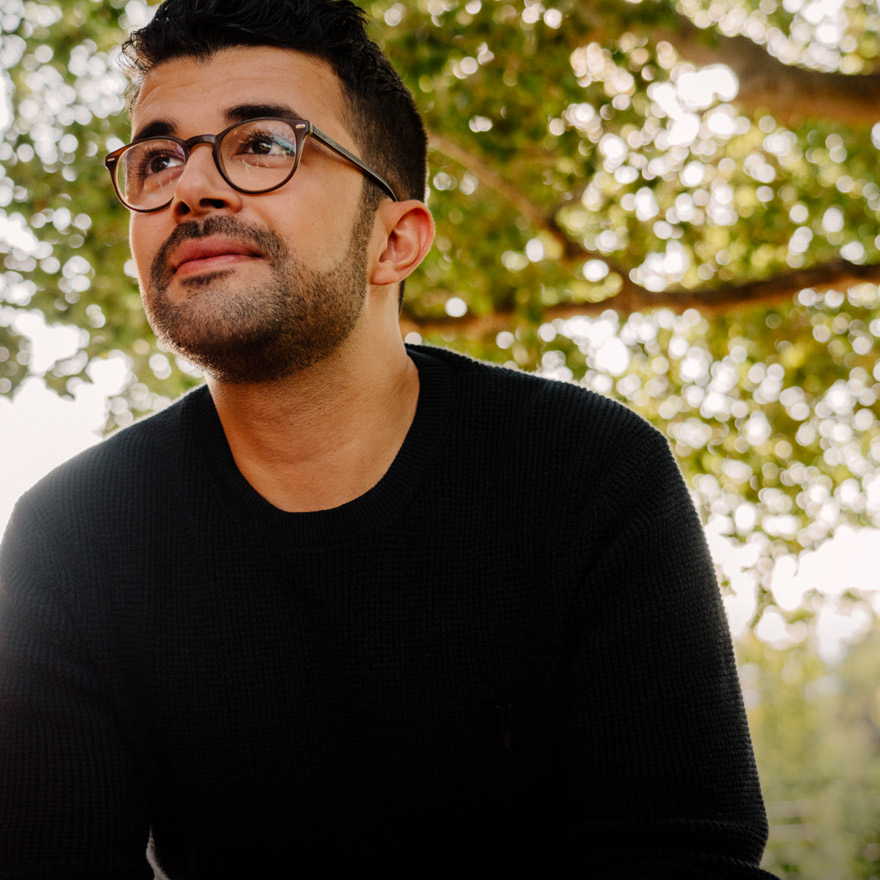
The Gamer Who Learned to Bet on Founders
There's a version of Anas Biad's story that starts with Sequoia Capital, one of Silicon Valley's most storied firms, hiring a young Moroccan-French mathematician to help build out its European investment operation. That version is accurate. It is also the least interesting place to start.
Start instead in Casablanca, where a teenage Anas Biad was winning local gaming competitions. Not just playing - winning. Between matches, he was teaching himself to build games in Unity. The precision required to compete, the systems thinking that separates a winner from a player, the discipline to keep iterating: all of that got baked in long before he ever read a term sheet.
"Empowering IT teams is one of the most scalable ways to deliver AI automation to the enterprise," Biad said in 2025, when Sequoia led Serval's $75 million Series B at a $1 billion valuation. The sentence is dry and corporate on its surface. Underneath it is the same kind of thinking that wins gaming tournaments: identify the leverage point, scale the effort, win the outcome.
I'm incredibly excited to work with the team to support exceptional founders across Europe, in their journey to building legendary companies from the ground up.
- Anas Biad, on joining Sequoia Capital, May 2021Mathematics at Ecole Polytechnique is not a gentle education. The grande ecole in Palaiseau sits at the top of France's notoriously brutal academic hierarchy. You don't glide through four years of Polytechnique - you earn them. Biad did exactly that, graduating with an MSc in Mathematics around 2016. The curriculum builds people who are comfortable sitting with complexity, who can model messy systems and extract signal from noise.
He then spent two years at Bain & Company, doing strategy and due diligence work for technology companies. Anyone who has done consulting knows it trains a very specific skill: the ability to form a defensible opinion about a business you barely know, very quickly. Biad collected that skill and moved on.
Silver Lake came next, in March 2019. The large-cap technology-focused private equity firm gave him direct exposure to European technology deals at scale. He spent two years there before making the jump that changed the trajectory: in May 2021, he joined Sequoia Capital as a Partner, becoming one of the first three European partners the firm had ever appointed.
Biad joined Sequoia as it was deliberately and deliberately expanding its European presence - not as a satellite office, but as a genuine commitment to founder-led companies building from London, Paris, Berlin, and beyond.
Luciana Lixandru, who had been Sequoia's first European partner, welcomed him to the team. The signal was clear: this wasn't a gesture. It was infrastructure. Sequoia wanted someone who understood European founders from the inside - the funding landscapes, the cultural rhythms, the ambition that often stays quiet until it isn't.
Biad's focus areas at Sequoia - enterprise software, AI, SaaS, gaming, fintech - are not arbitrary. They map almost exactly to the sectors where his personal curiosity runs deepest. He is, as he has noted publicly, a gamer himself. That is not a footnote; it is a sourcing advantage. You notice things about a market differently when you participate in it.
Richard Feynman, who Biad cites as a role model, once said that if you can't explain something simply, you don't understand it yet. Feynman was drawn to things as they actually are, not as they sound in a press release. That instinct - build understanding from first principles, cut the noise - shows up in how Biad talks about his investments.
When he announced Sequoia's lead on Serval's Series B, he didn't describe Serval as an "AI-enabled enterprise workflow optimization platform" or some other glossy abstraction. He explained what Serval actually does: provides both an AI system of automation and an ITSM system of record. Two things, clearly stated. Feynman would approve.
His interest in quantum computing is less about chasing hype and more about genuine intellectual curiosity - the same curiosity that pushed him through four years of Polytechnique mathematics. Quantum computing is one of the few technological domains where mathematical intuition, rather than product intuition, is the primary advantage. For someone with Biad's training, it's a natural obsession.
Check Size Range
$10M - $200M
Sweet Spot
$25M
Stage Focus
Seed - Series B
Geographic Focus
Europe
His most notable recent bets tell a clear story. Profound - AI-powered search and analytics for marketers - captures the intersection of enterprise workflow and intelligence. Serval - the AI-native ITSM platform that reached unicorn status in 2025 - is a bet on IT teams as the internal distribution engine for enterprise AI. Both deals share a thesis: the most durable AI businesses are not consumer-facing chatbots but the infrastructure that makes entire departments smarter.
Biad came to Sequoia from a world of large-cap private equity, where deals move slowly and the emphasis is on margin, moat, and management. Venture is different: faster, more uncertain, more relational. The adjustment is real. What appears not to have changed is the underlying intellectual framework - find the systems that scale, understand them from first principles, back the people who built them.
He is based in Marylebone, in Sequoia's London office. The choice of London as Europe's hub for one of the world's most prestigious venture firms is itself a statement about where the firm believes the next generation of enduring companies will come from. Biad, who grew up between Casablanca and Paris before landing in the English capital, embodies the transatlantic, cross-cultural character of that bet.
We at Sequoia are leading Serval's Series B. Empowering IT teams is one of the most scalable ways to deliver AI automation to the enterprise.
- Anas Biad, announcing Serval's $75M Series B, 2025There is something worth noting about how he got here that the usual bio obscures. The path from Casablanca gaming competitions to Ecole Polytechnique to Bain to Silver Lake to Sequoia is not a straight line drawn by someone who always knew what they wanted. It is the path of someone who kept finding the next hard problem and walking toward it. That quality - toward the hard problem, not away from it - is probably the most important thing a venture investor can have.
He is not prolific on social media by VC standards. His tweets tend to be deal announcements or pointed observations about enterprise AI. He does not post thought leadership threads or build a personal brand through hot takes. The signal-to-noise ratio is deliberately high. That too, feels consistent with someone trained in mathematics: precision over volume.
Europe's best founders are building in a moment where AI is reshaping every enterprise workflow, where the next wave of unicorns will be born in London, Paris, Berlin, Amsterdam, and Stockholm. Anas Biad, with his odd combination of mathematics, gaming instincts, consulting pattern-recognition, and private equity rigour, is positioned to back the ones that last. Not because he has the best brand. Because he can do the math.
Won gaming competitions in Casablanca, Morocco as a teenager
Built video games using Unity before pivoting to finance and venture
Richard Feynman is his intellectual role model - admired for learning, problem-solving, and engaging others
One of only three founding European partners at Sequoia Capital
Has a Mathematics MSc from Ecole Polytechnique - one of the world's most elite STEM programs
Deeply interested in quantum computing as a future frontier for investment and science