At Calvi, a business software company, the revealing number was sixteen. That was the minimum number of hours a month that Sectigo’s customer case study says its certificate-management solution saved compared with alternatives. Calvi managed roughly seventy certificates. Seventy sounds manageable, until each credential brings its own renewal, validation and installation work. The small chore had acquired a calendar of its own.
- Sectigo issues digital certificates and automates their upkeep.
- Its enterprise platform manages public and private certificates across supported authorities.
- Shorter certificate lifetimes make manual renewal a more demanding job.
The reminder became the job
Calvi’s problem began with manual processes that became inefficient and error-prone as the company grew. It adopted Sectigo Certificate Manager, used the ACME automation protocol and worked with Azure Key Vault to secure keys. Sectigo also helped issue a root certificate authority for a customer and integrate it with that vault.
The choice had an interesting wrinkle: Sectigo was not the cheapest option upfront. In the vendor’s account, faster onboarding and recovered staff time made the difference. That is a useful purchasing question for anyone evaluating infrastructure software. How much does it cost to buy? Then: how much work remains after buying it?
A certificate is a perishable credential
A digital certificate binds an identity to a cryptographic public key. On the public web, it helps a browser establish that it is talking to the intended site and set up a protected connection. Inside an organization, certificates can identify users, devices and workloads. Each has a lifetime. Expiration is part of the design.
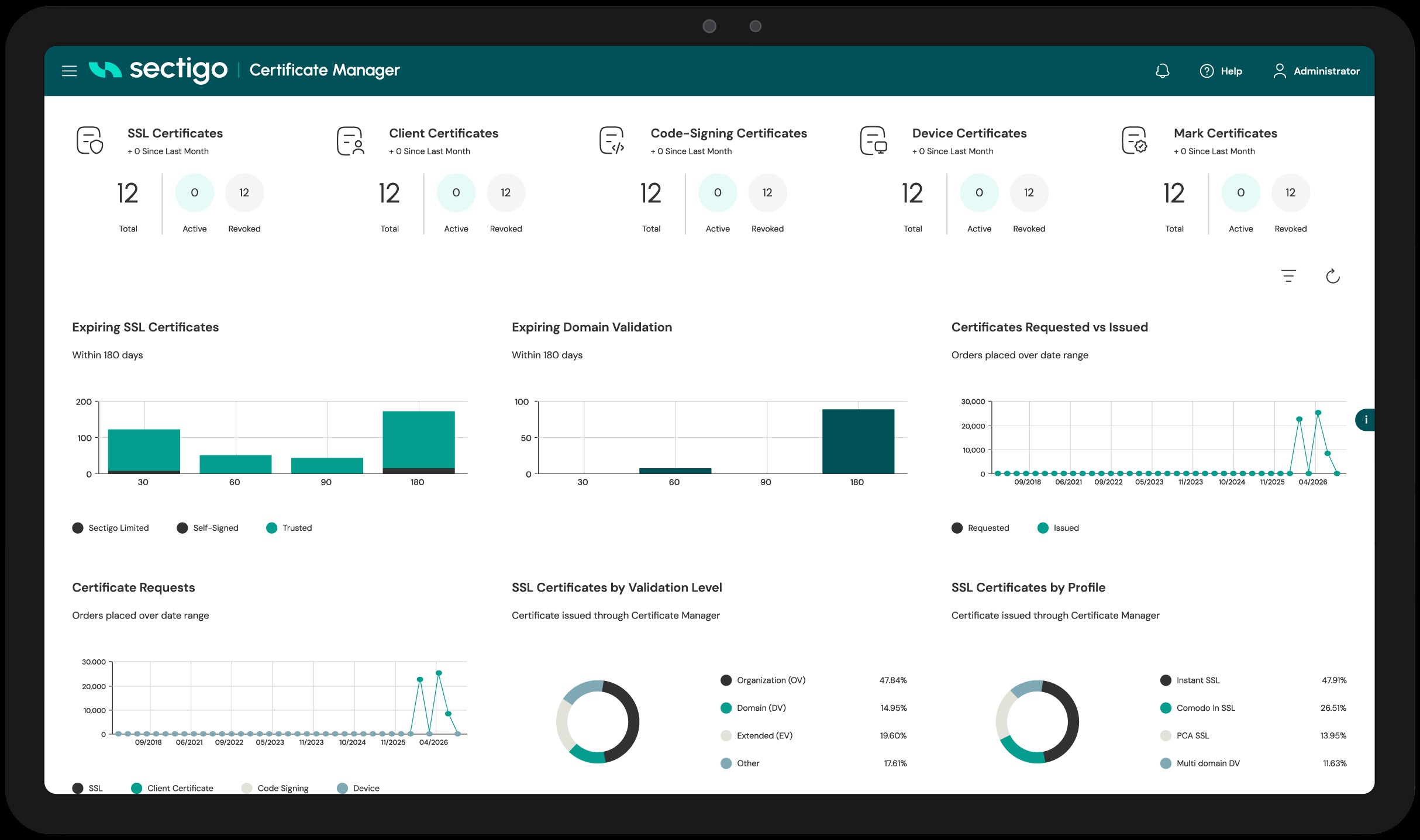
Sectigo occupies two positions in this system. It is a certificate authority, issuing credentials, and a software provider, helping customers look after them. Its catalog includes SSL/TLS certificates, code signing, S/MIME email certificates and private PKI services. Certificate Manager supplies discovery, inventory, issuance, deployment, monitoring and renewal. The commercial opportunity lives in making those steps repeatable.
The clock gets smaller
The CA/Browser Forum’s rules make the timing unusually consequential. For newly issued, publicly trusted TLS server certificates, the maximum lifetime fell to 200 days in March 2026. It falls to 100 days in March 2027, then 47 days in March 2029. These limits concern public TLS server certificates; they do not impose one universal schedule on every private certificate.
*Changes take effect March 15 of each year shown. Maximum validity is a ceiling, not a recommended renewal interval.
The arithmetic changes the character of the work. At the maximum lifetime, a continuously covered endpoint moves from roughly one replacement a year to about eight. Actual renewal schedules need headroom. Multiply that across a company’s systems and the calendar starts looking crowded. Software can repeat the process; a reminder merely asks someone else to repeat it.
The price of remembering
Sectigo sells certificates directly and through partners, alongside recurring management software and services. Its smaller-business product, SCM Pro, publishes monthly prices of $25 for Basic, $100 for Plus and $225 for Advanced. Annual options are available. Those are advertised plan prices checked in October 2026, with different domain capacities and features.
There is a distinction worth reading before reaching for a card: Basic includes manual issuance and management; ACME automation starts with Plus. Enterprise SCM, intended for more complex environments and multi-CA management, requires a sales quote. A price comparison therefore needs to include the workflow being purchased, the systems it reaches and the staff time it actually removes.
One console, several authorities
At the University of Colorado Boulder, the scale was different. Sectigo’s case study says the university adopted an early Certificate Manager version in 2009 to manage more than 2,800 certificates. A central dashboard, domain verification and email alerts helped staff handle issuance and expiration. The campus example makes the organizational benefit visible: many credentials, one place to see the work.
“saved the day and made life easy”Chris Snell · Identity & Access Management Architect, Darling Ingredients
Sectigo describes enterprise SCM as CA-agnostic. That lets the management layer span supported certificate authorities instead of forcing every certificate into one issuer’s inventory. DigiCert Trust Lifecycle Manager and Keyfactor Command compete for similar management work. The distinction to test is practical: can a platform discover your certificates and carry replacements all the way into your actual infrastructure?
For a straightforward website, free automated certificates from Let’s Encrypt may already solve the problem. Enterprise management becomes more persuasive when public and private identities, multiple teams, policy requirements and different deployment targets accumulate. Even then, a dashboard cannot confer missing permissions or make an unsupported appliance accept a replacement. A trial should prove a complete renewal on the systems that matter.
The name changed. The work expanded.
Sectigo traces its roots to Comodo CA in 1998. Francisco Partners acquired the certificate business in 2017; the Sectigo name followed in 2018. The separation created enough confusion that the company later publicly clarified that Sectigo and Comodo were separate businesses. GI Partners acquired Sectigo in September 2020.
In January 2025, Sectigo bought Entrust’s public certificate business, saying the purchase doubled its enterprise footprint. The accompanying migration involved customer accounts, certificate inventories and domains moving to Sectigo’s platform. This was expansion with an operational obligation attached. By May 2026, its refreshed positioning emphasized coordinated visibility, control and automation under the phrase “Simplicity at Scale.”
A rehearsal for the next algorithm
The next change involves cryptography itself. Sectigo launched PQC Labs with Crypto4A in February 2025, providing a sandbox for testing post-quantum certificates. That is a concrete task teams can undertake before production migration: discover what they have, then test whether replacements work with their systems.
The lesson from Calvi travels well beyond certificates. Count the recurring work, assign ownership and automate a whole cycle before expanding. Sectigo’s appeal rests on that unglamorous completion. A credential gets renewed, the service keeps running, and nobody outside the operations team has a reason to notice.