In 1984, a new software company in Berkeley needed a computer. The machine it wanted cost more than $10,000. The founders had put up $500, which had already gone toward incorporation, blank stock certificates, and an embosser. They offered Sun Microsystems something they did have: a port of Franz Lisp to a Sun workstation. In return, Sun gave them a machine. Fritz Kunze and John Foderaro drove down to collect it the same day, worried the bargain might evaporate.
That is a tidy origin story, but it contains the business model too. Franz Inc. was formed to make a widely distributed research language dependable for people who could not afford a research project every time they wanted to ship software. The product was technical skill made available on commercial terms. The first asset arrived because someone needed that skill badly enough to pay in hardware.
- Franz sells AllegroGraph, a database for connected facts, and Allegro CL, a Common Lisp development system.
- Its buyers include teams in telecommunications, healthcare, life sciences, intelligence, and other data-heavy organizations.
- A free AllegroGraph edition allows up to five million RDF triples; larger deployments require a license.
- The practical lesson from its history: fund a hard technical shift with a real customer problem.
The composer and the computer
Franz Lisp began at UC Berkeley as part of the effort to run Macsyma, a symbolic mathematics program, on more accessible computers. Its name nodded to composer Franz Liszt. By the mid-1980s, the language had traveled with Berkeley Unix to universities and laboratories. Kunze saw the opening: researchers were good at research, but commercial users needed ports, maintenance, and direct support. He joined Foderaro, Kevin Layer, and Keith Sklower to start Franz.
The opening almost closed immediately. The US Department of Defense pressed the Lisp community toward a common standard, while Lucid, a rival backed by roughly $25 million in government and venture money, moved quickly into the market. Franz Lisp would need a major rebuild. Franz’s own history describes losing access to contracts and influence as the new standard took shape. This was the first failure: the original product’s market was disappearing before the small company had established itself.
“There was no money to buy the computers they needed.”Franz’s account of its early days
The founders sent Foderaro home for a year to write a Common Lisp implementation from scratch. Tektronix, which wanted Lisp for an AI machine, became the contract that kept Franz in business. Franz offered a two-stage deal: its existing Lisp first, the new Common Lisp later. By the end of 1986 the new implementation was ready; in 1988 it took the name Allegro CL. A crisis had forced a product change, and a customer had paid for the bridge.
When the relationships became the product
Today, Franz has two distinct lines. Allegro CL remains a commercial Common Lisp implementation for building and maintaining demanding applications. AllegroGraph is an RDF graph database: it stores facts as relationships, commonly expressed as subject, predicate, and object. “A company supplies a hospital” is one fact. “That hospital sits in a flood zone” is another. A graph lets a query follow the connection between them. The point is less a prettier diagram than a question that would otherwise demand awkward joins across unrelated systems.
AllegroGraph supports SPARQL queries, Prolog reasoning, and temporal and geospatial analysis. Gruff, its visual browser, lets users inspect the network and build queries graphically. Franz has also added vector storage and integrations with large language models. That combination is its current pitch: similarity search can find a relevant passage; the graph can express what the passage is about, how entities relate, and where a rule or answer came from. Those are capabilities, not a guarantee that an AI answer is correct. Data still has to be modeled, checked, and kept current.
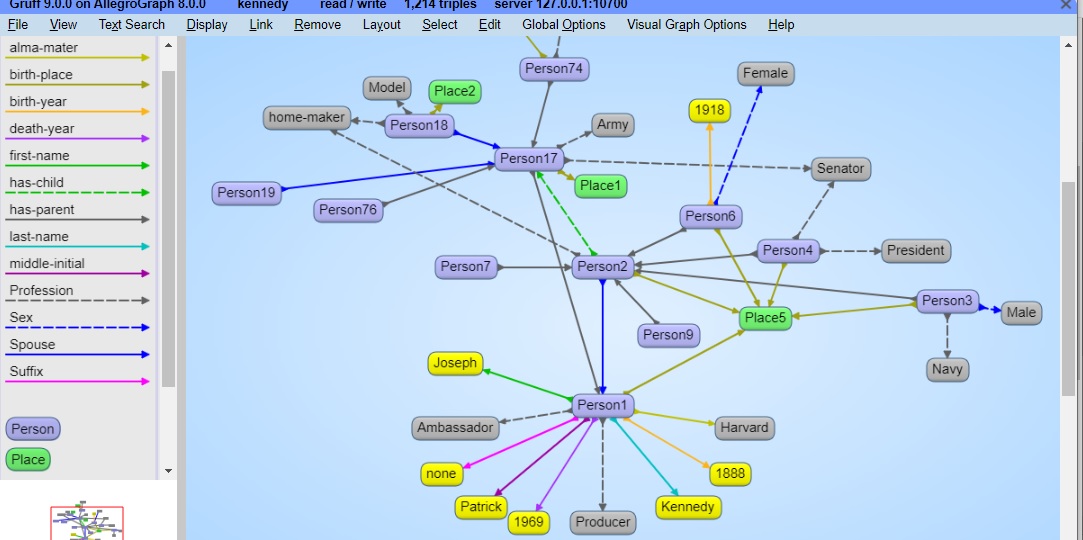
Expand the model only when the next question earns it.
Who pays for a map of facts?
Franz sells to organizations whose information is spread across systems and whose questions cross the boundaries. Its public customer material names Lucent Technologies as a long-term Allegro CL licensee. Tohoku Medical Megabank licensed AllegroGraph in 2014. Franz also points to Montefiore Medical Center’s semantic data lake work with Intel, and to Noblis’s ontology-based work in defense and intelligence. The examples differ in field but share a nuisance: the answer depends on connections that a single table does not hold.
The company makes money from software licenses and services. AllegroGraph’s free edition is capped at five million triples, the developer edition at 50 million, and the enterprise edition is listed as unlimited. Hosted options and cloud marketplaces are also available. Franz publishes no simple enterprise price on its download pages, so a buyer should budget for the license, data preparation, ontology design, integration, and upkeep. The license is only one line in the cost of making facts agree.
This is also where Franz differs from many graph pitches. Its roots are in language tooling and reasoning, not simply drawing a network. It uses the RDF and SPARQL standards to make data interoperable, while pairing symbolic rules with newer vector search. Alternatives include other RDF platforms such as Stardog and GraphDB, property graph systems such as Neo4j, and cloud services such as Amazon Neptune. A buyer’s choice turns on data model, queries, security, deployment, and the people available to maintain the graph. A team with one clean dataset and straightforward lookups may need no graph database at all.
A record is not a verdict
In 2011, Franz announced that AllegroGraph had loaded and queried one trillion RDF statements, with support from Intel and Stillwater SuperComputing. It was an impressive engineering demonstration, but it was a demonstration. Scale in a benchmark does not tell you whether your messy customer identifiers reconcile, whether a clinician trusts a match, or whether an analyst can explain a result six months later. The real test is what happens when the graph meets a decision.
That is the most useful idea to copy from Franz’s long run. Its founders did not begin with a grand new market. They found users of a free tool who needed dependable support. When a standard threatened that market, they rebuilt the product and found a customer to finance the transition. For a knowledge graph project today, the parallel is clear: start with a question expensive enough that someone will pay to answer it, model only the relationships needed, and prove the result in the user’s workflow. If the source data is unreliable or nobody will maintain the model, the graph becomes a handsome map of old mistakes.
Franz has lasted from VAX machines to LLMs because the machinery keeps changing while the inconvenience persists. People have more data than they can sensibly join. A database can store the connections; a language can describe them; a person still has to decide which ones mean something. Franz’s business has always lived in that last, stubborn step.