audience-targeting
(23)
Cadent wants your screens to talk.
The audience moved. The advertising budget got stuck. Cadent is stitching TV, streaming, digital, and YouTube into a system that can follow the money - and change where it goes.
Multiview found the buyers already in the room.
Professional associations had the readers. Advertisers wanted their attention. Multiview built a business connecting the two - and now puts that network behind an AI-assisted audience finder.
Adstra wants you to know who’s who.
One customer can look like five strangers in a marketing database. Adstra connects the dots - and lets brands decide how much to trust the connection.
Choozle puts the buyer back in charge
Buying an ad is easy. Knowing what you bought is harder. Choozle has built its business around giving smaller agencies a clearer view of the machinery.
OpenX bets better advertising starts before the bid
The ad exchange moved its machinery into Google’s cloud, then moved more decisions toward the publisher. Its wager: the route to an audience can matter as much as the audience itself.

Vistar Media taught the billboard to wait for rain
A cold day in Salt Lake City becomes an invitation to Hawaii. Behind that small act of persuasion sits Vistar Media’s larger business: making outdoor advertising easier to buy, sell and run.

C1X and the Price of a Promise
A Silicon Valley ad exchange built a business around a deceptively hard question: can a buyer reserve a real audience, on a real publisher, without losing the plot in the machinery between them?
The Button That Ate the Marketing Funnel
Shopalyst began with a small, audacious idea: let a shopper buy wherever desire strikes. A decade later, that button has expanded into an operating system for the messy distance between an ad and a sale.
The Agency Built for the Places the Spreadsheet Flattens
The Collective Agency began with a stubborn observation: Latin America is a region, but it is not one market. Its answer is a network that shares tools and senior talent without sanding away the local details.

The Video Call That Became a 14-Billion-Request Ad Machine
When streaming costs outran ooVoo's advertising income, two operators kept the useful part: the machinery for finding, checking and selling attention. Krush Media is what happened next.
The Chambers Group knows where the audience is hiding
From supermarket packaging to celebrity feeds and hotel-room televisions, this family agency follows attention wherever it goes. Its most revealing sales pitch comes with a $498,000 email bill.
INVIDI Put Digital Ad Logic Inside Television - Now It Has to Make Every Screen Behave
The Princeton ad-tech company made the old television set act a little more like the internet without turning the viewer into the product. Its next trick is harder: carrying that precision across streaming, live sports and hundreds of millions of boxes that are not even online.
The Company That Reverse-Engineered America's Closet
Rob McGovern built a database of what 99% of American shoppers actually like to wear. Now fashion brands rent it to stop wasting ad money on people who were never going to buy.

InMarket Wants to Measure What Happens After the Ad
The Austin marketing platform follows advertising beyond the click - into stores, shopping baskets and sales reports. Its bet is that marketers will pay for evidence of outcomes, not another dashboard of impressions.

Ogury
Ogury is betting that advertisers can understand people without following them. Its persona-based system turns surveys and contextual signals into campaigns across the open internet - a pragmatic answer to the slow collapse of cookies and mobile IDs.
Adsquare
Adsquare is a Berlin-based location intelligence company that turns real-world movement and behaviour into audience data marketers can use to plan, target, optimize and measure advertising campaigns. Founded in 2012, its mobile-first data exchange connects location, app-usage, demographic and offline signals to leading DSPs, SSPs and CDPs, powering geocontextual, proximity and audience targeting across mobile, online and digital out-of-home (DOOH). The platform is built privacy-first around consent-based signals and serves thousands of advertisers and dozens of platform partners across Europe, North America and Asia-Pacific.

Dstillery
Dstillery is a New York-based predictive AI audience-targeting company for the advertising industry. It builds custom, model-driven audiences that let brands and agencies reach the right consumers programmatically, including through its patented ID-free cookieless technology and its DS-1 agentic AI platform that turns audience building into a natural-language chat. It works across major demand-side platforms such as The Trade Desk, Yahoo, and Microsoft Advertising, and counts a large share of the Fortune 100 among its users.

Proxima
Proxima is a New York-based predictive data intelligence platform that helps consumer and DTC brands find high-value customers and scale paid media efficiently. It turns billions of anonymized ecommerce transactions from a proprietary network of tens of millions of shoppers into AI-powered audiences, conversion attribution, creative guidance, and industry benchmarks across Meta, TikTok, and Google. Founded in 2022 by Alex Song, the company raised a $12M Series A in April 2024 led by Mucker Capital.

Simulmedia
Simulmedia is a New York adtech company that turns TV advertising into a measurable, performance channel. Founded in 2008 by Dave Morgan, it pioneered data-driven linear TV and now spans streaming, cable, broadcast, and in-game inventory through its TV+ media-buying platform, Skybeam self-serve tool, and PlayerWON in-game ad product. Its software plans, activates, optimizes, and measures campaigns across screens, backing managed buys with delivery guarantees and closed-loop measurement so advertisers of any size can reach and prove TV audiences.
The Brief
The Brief is an AI marketing platform that runs the full advertising campaign lifecycle - discovering competitor and market signals, creating ads at scale, launching them across channels, and optimizing performance - through a system of four AI agents. Formerly the ad-design tool Creatopy, the company rebranded to The Brief in October 2025 to position itself as an 'AI agency' for in-house marketing teams and agencies, and reports nearly 10,000 brands using the platform.
Primer
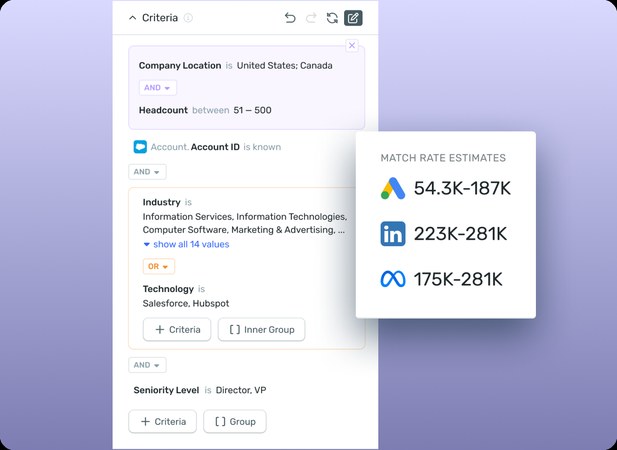
Primer turns a company's ideal customer profile or account list into high-match B2B audiences and pushes them across consumer ad channels like Meta, Google, LinkedIn and Reddit, then measures real pipeline impact with website de-anonymization and holdout testing. Founded in 2019 and based in San Francisco, Primer resolves identities and runs enrichment waterfalls to deliver 3-5x better match rates than CSV uploads, helping growth and ABM teams prove advertising ROI instead of guessing at it.

Scalify
Scalify is an AI-powered ad management and automation platform that lets businesses launch, analyze, optimize, and scale Facebook, Instagram, TikTok, and Google ads from a single dashboard. Built originally as a Shopify app for e-commerce and dropshipping store owners, it automates the grunt work of media buying - building hundreds of custom and lookalike audiences in seconds, generating ad creatives and copy with AI, running 24/7 rule-based optimization, and shifting budget toward winning ads - so smaller brands can advertise like they have an in-house agency without the agency price tag.

LiveRamp
LiveRamp is a data collaboration platform that helps companies connect, control, and activate their first-party data across the marketing and advertising ecosystem without giving up control of it. Born from the simple idea of an 'on-ramp' that links offline customer records to online channels, LiveRamp now runs a privacy-centric identity graph (RampID) and a cloud-native data clean room used by brands, agencies, retail media networks, and publishers to match, measure, and monetize data securely.