In 2012, Choozle was working on media creation. Two years later, it changed direction. Customers wanted to buy the media, too, and to have the data and analytics alongside the transaction. A tool for one part of the process had run into demand for the rest of it. There is a useful business lesson hiding in that request: sometimes the feature your customer keeps asking for is the business.
- Advertising software and media expertise for independent agencies and growth brands.
- Access to buying technology including The Trade Desk and Amazon DSP.
- A choice of self-service or managed campaigns, with real media-budget requirements.
The customer wanted the rest of the job
Andrew Fischer and Jeffrey Finch founded Choozle in Denver. Its early connections included Galvanize, the coworking community where the founders met people who helped shape the product. Colorado data company iBehavior became an early partner. The origin is pleasantly unglamorous: useful proximity, useful introductions, a product taking shape through conversation.
The 2014 pivot put programmatic buying at the center. Programmatic means software purchases advertising placements using campaign rules, audiences and bids. Choozle wanted medium-sized agencies and advertisers to operate that machinery themselves. The pitch required some explanation in a market accustomed to handing execution to somebody else. Access was one problem; persuading customers to take the controls was another.
By 2017, Choozle ranked No. 113 on the Inc. 5000. A $6 million Series B, led by Gemini Group, supplied more room to grow. In 2021, Boathouse Capital invested $15 million in a Series C aimed at product innovation and commercial expansion. The continuing bet was that the middle of the advertising market deserved tools it could actually operate.
Borrow the engine. Keep the controls.
Think of an independent agency with several clients and a modest operations team. One client wants television screens; another needs display ads; a third wants to reach shoppers. Each demand can introduce a new platform, audience definition and reporting routine. The workload expands even when the team does not.
Choozle connects buying technology, including The Trade Desk and Amazon DSP, with campaign management and reporting. Users can organize multiple advertisers, onboard customer data through LiveRamp, select targeting tactics and follow spending and performance. Its optimization tools can adjust bidding across dimensions of a campaign. That is a practical collection of jobs for someone who otherwise has to move between systems.
- 01Find the audienceCustomer data + targeting
- 02Activate the mediaConnected buying platforms
- 03Review. Adjust.Spend + campaign outcomes
Conceptual workflow, not a product screenshot.
Its position is interesting because some names a buyer might regard as alternatives also supply the underlying technology. Choozle offers a route into those systems with its own interface and support. Basis, StackAdapt and Simpli.fi sit in the wider competitive set. The choice turns partly on which workflows an agency needs and how much specialist work it can absorb.
The price of taking the wheel
Here the numbers deserve to be separated. Choozle’s billing guide lists a $99 monthly subscription. It also requires $15,000 in media spending per quarter. The self-service offering includes unlimited advertiser accounts and training resources. The managed offering lists a $10,000 monthly media minimum and a dedicated account manager. Subscription, media and services belong in different columns of the buyer’s calculation.
Media spending is additional
Per quarter
Per month
Public guide figures checked October 2026. Additional features and services can carry charges; confirm the applicable agreement.
Self-service also assigns work to the customer. Somebody must prepare creative, decide what counts as a conversion and watch the campaign. Choozle recommends completing its approximately 45-minute Academy overview before the setup call. That small instruction reveals something about the product: an accessible interface still benefits from an educated operator.
There are boundaries to the single-platform promise. Search and social are managed services only. The social advertising knowledge base says those campaigns run outside the standard platform, with weekly performance reporting. A team choosing Choozle should map its actual channel requirements to the available operating model before treating every task as self-service.
A sofa, a funnel, a useful number
Havenly, the online interior-design business, offers a concrete example. Its published case study describes bringing display buying into self-service to gain more control. The team split targeting across stages of the customer journey, combining prospecting, connected television and retargeting. The organizing idea was to give different audiences different jobs within the campaign.
The case study reports a $13.36 average cost per acquisition. Those figures describe one customer’s experience; changing targeting, execution and timing prevents a neat causal verdict about the software alone. The useful thing to copy is the discipline: state the audience, assign each tactic a purpose and decide what the result will mean before the campaign starts.
The human still has a job
Tina Starr became CEO in December 2025, following her role as executive vice president of revenue. Her appointment announcement describes bringing sales, account management and media solutions into one organization. That is a revealing operational choice for a company selling both a tool and help using it.
“I call it a cyborg approach, where people remain at the center and technology extends their impact.”
Tina Starr / CEO appointment, December 2025
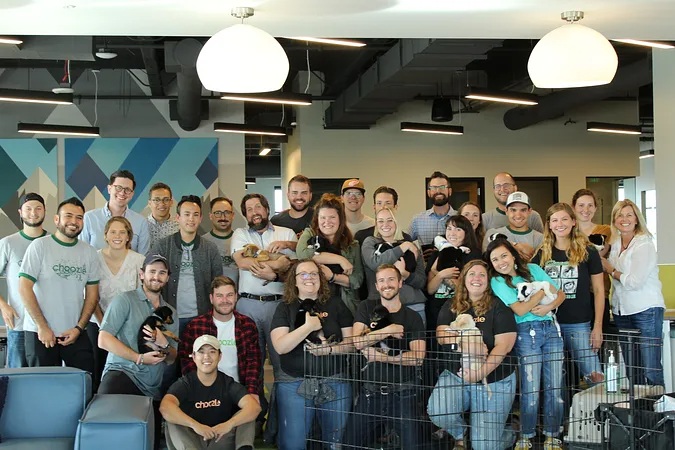
Choozle now describes itself as remote-first, with employees across the United States. Its benefits include paid volunteering and connectivity support; onboarding offers a buddy system. The office photographs belong to an earlier chapter, but the emphasis on people continues in the current product pitch.
In May 2026, Choozle expanded its Amazon DSP offering with more campaign management, audience-building and conversion-tracking workflows inside its platform. The change addresses a recurring cost of advertising work: moving between tools to finish one job. It also returns the company to the customer request behind its original pivot.
For a buyer, the final question is practical. Can the team meet the spend requirements, operate the campaigns and judge the results? A tiny test budget may fall below the published thresholds. A team without time for execution may need managed help. Choozle’s proposition is most useful when access, responsibility and measurement are settled together.