Your thumb is a difficult customer. It can dismiss an advertisement before the advertiser has finished congratulating itself on reaching you. It can also hesitate, reverse direction or linger over a product. Yieldmo has spent years building a business around the possibility that these little movements say something useful. The click gets the applause. The pause may contain the better clue.
That idea now sits inside a broader proposition: an ad’s design and its surroundings should be chosen together. Yieldmo supplies the technology, creative services and publisher connections to make that happen. Brands and agencies buy campaigns; publishers supply the places those campaigns appear. The company’s task is to make the match worth more than an anonymous rectangle on a screen.
In June 2026, it announced an expansion of YMax.ai, bringing pre-bid inventory intelligence and predictive creative into the foreground. Buyers can examine individual page URLs and expected performance before activation. For an industry exceptionally good at generating reports after money has disappeared, the timing of that information is part of the attraction.
A company built between the view and the click
Michael Yavonditte, Rick Eaton, Teddy Jawde and Todd Coleman founded Yieldmo in 2012. Yavonditte had previously led contextual advertising company Quigo through its acquisition by AOL. Eaton had been Quigo’s finance chief. They arrived with experience in the mechanics of advertising businesses, then applied it to the awkward relationship between mobile screens and the ads squeezed onto them.
Money followed. Google Ventures led an $8 million Series B in December 2013. A $10 million Series C led by Time Warner Investments arrived in October 2014, with existing investors participating. That financing supported two revealing priorities: an Ad Format Lab and a Private Mobile Marketplace. Yieldmo was developing the thing people saw and the system that sold it.
Early reporting described a design team sketching mobile formats each morning. That creative emphasis has survived several generations of ad tech terminology. A Hyperscroller, for example, makes the advertisement move with the reader’s scrolling. The medium is doing some of the work. A thumb becomes part of the presentation, instead of merely the instrument used to escape it.
By June 2018, Yieldmo was putting an engagement analytics platform into closed beta. The limitation it was addressing was straightforward: clicks reveal the behavior of a small fraction of the people exposed to a campaign. Gestural information offered a larger pool of observations. In a test described at the time, agency PHD’s automotive audience was twice as likely to take the desired action when optimized around engagement measures.
That was evidence for paying attention to the interval before a click. It was also a change in what advertisers could ask of an impression. Did it appear? Had anyone spent time with it? Was that behavior associated with a later action? Those questions demand different measurements, and their answers should not be treated as interchangeable.
“Advertisers no longer want to buy audiences blindly.”
Eddie Ishak · Chief Experience Officer · June 2026
The page gets a vote
YMax.ai turns that history into a buying workflow. An advertiser can begin with a brief, an image or a landing page. The system identifies relevant inventory at the article level, groups it into campaign-specific segments and provides forecasts. Those packages can travel into an existing demand-side platform through a Deal ID, the identifier that makes a curated collection of ad opportunities buyable.
The distinction matters. A broad category such as sports can contain a training guide, a contract dispute and last night’s score. They share a subject without offering the same setting for a running-shoe advertisement. Yieldmo’s semantic and sentiment analysis attempts to make those distinctions before a buyer commits money.
A conceptual guide to Yieldmo’s workflow, not a performance forecast.
Companion Audiences adds another route to reach. It uses a seed audience to identify promising content environments, then activates against those environments without requiring cookies or device IDs for that targeting. YMax+ offers a managed-service route using Yieldmo’s own bidder. The practical choice is how much of the execution a buyer wants Yieldmo to handle.
The studio remains central. Creativelab works across strategy, art direction, motion and interactivity, adapting existing assets or starting from a brief. Its public materials describe more than 175,000 creatives delivered and a library of over 30 formats. Predictive selection then chooses among variants for an impression. This is a production operation as well as a modeling exercise.
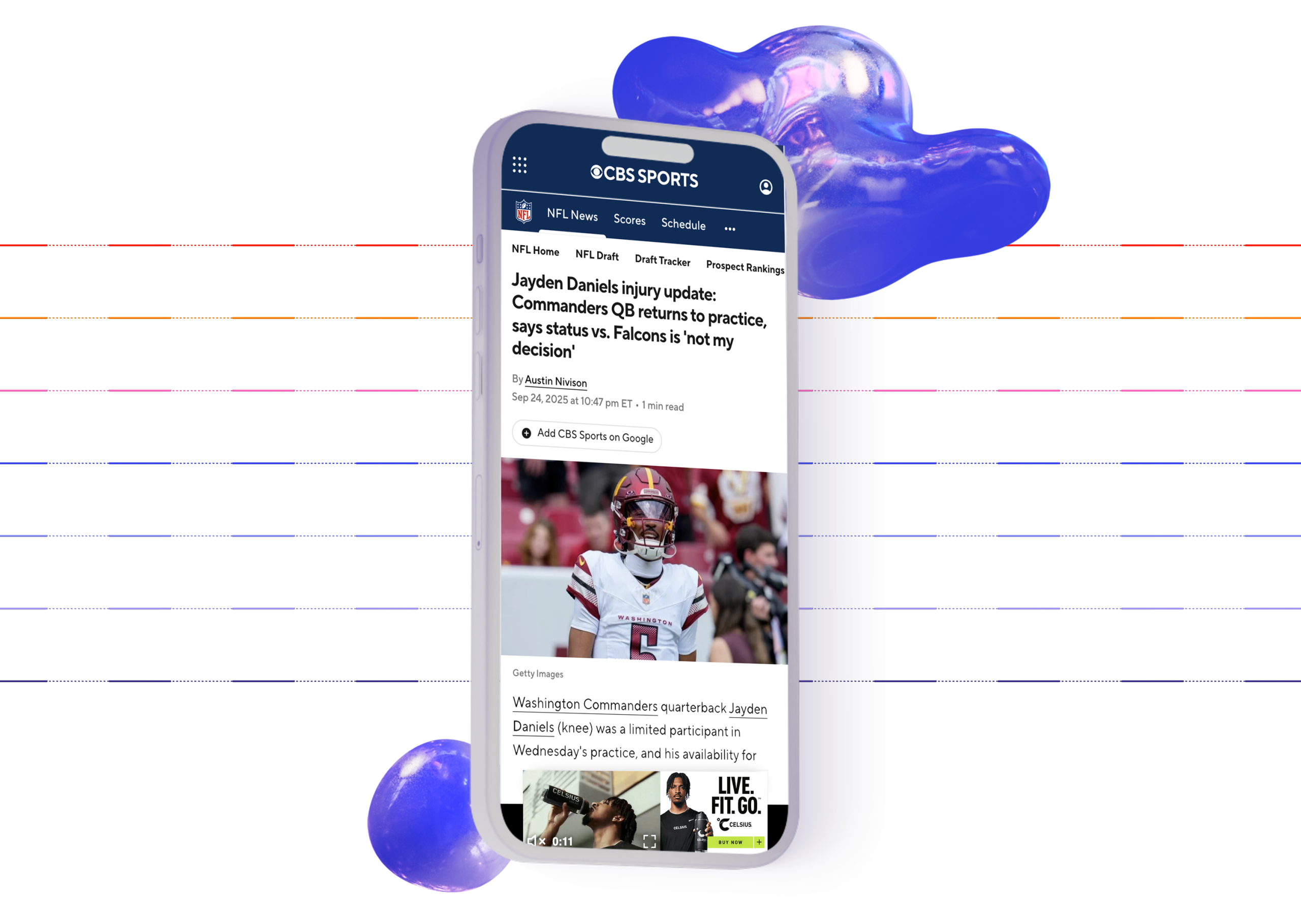
The format names provide some relief from the acronyms. Lookbook uses interactive product hotspots. Pinhole incorporates a scroll-to-reveal overlay. Megashopper combines video with shoppable content. Yieldmo’s technology catalog lists patents covering these experiences and the measurement behind them. The commercial argument is that distinctive presentation, informed by performance data, can give a publisher something more interesting to sell.
A restaurant test with a price attached
Jack’s Family Restaurants supplies a more tangible example than another promise about AI. According to Yieldmo’s case study, the chain began with standard display advertising in one small market. Meeting its initial benchmarks justified expansion into additional markets and larger budget allocations. The rollout earned its next step.
During successive 2024 buying windows, the campaign added Megashopper, Windowplay and Pinhole formats, then Foursquare location-based optimization and custom adhesion creative. The case study reports cost per store visit falling from $2.00 to $1.16 after the Foursquare integration, with an eventual result of $0.73. Jack’s target range was $0.50 to $1.00. Yieldmo also reports an 88% lift in click-through rate.
Company-reported campaign stages. Cost per store visit is not a price list or a measure of incremental profit.
The initial $2.00 figure was above the desired range. What changed was the combination of format, optimization and rollout decisions. Because several things moved, the result does not isolate one feature’s contribution. A measured store visit also differs from an incremental purchase. The useful lesson is the sequence: set a threshold, test locally, adjust, then earn the right to expand.
That sequence offers a way to use Yieldmo without turning a marketing case study into a budget forecast. The buyer needs a commercial outcome, a comparison and a rule for deciding whether the next dollar is warranted. An attractive creative can earn a second look. A test has to establish whether that second look is worth paying for.
The same creative, a different neighborhood
Another Yieldmo case study makes the targeting comparison more explicit. A sportswear brand tested its contextual curation against IAB category targeting while holding creative, inventory pool and budget constant. Yieldmo reports 81% higher click-through rates and 65% lower cost per click. Relevant pages included material on EatingWell and Good Housekeeping, alongside CBS Sports pages missed by the category approach.
Yieldmo’s reported comparison with IAB category targeting. One campaign, not an expected return.
The interesting part is the category boundary. Someone reading about training or nutrition may be a useful prospect for sportswear even when the website does not look like a sports destination. Page-level analysis gives the buyer a chance to discover that mismatch between the label and the actual article.
In a separate sports retailer comparison, Yieldmo reports 33% higher click-through rates and 91% incremental reach against an ID-based audience buy using identical creative. These are vendor-reported campaign findings. They make a case for testing context alongside audience selection; they do not establish that every identity-based campaign is inferior. A relevant article can create an opportunity, but relevance alone cannot prove a sale.
Publishers on one side, sponsors on the other
Yieldmo’s business needs both buyers and places worth buying. It reports more than 450 premium publisher partners. Its advertiser materials name direct supply connections including Hearst, Yahoo, ABC and Raptive. Publishers are offered differentiated demand, creative formats and page-level intelligence intended to improve the value of their inventory. Brands and agencies get a way to assemble those opportunities around campaign goals.
That places Yieldmo across several crowded markets: programmatic supply, contextual targeting and creative services. GumGum and TripleLift are relevant alternatives in that neighborhood. Yieldmo’s differentiating pitch is the combination of proprietary formats, attention information and inventory selection. A buyer evaluating it should compare the whole campaign arrangement, including execution and measurement, rather than treating every vendor’s contextual segment as the same product.
Inventory quality is another part of the job. A HUMAN Security case study describes Yieldmo’s use of fraud protection as its supply expanded. Better prediction is of limited value when the supposed audience includes automated traffic. The marketplace has to establish that an opportunity is real before debating how promising it is.
Sports gives the model a specific commercial use. Pacers Sports & Entertainment’s Fieldhouse Media Network uses YMax.ai in a collaboration developed with Deloitte. In July 2026, Yieldmo and WSC Sports-owned Partnerbrite announced a further partnership: fan-data campaign orchestration from Partnerbrite, contextual distribution from Yieldmo and automated branded content from WSC Sports. The aim is to help rights holders extend sponsor campaigns across digital channels.
Copy the experiment, then check the outcome
There is a human organization behind the automation. Yieldmo’s stated values include autonomy, collaboration, innovation and agility. Its creative roster spans designers, strategists and production specialists. “Grabbing attention in a way that piques curiosity is everything,” says creative strategist Justin Le Roy. That is an unusually plain sentence in a business inclined to make attention sound like a plumbing component.
For a prospective customer, the practical starting point is a brief that connects an audience, a situation and an outcome. A sports retailer could test training-related pages against its existing approach while keeping creative consistent. A restaurant could compare markets against a store-visit target. The discipline is to avoid changing every variable at once and then crediting the most fashionable one.
The approach depends on accessible inventory, useful signals and an outcome that can be measured over the campaign period. A very narrow context may limit delivery. Optimizing clicks can reward curiosity without improving purchases. Campaigns with too few meaningful outcomes may struggle to distinguish improvement from noise. Forecasts help frame a decision; they still need to meet actual results.
Yieldmo’s proposition is appealing because it puts a familiar advertising question back inside the machinery: why should this message matter here? The company can supply formats, forecasts and curated pages. The buyer still has to decide what success means. Your thumb, meanwhile, remains free to keep moving.
See it in motion
Explore Yieldmo, YMax.ai and the creative gallery. Watch Eddie Ishak’s Cannes interview with AdExchanger.
Follow LinkedIn, X, Instagram and Facebook; browse GitHub, the blog and company news.