Before there was a recommendation engine, there was a man carrying paper. In Outbrain’s account of its beginnings, Yaron Galai arrived for a sailing trip with web articles printed out and held together by paperclips. His friend Ori Lahav noticed. Galai had done something the internet was supposed to make unnecessary: assembled his own little magazine. The web had plenty to read. Finding the next worthwhile thing still required work.
- Outbrain turns publisher attention into advertising opportunities.
- Its roughly $900 million Teads purchase expanded the business into more screens and formats.
- Outbrain Direct Response survives inside the renamed group, serving marketers who want measurable action.
A reading list with a business attached
Galai and Lahav founded Outbrain in 2006. Their problem was recognizable to anyone who liked magazines: turning a page brought another story without requiring a new search. Online, an article often ended in a dead end. Outbrain developed recommendations to keep discovery going, eventually mixing editorial suggestions with sponsored links. A reader’s next move became something a publisher could organize and an advertiser could buy.
That explains the familiar boxes beneath articles. They belong to an advertising marketplace, although they look like a reading list. The advertiser supplies a destination and creative. The publisher supplies space and an audience. Outbrain supplies matching, ranking and delivery technology. Its expertise sits in the prediction: which available recommendation is likely to earn this person’s engagement in this particular setting?
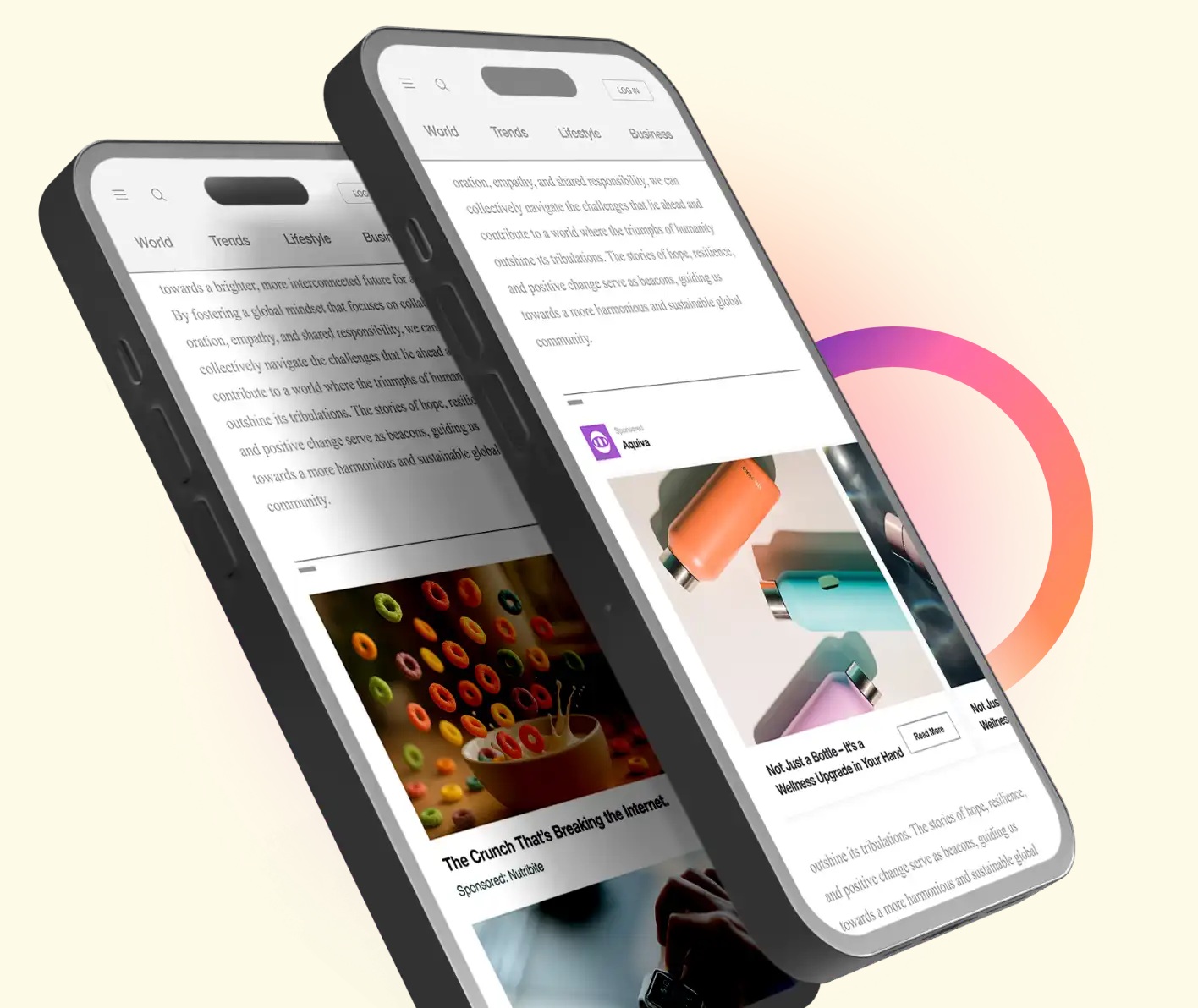
Three customers, one rectangle
The awkward part is that three parties want different things. A publisher wants income and another page view. An advertiser wants a useful visit, lead or sale. A reader wants something worth opening. Improving one number can spoil another: an irresistible headline can earn a click and deliver a disappointing destination. The business depends on keeping those interests close enough that everyone returns.
Historically, much of Outbrain’s advertiser pricing has depended on engagements, commonly clicks. It pays media partners traffic acquisition costs. Consequently, a dollar of reported revenue is not a dollar retained by the platform. Some money belongs to the publisher. This is why advertising-platform accounts distinguish revenue, gross profit and measures that exclude those partner payments.
The current Outbrain Direct Response site features EcoFlow, TORRAS and lead-generation company hipto. These are businesses seeking action beyond the social feed. Unlike a social network, Outbrain distributes recommendations across other publishers’ properties. Those media relationships are central to the offer. Publishers approach from the opposite direction: they have readers and need to fund their work. Smartlogic addresses the presentation problem, dynamically adjusting recommendation formats and layouts rather than giving every visitor the same arrangement.
The reader decides whether the recommendation deserves another click.
The 80-cent decision
In a 2021 explanation of their operating philosophy, the founders offered a revealing hypothetical. Suppose one ad pays a dollar and another pays 80 cents. Choosing the cheaper ad might seem absurd. But if the better experience produces two engagements over time, the platform earns $1.60 instead of $1. The advertiser gets a lower price per engagement; the publisher can earn more from a reader who stays.
That example describes an ambition, not a measured campaign result. It also explains the company’s stated culture. The founders’ public manifesto treats engineering as craftsmanship and asks employees to exercise judgment. The connection is practical: optimizing a feed involves repeated decisions about immediate yield and future trust. A model can make those decisions quickly. Management still chooses what the model should reward.
“To elevate advertising outcomes.”
The combined company’s mission, February 2025
The deal that did not sail
Outbrain’s route beyond the widget was untidy. A planned merger with Taboola, another recommendation-advertising company, came apart in 2020. Galai publicly said the companies had proved too different to combine; he left the confidential details undisclosed. Outbrain went public independently in July 2021, raising $160 million in gross IPO proceeds.
The later strategy widened the product. Onyx, launched in June 2023, pursued brand campaigns through in-article video and high-impact display. Instead of waiting for a click to demonstrate value, it emphasized attention and consideration. The commercial implication was substantial: Outbrain could seek budgets intended to build a brand as well as budgets intended to generate an immediate response.
A new screen, a real bill
On February 3, 2025, Outbrain completed its acquisition of Teads for approximately $900 million, with announced closing consideration of $625 million in cash and 43.75 million shares. Teads brought complementary branding, video and connected-TV capabilities. The combined business adopted Teads as its name. By June, the public parent was Teads Holding Co., trading under TEAD. Outbrain Direct Response remained a business within it.
The financing imposed its own timetable. A February 2025 refinancing issued $637.5 million of senior secured notes carrying a 10% annual coupon. At the original principal, that implies $63.75 million in annual coupon interest before principal changes. This was an expensive expansion. For 2025, the combined group reported $1.3005 billion in revenue and a $517.1 million net loss, including a $352.1 million non-cash goodwill impairment.
Connected-TV revenue grew 67% over the same period.
By August 2026, the evidence remained mixed. Connected-TV revenue was growing, but total second-quarter revenue fell 17% year over year. Teads suspended guidance amid volatility in Direct Response and small-business demand. September’s Koddi partnership opened another route, programmatic retail media. The strategic direction was clear: reach consumers in more places. The financial recovery was still unfinished. An October 5 filing disclosed a new $125 million receivables-financing facility, adding liquidity capacity rather than evidence of improved advertising demand.
Give the machine something to learn
For marketers, the useful takeaway is wonderfully unglamorous: define the outcome before buying the traffic. Outbrain’s bidding guidance recommends a starting budget capable of generating at least seven daily conversions for Target CPA or Target ROAS campaigns, and allowing 48 hours before adjustments. Thin conversion volume and unrealistic targets can restrict delivery. A cheap click alone says little about whether a customer was worth acquiring.
For publishers, the transferable idea is to evaluate the whole reading session, including whether recommendations earn a return visit. For product builders, it is to test what happens after the immediate win. Outbrain began by asking what someone should read next. Its larger business now asks where someone should see the next ad. Both questions become difficult at precisely the same point: when the person gets to choose.
Follow the next click
Outbrain Direct Response ↗ · Teads ↗ · Outbrain blog ↗ · Company news ↗
LinkedIn ↗ · X ↗ · Teads Instagram ↗ · Facebook ↗ · GitHub ↗
Watch: official Outbrain video playlist ↗ · Teads on YouTube ↗