In 2015, the internet was already very good at making a person want lipstick. It was less accomplished at letting her buy that lipstick without losing the plot. An ad could seduce. A retailer could transact. Between the two sat a small swamp of redirects, searches, wrong variants and abandoned carts. Shopalyst proposed a bridge: a universal buy button, carried to the moment of inspiration.
The company was founded a year earlier by four Infosys veterans - Girish Ramachandra, Mohan Kumar Krishnan, Sajeesh P. J. and Vibin Balakrishnan. Kalaari Capital invested $2 million in a 2015 Series A. The wager was not that people needed another shop. It was that every useful corner of the internet might become the entrance to one.
The whole thing, before your coffee cools
- What it sells: enterprise software for finding audiences, making product-aware ads, publishing campaigns, building shoppable journeys and measuring the result.
- Who buys it: global consumer brands and agencies; Shopalyst says more than 500 brands use it across 30-plus countries.
- Its useful trick: product, price, availability and intent data travel with the campaign instead of living in separate spreadsheets.
- The business: B2B SaaS sold through a demonstration-led process, with integrations and customer-success support.
- The constraint: it makes most sense for brands with catalogs, paid media, retail partners and enough campaign volume to reward automation.
The checkout was only the first loose thread
Pull a thread in enterprise marketing and a wardrobe falls on you. A buy button requires accurate product information. A relevant product requires an audience. The audience needs creative in half a dozen formats. The click needs a landing page. The media team needs campaign controls. The finance team wants return on ad spend. Shopalyst followed this chain outward until its original shortcut had become a suite.
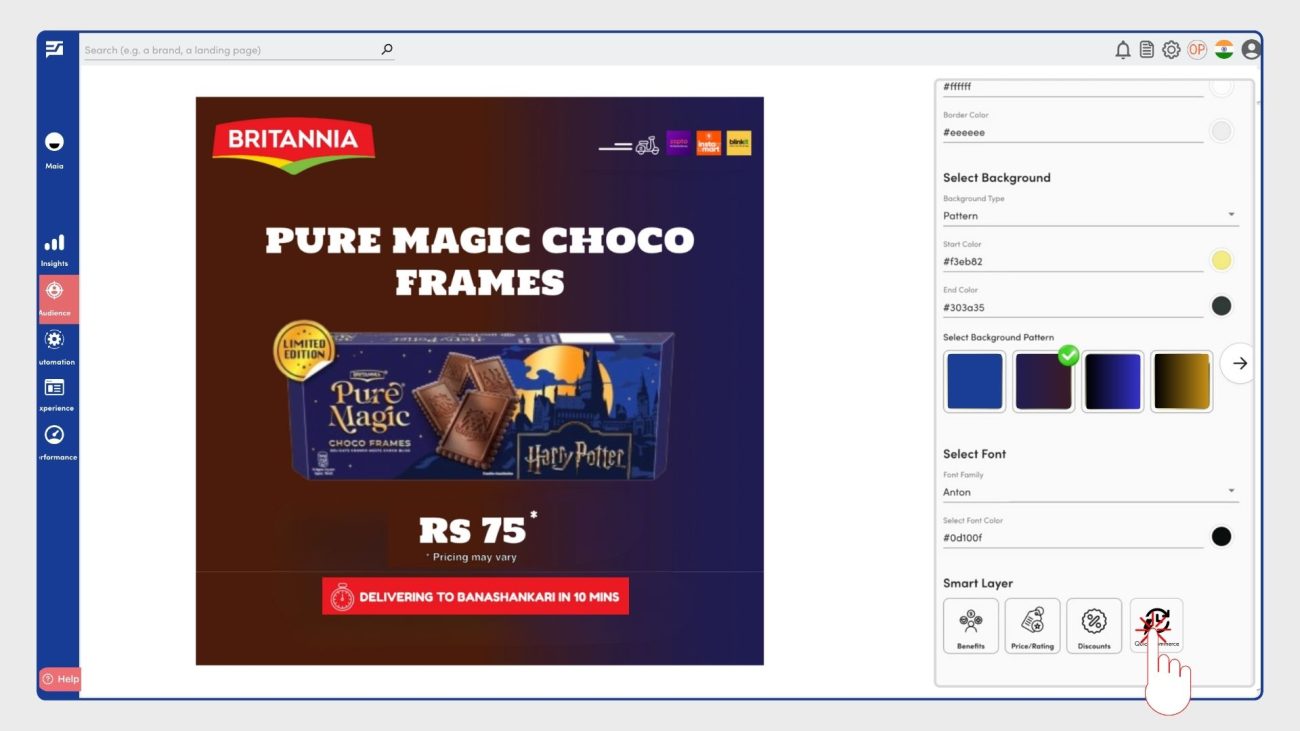
Shopalyst calls its organizing idea ACE: Audiences, Creatives and Experiences. Audience Builder turns product descriptions, shopper behavior and media signals into targetable groups. Creative Builder combines brand assets with commerce facts such as price, ratings or stock. Experience Builder makes the post-click destination without a developer queue. Campaign Manager pushes work into platforms including Google Ads, DV360, Meta, Amazon Ads, X and TikTok. Market Intelligence watches share of search, voice and shelf, along with pricing, availability and reviews.
“We democratize product discovery.”Shopalyst's statement of intent
The quiet advantage is product knowledge
Most campaign software begins with the campaign. Shopalyst would rather begin with the product. By 2019, its product knowledge graph was reported to organize information on more than 100 million products. That heritage now appears in its Brand Knowledge Graph, which maps products, brand language, market context and performance signals. The distinction matters because a generic model can draft an elegant ad for an item that is unavailable, mispriced or tonally absurd. Elegance is a poor consolation for being wrong.
This is also where Maia, Shopalyst's AI copilot, enters. The company presents Maia as a guide through audience selection, campaign construction and optimization, grounded in that graph. Symphony, its newer agentic layer, goes further: a set of no-code tools and specialist agents intended to coordinate persistent marketing workflows. In the company's telling, the marketer stops operating every lever and begins directing the orchestra. The metaphor is grand; the practical appeal is modest and real - fewer exports, fewer handoffs, fewer opportunities for yesterday's inventory to become today's advertisement.
Company-reported figures. The same activation produced more than 500,000 registrations.
A useful ad knows the neighborhood
Quick commerce exposes the old funnel's silliness. A beverage may be available in one pin code, missing in the next and deliverable in ten minutes across the road. Advertising it uniformly wastes money and irritates shoppers. Shopalyst's quick-commerce version of ACE begins with local serviceability and stock. It can then target places where the item exists, generate creative with the local price or delivery promise, and land the shopper on a page that reflects the same reality.
That sequence is the company's difference in miniature. Criteo can buy commerce media. Profitero or DataWeave can inspect the digital shelf. Adobe, Salesforce, Google and Meta offer large pieces of the marketing stack. Smaller tools can make ads or landing pages beautifully. Shopalyst's argument is connective: use one product-data spine to make the audience, message, destination and measurement agree.
Evidence arrives campaign by campaign
The customer list is the sort that makes enterprise sellers sit straighter: Unilever, P&G, L'Oréal, Reckitt, Adidas and others have been named by the company or its investor. Published examples report a haircare campaign drawing more than 500,000 registrations with an 85 percent submission rate, another brand improving targeting relevance by 3.2 times, and a large consumer-goods company making ad operations ten times faster. A beauty campaign is credited with a 21 percent increase in marketplace share.
These are vendor case studies, not universal laws. Yet they show the jobs customers hire Shopalyst to do: collect consented first-party data, shorten the route to purchase, localize retail choices, turn influencers and QR codes into storefronts, and reconcile media engagement with commerce outcomes. The platform is less a prettier billboard than a piece of plumbing with an opinion about where the water should go.
Where the model earns its keep
- Large or changing product catalogs
- Paid media across several platforms
- Retailer, marketplace or quick-commerce distribution
- Repeated campaigns with format and reporting overhead
Where the arithmetic weakens
- A tiny catalog and a single sales channel
- Weak product or inventory data
- Little paid media to automate
- Teams unwilling to join commerce and media operations
What another company can borrow
The copyable lesson is not to rename the funnel. It is to make every campaign begin with the same facts. Establish a clean product record. Add availability and location. Define audiences from behavior rather than demographic folklore. Build creative from the product record, not a detached slide deck. Preserve the message after the click. Measure the whole path. Only then invite AI to help, because automation magnifies coherence just as cheerfully as it magnifies nonsense.
Shopalyst's own history supplies the second lesson. Start with a sharp seam in the customer's workflow, then follow the friction beside it. The universal buy button led to product infrastructure; product infrastructure led to audiences and creative; those led to campaign control and measurement; the connected data now gives Maia something substantial to reason over. A decade later, the little button has not disappeared. It has simply acquired an orchestra pit.