The first thing to understand about Clinch is that it does not make the big idea. It makes the big idea survive contact with modern advertising. A campaign that begins as one clever film or handsome layout can quickly mutate into hundreds of sizes, languages, offers, product combinations, audiences and media placements. Someone has to build the variants, approve them, send them to the right platform and work out which one sold anything. Usually, several someones do it across several systems, with a spreadsheet quietly running air-traffic control.
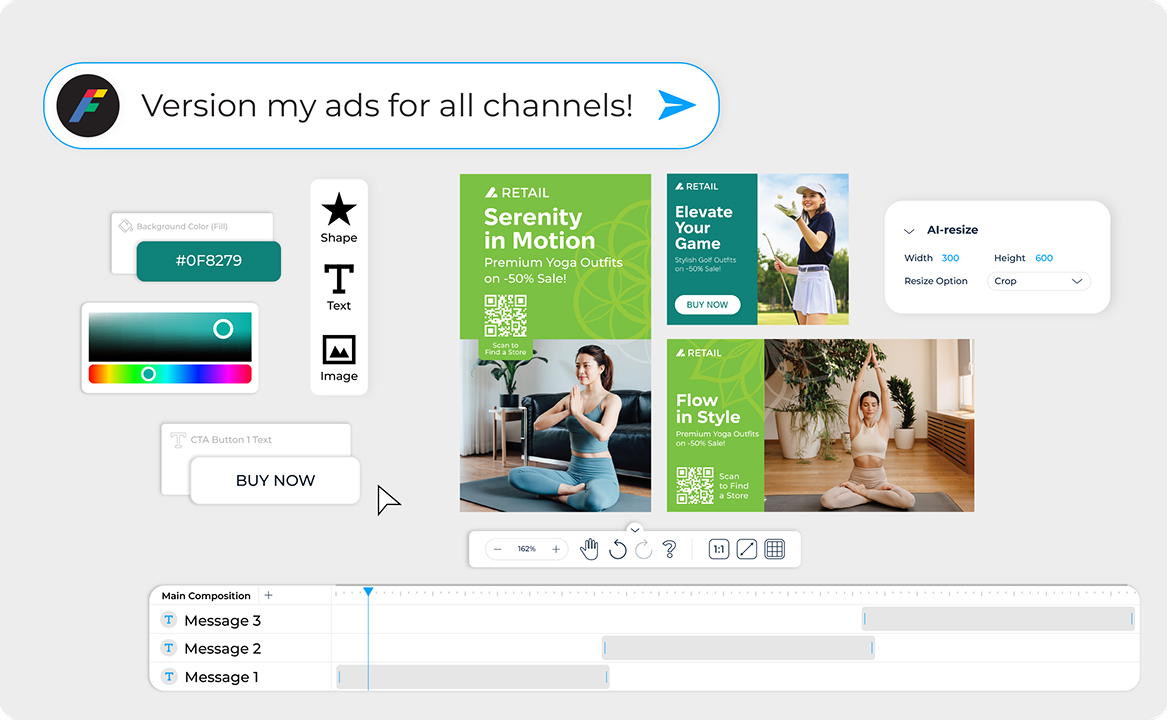
Clinch built software for that control room. Its flagship platform, Flight Control, connects campaign strategy, creative authoring, dynamic ad serving, media activation, review and measurement. A brand or agency supplies assets, product feeds, audience rules and goals. The system can produce channel-ready variations, send them into places such as display, online video, connected television, social, audio and digital out-of-home, then use performance signals to change what gets shown.
This is enterprise plumbing dressed in a bright interface, and that is the point. Clinch is not a demand-side platform. It does not buy or sell media. It sits around the buy, giving creative, ad-operations and media teams one place to coordinate what the audience sees. Customers named in public material include Dentsu, Tombras, Hyundai and Genesis, Nespresso, Iberia, KFC, Mars and Jack in the Box. Its natural buyer is a large brand or agency with enough campaigns, channels and creative volume to feel the coordination tax.
From personalized video to the whole flight deck
Oz Etzioni, an aviation and industrial-design alumnus who later led user experience and innovation at McCann Worldgroup's MRM, founded Clinch with technologist Raz Peter in 2015. Etzioni ran the commercial side from New York; Peter led technology with an R&D base in Israel. The original wedge was personalized creative, especially video that could change more than a nameplate pasted over a fixed film. Location, device, interest and other signals could alter the underlying edit.
That pitch brought a reported $3 million round in 2017. Early campaigns ran in Latin America and Asia with customers including Walmart and AT&T, even as Clinch prepared a larger push into the United States. In 2021, D Squared Capital led another $10 million round, with OurCrowd participating. The money supported international growth and a wider product idea: personalization was not merely a rendering problem. It was a workflow problem.
The product expanded accordingly. Flight Control now covers dynamic templates, rapid video rendering, primary ad serving, rules for audience and context, integrations with media platforms, collaborative approvals and analytics. Its Copilot, announced in 2024, can help draft campaign logic, find account knowledge, resize assets and recommend actions. Clinch's published AI terms make those features opt-in and require human authorization for consequential campaign actions. The machine may suggest the route; a person still clears takeoff.
“AI didn't create the cracks in the system, it exposed them.”Oz Etzioni, co-founder and CEO
What failed first
The neatest explanation of Clinch's value comes from a campaign that was not working. Nespresso had been showing one creative to everyone: 30 percent off its machines. After several months, performance had barely improved. The failure was not a broken banner. It was the assumption that prospects, returning visitors and existing customers should hear the same thing.
Clinch began with three segments - prospects, retargeting audiences and customers - then tested messages and used behavioral results to refine them. What started as a one-month experiment became a six-month partnership. Nespresso reported machine sales up 38 percent, capsule sales up 15 percent and acquisition cost down 36 percent. It also reduced its dependence on the blanket discount. The campaign changed the team's mind because the alternative did not merely personalize decoration; it made the audience structure visible and testable.
A separate global-retailer example makes the production economics plain. Clinch built three master templates for display, video and social, then connected them to feeds and rules involving weather, time, customer persona and geography. Those templates dynamically served 6,000 products. The retailer reported a 228 percent increase in click-through rate and 55 percent efficiency cost savings. Another grocery campaign used one-time templates and daily competitor-price feeds to generate more than 1,800 variations, moving production from days to hours.
What did that cost? Clinch does not publish Flight Control prices, and its contracts are sold through enterprise demos and proposals. That omission matters. The return has to cover software, integration, data preparation, template design and organizational change. Case studies tell us the savings, not the invoice. Buyers should ask for a pilot measured against the true old cost: production hours, agency fees, trafficking errors, approval delays and missed selling time.
The difference is the loop
Creative-automation tools are not rare. Neither are ad servers, analytics suites or media platforms. Clinch competes with combinations of Google Campaign Manager 360, Flashtalking, Innovid, Jivox, Celtra and Adform, as well as the remarkably durable alternative of agency labor plus spreadsheets. Its distinction is the attempt to close a loop: author the creative, serve it, connect it to media and business signals, then bring the learning back to the next creative decision.
In 2025, Clinch added the ability to optimize creative using aggregated performance information from outside media partners. Genesis and agency Canvas Worldwide used signals from The Trade Desk to optimize dynamic video toward post-exposure search behavior, rather than relying only on video completion or click-through rates. This sounds like a small plumbing upgrade. Strategically, it is the whole bet. If creative data and media data remain in separate rooms, “omnichannel” is merely a list of channels.
The company has also built a broad integration map. Flight Control connects with Amazon DSP for placement imports and tag trafficking, with Meta for social activation, with The Trade Desk for campaign and performance data, and with Figma for creative workflow. Audio tags have been certified across services including iHeartMedia, Google DV360, Yahoo, Xandr, AdsWizz and VideoAmp. The integrations are not ornamental badges. They reduce the copying, exporting and re-entering where mistakes breed.
What to copy - and when not to
The best idea to steal from Clinch is smaller than “use AI.” Start with the expensive handoff. Map where an asset waits, where a human repeats a rule and where data arrives too late to change the outcome. Build one reusable template around a live feed. Choose a few genuinely different audience states. Measure hours and errors before measuring uplift. Only then add channels and more elaborate decisioning.
The second steal is organizational. Clinch treats creative, media and ad operations as one workflow without pretending they are one job. That distinction matters. Shared previews, approval tearsheets and a common campaign logic can eliminate translation work while leaving specialists responsible for judgment. Etzioni's useful formulation is that machines should take the tedious tasks so people can focus on concepts and strategy. It is less theatrical than replacing the marketing department and more likely to pass procurement.
A tiny, single-channel campaign does not need an air-traffic system. Nor does automation rescue a weak offer, muddy product feed, meaningless segment or missing conversion signal. Thin audiences can make testing noisy. Strict privacy rules can limit available inputs. And a beautifully scaled template can become beautifully repetitive. Clinch works best when volume, variation and reliable data are high enough to repay the setup.
Culture is part of the pitch because enterprise platforms still arrive with humans attached. Clinch has promoted hybrid work, roadmap transparency, professional development and global team rituals. It appeared on Fortune and Great Place to Work's advertising and marketing workplace list for four consecutive years through 2025, and on Ad Age's 2024 list. That does not prove the software works. It does suggest the company understands that complicated client operations are a service problem as much as a code problem.
A decade after personalized video supplied the wedge, Clinch is now describing Flight Control as an agentic-AI orchestration layer. The language is fashionable; the underlying problem is old. Campaigns contain too many assets, destinations, owners and feedback loops for manual coordination to remain cheap. Clinch's opportunity is to make that machinery disappear. Its constraint is equally clear: when every brand can manufacture endless variants, the scarce thing is no longer production. It is having something worth varying.