Advertising is excellent at finding people. It can locate a basketball obsessive during a playoff game, a traveler while the suitcase is still open on the bed, or a shopper lingering near the cereal aisle. Then, after all that expensive precision, it can present each of them with the same generic rectangle. Oz Etzioni built his company around the absurdity of that last step.
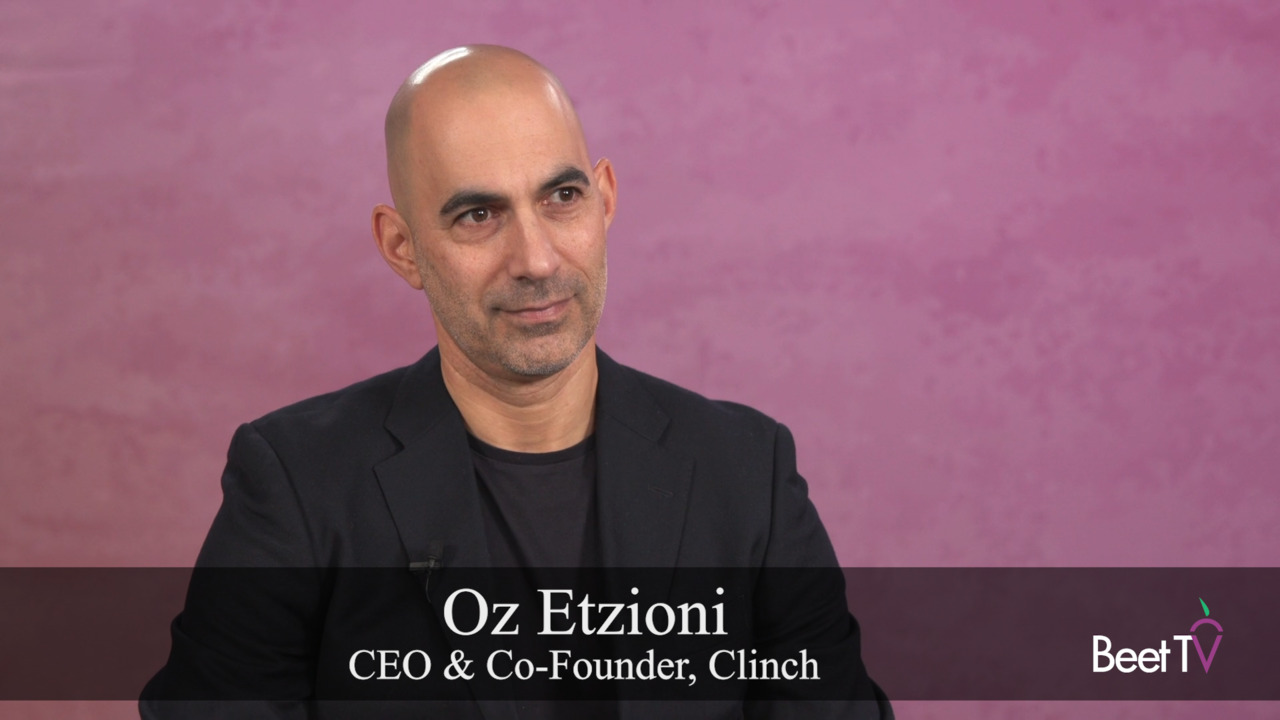
The founder and CEO of Clinch did not arrive in New York advertising by the customary route. His résumé begins with eleven years in the Israeli Air Force, where he held command and management roles. It continues through industrial design at the Elisava School of Design in Barcelona and a design degree, earned with honors, at Parsons in New York. Then came agency work, culminating in his role building and leading user experience and innovation at MRM, part of McCann Worldgroup.
Aviation, product design and adtech look like three careers assembled by a restless guidance counselor. Look closer and they describe one occupation: systems. Each asks how complicated parts behave together, where human judgment belongs, and what happens when a handoff fails. In an aircraft, the consequences announce themselves quickly. In advertising, they tend to arrive disguised as a spreadsheet.
The missing half of precision
Etzioni and technologist Raz Peter founded Clinch in 2015. Programmatic media buying had become adept at identifying the right audience and moment, but Etzioni thought the creative had been left behind. If software could distinguish one viewer from another, why should both viewers receive a message made for everybody?
Clinch began by automating personalized video and display creative. The proposition was not simply to manufacture more ads. It was to use product, audience, location and campaign data to make the message relevant, then learn from the response. Over time, that premise widened. The company’s Flight Control platform now connects strategy, creative production, ad serving, optimization and measurement across display, video, connected television, social, audio, in-app and digital out-of-home channels.
“The goal was always to combine all the channels together and have one big activation.”Oz Etzioni, 2024
The word Etzioni now favors is orchestration. Adtech has no shortage of instruments; the trouble is that creative teams, media buyers, data systems and analytics tools often play from different sheets. A campaign asset moves from one group to another, is reformatted for several platforms, trafficked into separate systems, and finally returns as a report after the useful moment has passed. Every transfer creates a small republic of copying, checking and waiting.
The connected campaign loop
+ audience
at scale
activation
measurement
Performance feeds the next decision while the campaign is still alive.
Etzioni’s designerly move is to treat those seams as the product. The value is not just in creating an asset or serving an impression. It is in keeping the original intent and the performance signal intact as the campaign travels. The ambitious version of Clinch is therefore less like a clever creative tool and more like backstage machinery: rarely admired by the audience, painfully obvious when absent.
AI, without the costume jewelry
Etzioni is enthusiastic about generative AI and notably impatient with the label. In a 2025 interview, he criticized vendors for dressing ordinary automation in AI language. The distinction matters to him because marketers already spend too much time on repetitive production, manual setup and campaign versioning. A new label does not remove the chore.
His preferred division of labor is plain. Let machines run the tedious tasks. Let people build concepts and strategy. In one example he gave to Digiday, an unnamed client used Clinch’s CoPilot to reduce campaign versioning for different markets and platforms from two weeks to three hours. It is a claim from the company’s chief executive, but also a revealing choice of metric: hours returned, not prompts submitted.
By 2026, his criticism had sharpened into a diagnosis: AI did not create the cracks in advertising’s infrastructure; it exposed them. When a process depends on disconnected systems, increasing the speed and quantity of content can make the bottlenecks worse. Hundreds of new variations still have to be approved, delivered, measured and understood. A fire hose attached to antique plumbing is mostly a decorating decision.
This explains why Clinch’s story has expanded beyond dynamic creative. Etzioni argues that media and creative are interdependent growth engines, yet the industry has long managed them separately. His answer is one continuous operating layer where an impression can inform the next choice while a campaign runs. In August 2026, MarTech Breakthrough named him its MarTech Company CEO of the Year, citing that expansion of Flight Control. Clinch says customers using the platform have cut campaign launch timelines by more than 80 percent. Those numbers belong to the company’s account of its work; the philosophy beneath them is easier to inspect: speed matters when it shortens the distance between learning and action.
The designer remains in the room
Etzioni’s earlier work makes his fixation on workflow feel less like a market pivot than muscle memory. At MRM, he created and managed digital experiences and campaign strategy for organizations including MasterCard, Verizon, General Motors, Diageo, ExxonMobil and the U.S. Army. The job was not only to make interfaces attractive. User experience asks a more impolite question: why is the user being asked to do this at all?
Industrial design adds another habit. A beautiful component can still produce a poor object if it is awkward to hold, repair or use. Etzioni applies the same suspicion to advertising’s collection of specialized tools. Each may perform its assigned task perfectly while the complete campaign remains slow, fragmented and difficult to understand. The failure lives between the products.
A stealable Etzioni question: Where is your team repeatedly translating, copying or re-entering context between tools? That seam may be costing more time than the work on either side.
There is also a pragmatic humanism in his automation argument. In interviews, Etzioni does not frame people as the troublesome part to engineer away. He talks about empowering teams and freeing them from mechanics. In 2018, he described Clinch employees as vital to every campaign, regardless of client size. His productivity habits were modest: dedicated Slack and WhatsApp groups, plus the occasional one-on-one meeting over coffee outside the office. For an executive selling connected software, the coffee is a useful footnote. Some forms of bandwidth do not require a dashboard.
“Gen AI helps us to take all those tedious tasks and let the machine run it and let people focus on building the concepts and building the strategy.”Oz Etzioni, Beet.TV
The personal details around the work have a pleasingly low-tech quality. He is a Chicago Bulls fan, snowboarder, traveler and, according to an older profile, a chocolate addict. Asked what he was reading in 2018, he answered Ready Player One, then made sure to add that it was the actual paper book. His favorite advice included trusting your gut, remembering grit and raising money before it becomes necessary.
None of this turns his company into a cozy craft shop. Clinch has raised outside capital, works with large brands and agencies, and sells infrastructure into an industry built on enormous volumes of automated decisions. The platform is meant to operate at scale. But Etzioni’s language keeps returning to human time: less manual setup, fewer broken handoffs, faster learning, more room for strategic and creative thought.
A campaign that can remember
Clinch’s more recent work extends that logic into new territory. In 2026, the company launched an offering for generative engine optimization, intended to help brands understand how systems such as ChatGPT, Gemini, Claude and Perplexity describe and compare them. The product connects those observations back to content, creative and media decisions. It is another version of the same loop: see what the system is doing, carry the information to the people making the next choice, and do it before the context goes stale.
Etzioni has also challenged impression-based pricing for core advertising technology, arguing that fees tied to every thousand impressions can discourage experimentation. Again, the complaint is directed at an incentive embedded in the machinery. If the commercial model punishes a team for testing more creative, the platform can preach optimization while its invoice quietly votes against it.
The larger aspiration is an advertising system that remembers. Creative decisions inform media delivery. Delivery produces evidence. Evidence improves creative while there is still time to matter. The loop sounds obvious when drawn with four boxes and arrows. Building it across teams, platforms and channels is the stubborn part.
Etzioni’s career offers a useful way to look at that stubbornness. Do not begin with the newest tool. Begin with the whole object. Watch where people compensate for its poor design, where information gets dropped, and where repetition pretends to be expertise. Then decide what the machine should carry.
Advertising will always contain some theater; it is one of the industry’s more honest pleasures. The machinery behind the curtain need not join the performance. Etzioni would prefer it connected, measurable and quiet, leaving the humans enough time to come up with something worth seeing.