Somewhere between watching an advertisement and buying the thing, a person might change their mind. Advertising has plenty of ways to count the watching. LoopMe has spent years trying to make that middle moment useful: ask consumers what they think, find patterns in the answers, then let those patterns influence which advertisement appears next.
It is an appealingly circular idea for a company called LoopMe. The London business sells technology to brands and agencies trying to make their budgets work harder, and to publishers trying to earn more from their audiences. Its territory includes mobile video, games, apps and connected television. The product is less visible than the commercial on the screen; it helps decide who sees it and whether it accomplished anything.
That puts LoopMe in a busy corner of advertising technology, where almost everyone promises better performance. Its particular proposition combines consumer surveys, predictive AI, media delivery and measurement. A question answered during an ad break can become information for the next buying decision. The feedback arrives while there is still money left to move.
An ad inbox grew up
Stephen Upstone and Marco van de Bergh founded LoopMe in 2012, bringing experience in mobile advertising. The early product sounds almost quaint today: an inbox for advertisements. Users could tap a button inside an app to browse offers, interact with advertisers and stay within the app. The ambition was to make mobile advertising less intrusive and more useful to developers.
A $500,000 seed round followed in 2013. The present-day company reaches much further into the advertising machinery, but the continuity is clear: the phone remains central, and the interests of advertiser, developer and user still need reconciling. By 2017, its work with Microsoft and The Story Lab showed the new emphasis: optimizing mobile video toward brand response during a programmatic campaign.

In 2018, BGF led a $17 million investment intended to support international expansion, particularly in the United States. Mayfair Equity Partners became the majority investor in January 2022 through a $120 million transaction that valued LoopMe at close to $200 million. Those are investment and ownership figures, not the price of running a campaign.
The survey gets a seat at the trading desk
PurchaseLoop is the central product family. Its published process begins with audience research, potentially three to four weeks before a campaign starts. Survey responses help define a custom audience; predictive modeling expands it. During the campaign, additional questions test brand response, and the system adjusts delivery toward the chosen outcome.
The design separates three groups: people who have not seen the ad, people exposed without AI selection, and people exposed after AI selection. That distinction helps a buyer examine advertising exposure and the added contribution of optimization. The questions concern matters such as awareness, consideration or purchase intent. An enthusiastic answer remains an answer, rather than a receipt.
↶ Responses feed the next buying decision.
There is a separate entrance for customers who want the intelligence without commissioning the entire media campaign. AMP, the Audience & Measurement Platform, supports standalone studies and bespoke audiences that can be exported to other platforms. Agencies, media companies and technology platforms can use it alongside their existing activity. That makes LoopMe both a campaign operator and a supplier of components.
A laptop, an oat drink, and two different measures
A 2017 campaign with The Story Lab illustrates the older version of the proposition. The work promoted content featuring the HP Spectre x360 for Microsoft, distributing short video teasers through programmatic buying. LoopMe reported more than two million impressions, a 41 percent increase in purchase intent and a 165 percent increase in click-through rate.
The interesting detail is the coexistence of those last two numbers. Clicks describe an action on the advertisement. Purchase intent describes a stated inclination toward the product. A useful report keeps the measures separate, even when both move in a pleasing direction. These are company-reported campaign results, rather than a universal forecast for the next advertiser.
Reported increase in purchase intent
A survey outcome. Not a reported increase in sales.By October 2025, LoopMe was putting a different commercial offer around brand outcomes. Its launch with Dentsu X described a model in which advertisers pay for achieved results. The first global campaign, for plant-based beverage company Califia Farms, reported 28 percent brand lift and 325,000 users experiencing positive ad recall.
The attraction is easy to understand: buyers want the supplier to have a stake in the result. The practical question is which result the agreement names. Recall, consideration, a store visit and a purchase have different meanings. A guarantee becomes useful when the parties agree on the measure, the comparison and the terms before the campaign begins.
Chartboost bought time
In December 2024, LoopMe acquired Chartboost from Zynga. Chartboost supplied mobile advertising and monetization technology, along with established connections to app publishers. The deal brought LoopMe closer to the inventory where it wanted more brand spending to land, including games. For publishers, it promised another route to brand advertisers.
“We see mobile in-app and CTV as the future of brand advertising”Stephen Upstone / December 2024
Upstone supplied a useful explanation in an April 2025 interview: expanding app access depends on software development kit integrations, and building those relationships is technically difficult and time-consuming. An acquisition could accelerate the work. This is a refreshingly concrete reason to buy a company. A model can be retrained; persuading a developer to integrate your technology takes a different kind of effort.
The next visible step was Chartboost Direct, launched in April 2026. Its Direct Pay feature lets publishers contract with and receive payments from participating brand supply-side platforms. Direct Deals connects placements with brand buying platforms through private marketplace deal identifiers. Marketplace Deals lets publishers package inventory within mediation auctions. The common aim is to make existing app connections more useful to brand buyers.
The bill still counts impressions
LoopMe’s August 2026 expansion brought PurchaseLoop further toward immediate commercial actions. Performance App targets installs and subsequent in-app activity; Performance Web targets outcomes such as acquisitions, leads and sign-ups. Both use a cost-per-thousand-impressions buying model, even when optimization focuses on cost per acquisition or return on advertising spend.
That distinction deserves to survive the sales presentation. The result an algorithm pursues and the unit a buyer pays for are separate choices. These products also use advertisers’ existing mobile measurement partners or conversion tracking. For a buyer evaluating the offer, the useful exercise is to set an explicit goal and judge delivery against the same measurement used elsewhere.
LoopMe’s broader business combines media activation, data, measurement, creative services and publisher monetization. Its Intelligent Marketplace applies predictive filtering to advertising requests, aiming to reduce processing that will not produce a bid. Its creative studio builds interactive formats. Depending on the customer's problem, the relationship can start with an audience, a study, an advertisement or supply.
Partners are part of the product
LoopMe sits between brand budgets and digital publishers, with connections into other advertising systems. Microsoft Curate added PurchaseLoop real-time brand optimization in April 2025. Evorra’s Australian integration followed in February 2026, making LoopMe audience segments available through its data marketplace. These arrangements let customers use LoopMe capabilities where they already work.
On September 2, 2026, LoopMe announced a direct brand-lift integration with The Trade Desk’s Measurement Marketplace. The company described coverage across more than 35 markets and 17 languages, with study feasibility starting at one million impressions. Initial results can arrive as early as ten days after launch, with subsequent updates every 24 hours.
Those details tell a prospective buyer more than a sweeping claim about AI. A campaign needs enough exposure, appropriate respondents and enough time to learn something. A brief, tightly targeted campaign may be a poor match for that particular study format. Measuring a change also requires a credible comparison group; LoopMe describes matching controls across more than 100 variables.
The competitive picture consequently resists a tidy list. On their published capabilities, Teads is a comparison for brand and performance advertising, and AppLovin MAX for app monetization. A specialist measurement provider may cover another part of the brief. Microsoft and The Trade Desk are also distribution partners. LoopMe’s pitch is the combination of survey intelligence and action, plus its publisher access. Buyers should compare the job they need done.
The people behind the probability
The company’s expansion has a human footprint. Public recruiting material describes roughly 400 employees across 19 cities. A September 2025 engineering appointment put Edward Peterson, formerly of Microsoft, in charge of software development hubs in the United States, Poland and Ukraine. Operating an advertising system requires engineering, data science, commercial relationships and people who can explain a campaign result.
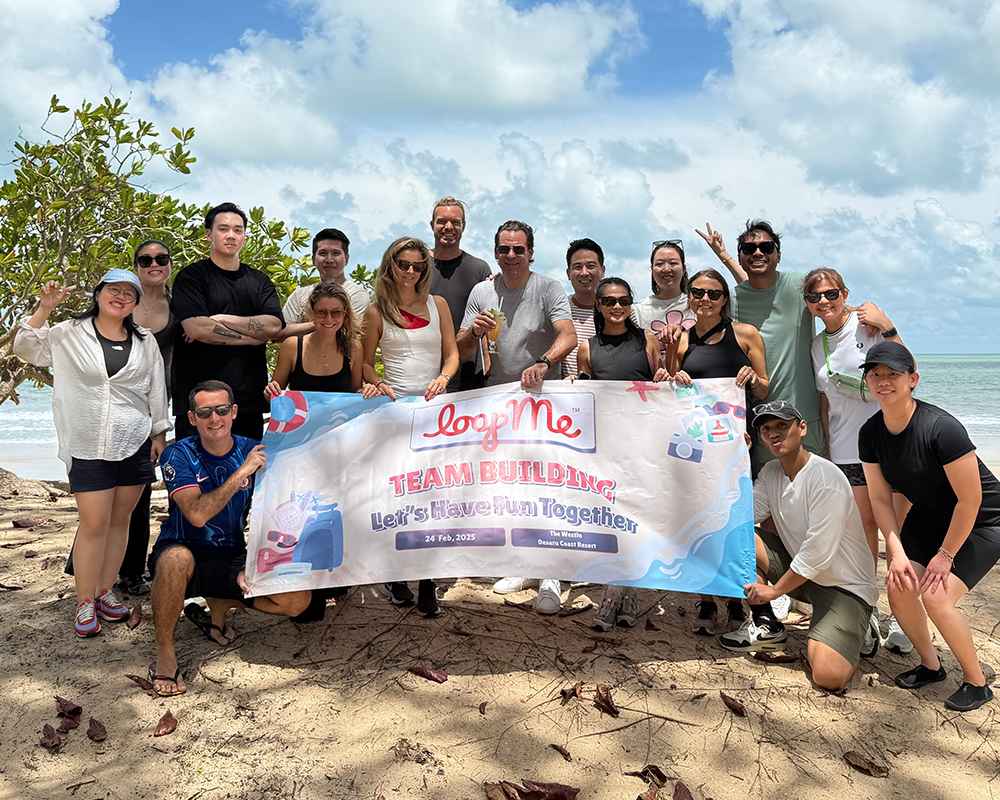
Employees are called Loopers. The careers material describes training, volunteering and an emphasis on inclusion; some engineering roles offer a month of working from another location. LoopMe also reports more than $240,000 raised and donated for Ukraine relief. These are specific signals of the employer it wants to be, rather than proof that every employee has the same experience.
Keep the loop. Read the labels.
In January 2025, LoopMe reported 40 percent organic compound annual growth in gross revenue for 2018-2024, excluding Chartboost. It also said the combined businesses had generated more than $2 billion in gross revenue cumulatively. The period and the word “gross” matter. That second figure should not be mistaken for a single year’s revenue or the amount left after costs.
The lesson a marketer can copy is smaller than an acquisition and cheaper than a platform rebuild: decide what a campaign should change, establish a meaningful comparison, and arrange to learn while spending can still be adjusted. LoopMe has made that sequence its business. The buyer’s job is to keep asking whether the measured change is the one worth paying for.
Follow the loop
PRODUCTS, PEOPLE & FURTHER READING