The campaign was doing wonderfully. That was the warning. In a story Vadim Rogovskiy later told, someone at Clickky entered a publisher payout of $1 per click instead of $0.01. Advertisers were paying roughly two or three cents. Every click brought another little catastrophe, dressed as a success.
It took a couple of days to become suspicious. The team negotiated discounts with developers and absorbed a loss. Rogovskiy blamed the missing processes around the technology. Software could distribute advertising; it could also distribute a typo with admirable efficiency. For a company selling measurable results, this was an expensive introduction to the difference between activity and value.
- Clickky matched mobile advertisers with publishers who had attention to sell.
- Its pricing experiments moved from counting installs toward measuring engagement.
- Automation helped it grow. A changing market and a failed sale later overtook the business.
The traffic ran out before the ambition did
Clickky emerged from Odesa’s social-app advertising scene. Its early network was called Clickburner; a public Clickky launch followed in 2011. The premise was straightforward: developers had audiences, advertisers wanted them, and a small intermediary could arrange an introduction. The toucan in the logo supplied rather more plumage than the business model required.
The first limitation was supply. In a 2017 account, Rogovskiy described larger advertisers consuming the available traffic. By late 2012, he had mortgaged his car. An investment from Alex Bornyakov helped, and the company shifted toward mobile promotion. The interesting move was following developers onto phones, where a different pool of inventory offered room to grow.
In April 2015, iTech Capital invested $2 million for a minority stake. The announcement described a platform for finding app audiences, monetizing traffic and assessing its quality. Funding would support international expansion and additional technology. Later reporting explained that half the deal financed the business and half bought existing shareholders’ stakes. A headline funding number can conceal two quite different transactions.
Reported allocation; not a valuation.
What, exactly, counts as a customer?
An app developer’s problem begins after the app exists. People must discover it, install it and find a reason to return. Clickky bought access to audiences through other apps and mobile websites. Publishers received advertising income; advertisers received a route to prospective users. The intermediary handled the uncomfortable machinery between those wishes.
Cost per install, or CPI, gave the transaction an apparently tidy endpoint. An installation happened; a payment followed. But somebody who deletes an app immediately is a peculiar sort of customer. In July 2014, Clickky announced cost-per-engagement campaigns. Advertisers could choose an action such as completing a tutorial, making a purchase or booking a hotel room.
The rate came from testing: start with an install campaign, measure how many users performed the desired action, then establish the price of acquiring an engaged user. This was the distinguishing proposition. It changed what the buyer rewarded. An advertiser choosing the wrong event, however, could still purchase an impressive count of something commercially useless.
- 01ImpressionAn ad is shown
- 02InstallAn app is downloaded
- 03EngagementA chosen action happens
Different buying models, not a guarantee of customer loyalty.
A dashboard on each side of the bargain
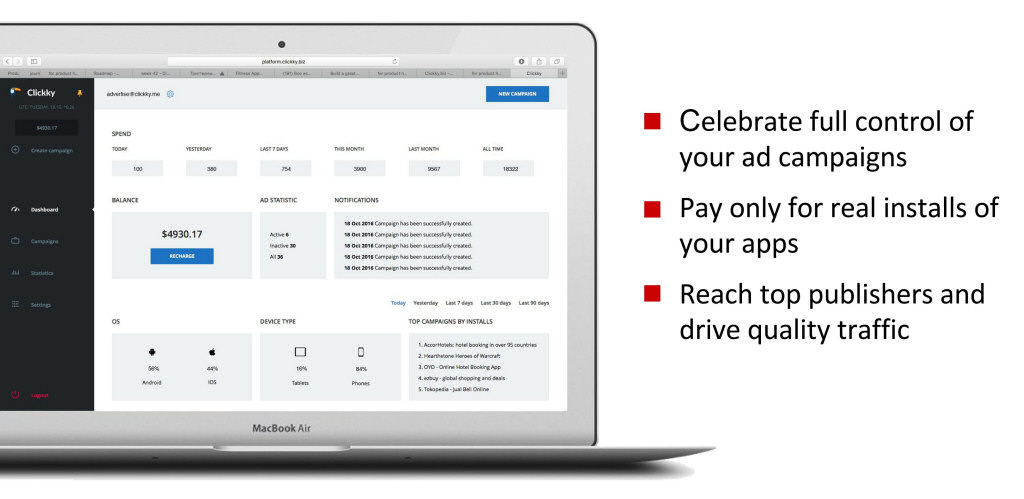
By October 2016, Clickky’s advertiser self-service platform allowed customers to set up and analyze campaigns without waiting for a manager. Its CMO stated a $100 minimum campaign budget. Automated tracking links and CPI guidance reduced the work involved in buying users. The service emphasized non-incentivized traffic: people were supposed to install because the advertisement interested them.
Publishers got their own controls that November. The launch announcement described native placements, rich media, fullscreen banners and video, with category choices and customizable native formats. Monthly payouts began at $100. More than 2,000 publishers had tried the beta, according to Clickky. These were historical launch terms, rather than a subscription price list.
The plumbing became more elaborate. An AdExchange API distributed advertising offers; a supply-side platform and real-time bidding marketplace connected inventory to programmatic buyers. Offerslook’s 2016 partnership announcement described access to over 30,000 mobile offers. Clickky occupied the busy middle of advertising, where integration and delivery matter as much as a persuasive banner.
A June 2018 guide offered Android developers an SDK for displaying ads, plus Smartlink for remnant traffic. That menu gave publishers several ways to earn from an audience. The sensible choice depended on the app’s flow, its available traffic and what buyers would pay. An advertisement that interrupted the experience could make monetization an expensive bargain.
Its alternatives included established mobile advertising providers such as InMobi, ironSource and Appodeal. Clickky’s combination of managed service and independent controls gave buyers a choice about how much work to delegate. The comparison still needed to happen campaign by campaign: audience geography, ad format and the quality of measurement mattered more than a crowded menu of features.
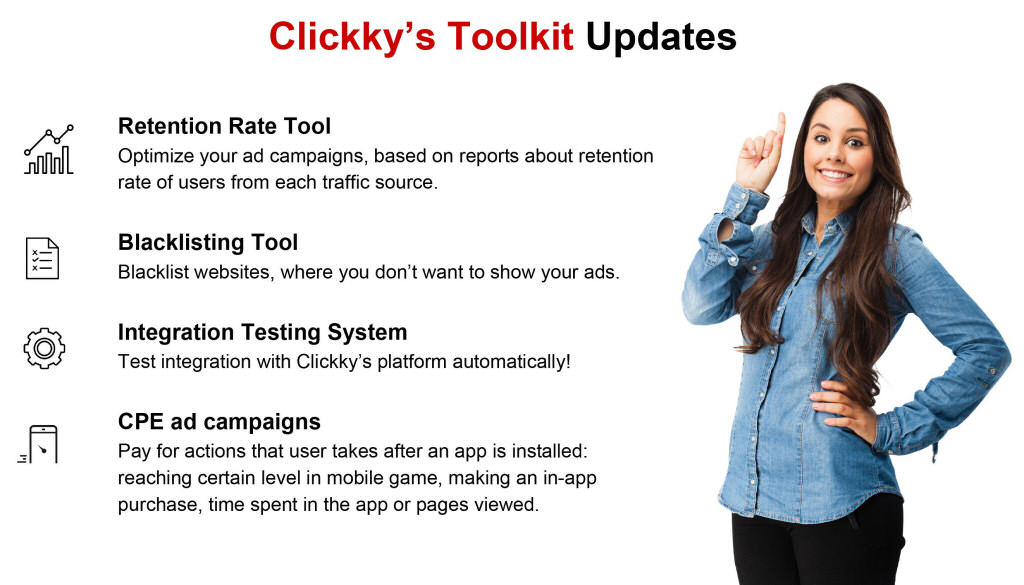
That interview also listed retention reporting, placement blacklists and integration testing as forthcoming additions. Each addressed a different uncertainty: whether people stayed, where the ads appeared, and whether the connection worked. A dashboard was becoming a place to ask better questions, as well as launch another campaign.
The beach was part of the business
Clickky also understood the value of getting people into the same place. Its Mobile Beach Conference brought mobile marketers to Odesa’s waterfront. The organizer’s 2017 recap counted roughly 1,000 participants from 29 countries, with speakers from Shazam, InMobi, AppsFlyer and others. Ten shortlisted startups pitched at Startup Alley. The setting supplied a memorable alternative to another hotel ballroom.
The commercial map widened too. Clickky announced a Beijing office in April 2017, hiring Ray Zhou, previously at ironSource, to lead local business development. Its stated priorities included the AdExchange and publisher SDK. A global platform still needed people who knew a local market. The auction might be automatic; the relationship rarely was.
The buyer who never bought
Rogovskiy later put 2017 revenue at $13.5 million. He wanted to wait for $20 million before selling. In his account, fraudulent installs damaged advertiser confidence, budgets fell, and an acquisition attempt collapsed. He described a demoralized team and insufficient runway. The business closed.
“it’s never too early to sell.”
Vadim Rogovskiy · DealMakers interview
The useful inheritance is practical: test acquisition against meaningful actions, protect payout settings, and give routine work repeatable controls. Those methods depend on trustworthy measurement and traffic. Clickky’s history leaves the buyer with a question worth keeping beside every dashboard: when the number goes up, who has actually become better off?