The most important room in a free mobile game has no walls. It opens in the instant after a player loses a life or finishes a level. Somewhere else, several advertisers decide what that instant is worth. One wins. A video appears. The player watches, earns another attempt, and returns to the game. The entire market may have cleared before the player has time to sigh.
The short version
- Chartboost connects app publishers selling attention with marketers buying users.
- Its tools cover monetization, user acquisition, mediation, reporting and real-time bidding.
- The company raised $21 million, sold to Zynga for about $250 million, then moved to LoopMe.
- The transferable lesson: win one narrow market with transparency before adding machinery.
Chartboost is the machinery in that room. Its software development kits sit inside apps; its exchange carries demand from advertisers; its mediation product decides which network gets a chance to show an ad. Publishers see requests, fills, impressions, prices and revenue. Marketers buy access to people who have already demonstrated a fondness for tapping screens.
The company says its platform reaches more than 700 million monthly active users and handles over 60 billion impressions a year. Those numbers are large, but the unit of work is comically small: one person, one pause, one rectangle, one bid.
It began with an insult to the middleman
Maria Alegre and Sean Fannan arrived at the problem from Tapulous, the studio behind Tap Tap Revenge. In 2011, mobile games could become famous quickly and fade almost as fast. A developer with a hit had valuable screen space. Another developer had a new game and needed players. Conventional ad networks stood between them, kept much of the machinery hidden, and took their cut.
Chartboost's first proposition was pleasingly impolite: let the developers make direct deals. A successful studio could promote its own titles for free or sell placements to another game maker. The publisher controlled the frequency. The advertiser could acquire users in the precise habitat where mobile players already lived. The company raised $2 million in October 2011 from TransLink Capital, SK Telecom Ventures and XG Ventures. A $19 million round led by Sequoia Capital followed in January 2013.
The early promise was not better advertising. It was more visible economics.
That distinction mattered. Ad tech is usually sold as a miracle of intelligence and experienced as a thicket of acronyms. Chartboost spoke the developer's language: installs, retention, lifetime value, average revenue per daily active user. Its product lived in code, not in a media buyer's PowerPoint. One SDK could become distribution.
A waterfall is orderly. An auction is honest.
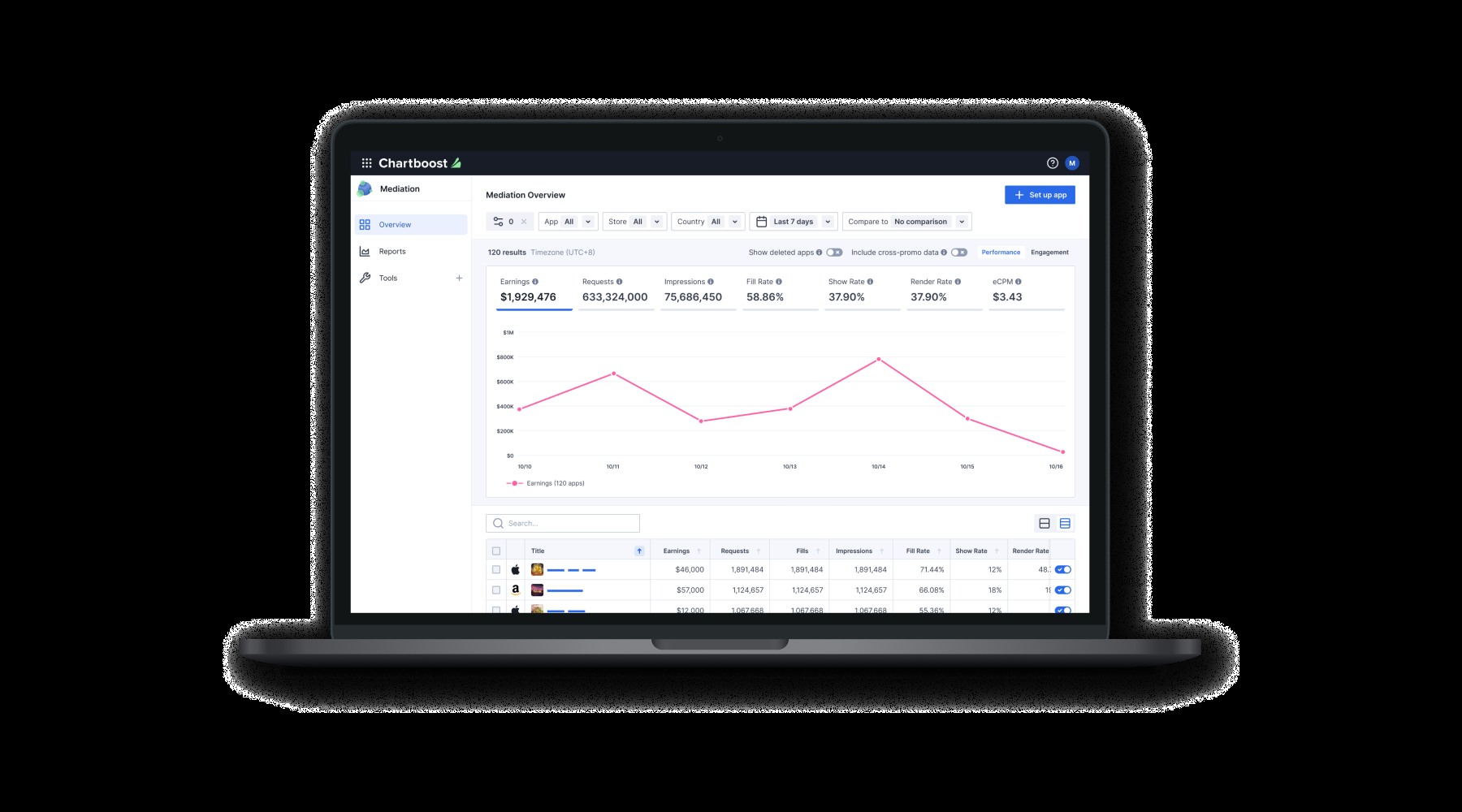
The central problem for a publisher is not merely finding an ad. It is finding the best available ad without making the game wait. In a traditional waterfall, networks are called in a preset order, often according to expected price. If the first cannot fill the slot, the request tumbles to the next. The arrangement is easy to picture and laborious to tune.
Bidding asks eligible demand partners at once. The price is discovered in the moment. Chartboost Mediation supports both because the market, unlike a manifesto, remains untidy: some partners bid, some still require waterfalls, and formats differ. The platform connects more than 30 demand sources and lets teams inspect auction and performance data in a single dashboard.
This is where Chartboost distinguishes itself from a plain ad network. It offers supply-side plumbing, demand-side buying and mediation. Its rivals include Google AdMob, AppLovin MAX, Unity LevelPlay, Liftoff Monetize and Digital Turbine. Several are larger. Chartboost's advantage is narrower: long familiarity with games, direct SDK relationships, and a public insistence on an auction without bias.
That last phrase is also the burden of proof. Any company that supplies demand while operating the auction must persuade publishers that its own bidder is not receiving a wink from the auctioneer. Chartboost answers with reporting, controls and granular data. In this business, transparency is less a feature than rent paid on trust.
The expensive turn - and the first retreat
Success tempted Chartboost outward. In 2016 it acquired Roostr, a marketplace matching mobile games with YouTube creators. The logic was fashionable and plausible. Players discovered games through personalities; developers wanted installs; creators wanted sponsorship income. Chartboost Influence, as the product became known, would connect them.
It did not last. The influencer service closed, and Chartboost returned its attention to the less photogenic work of exchanges, SDKs and mediation. The disclosed purchase price was never made public. The strategic cost is easier to see: a direct advertising marketplace and a creator marketplace may both match buyers and sellers, but their operations, incentives and measures of trust are not the same.
The correction is worth copying. Admitting that an adjacent market is merely adjacent can be more valuable than defending a glamorous expansion. Chartboost's durable expertise was not every method of game discovery. It was the measurable transaction inside the app.
Two sales, three theories of the same company
Zynga bought Chartboost in August 2021 for approximately $250 million in cash. To a mobile game publisher, ownership of the advertising stack promised scale, better margins and less dependence on outsiders. Take-Two then acquired Zynga, and the theory changed. By 2024, Take-Two was emphasizing premium, direct consumer revenue. Chartboost, useful though it was, no longer sat neatly at the center of that ambition.
LoopMe acquired the company in December 2024 for an undisclosed sum. To LoopMe, Chartboost meant direct paths into mobile apps, publisher relationships and roughly twice its previous direct SDK traffic. One asset had played three roles: strategic advantage for Zynga, non-core unit for Take-Two, distribution engine for LoopMe. Corporate strategy is sometimes just a change of preposition.
Direct deals
Two former Tapulous colleagues give game makers a way to trade promotion.
Influence, briefly
Roostr expands the idea into creator marketing; the experiment is later closed.
Zynga pays about $250 million
The buyer wants content and ad technology under one roof.
LoopMe takes the keys
The new owner wants SDK scale and a more direct route to publishers.
Direct demand, again
Chartboost Direct brings brand deals into apps, while an AI-assisted flow tackles SDK integration.
What builders can steal
First, begin with a grievance you have earned. Alegre and Fannan had watched early mobile games scale. They knew where the existing tools crashed, concealed data or frustrated developers. Second, choose a customer narrow enough to understand intimately. “Mobile games” was not a limitation; it was a vocabulary, a distribution network and a set of shared economics.
Third, make the first transaction useful before automating it. Chartboost started with developer-to-developer deals, then built the exchange, targeting, reporting and mediation around that trade. Fourth, treat integration as part of the product. In 2026 LoopMe introduced an AI-assisted workflow designed to turn current documentation into implementation guidance. The glamorous result is revenue. The unglamorous prerequisite is getting consent flows, dependencies and ad formats to compile.
There are conditions under which none of this works. An auction cannot manufacture an audience. A publisher with little traffic has little inventory. A badly timed interstitial can reduce retention faster than a high bid improves revenue. A product involving children or sensitive contexts carries obligations that no dashboard makes trivial. And a team that will not maintain an SDK, test demand partners and watch user experience should not expect passive income from a switch marked “monetize.”
The lesson is not to put more ads in a game. It is to make every interruption earn its place.
Chartboost's current products still carry the old argument. Publishers should see what their attention is worth. Advertisers should compete for it. Players should receive an experience coherent enough to keep playing. The company has changed logos, product names and owners. The tiny room remains open, taking bids.