Advertising has always been fond of machinery. The industry gives its inventions names that sound pleasingly industrial - exchanges, platforms, engines, stacks - then asks a human being to explain why the quarterly numbers went sideways. Tina Starr, the chief executive of Choozle, has spent her career near that awkward seam between what a system can do and what a client needs it to mean. Her answer to the latest wave of automation is compact enough to survive a board meeting: build a cyborg, not a robot.
The word “cyborg” supplies a little science-fiction sparkle. Starr's definition is more sober. People remain at the center; technology extends their impact. Algorithms can sift signals, move budgets, and test variations at speeds no media team could match. People still choose the aim, inspect the evidence, and answer for the result. It is a view of artificial intelligence that grants the machine plenty of work but denies it the corner office.
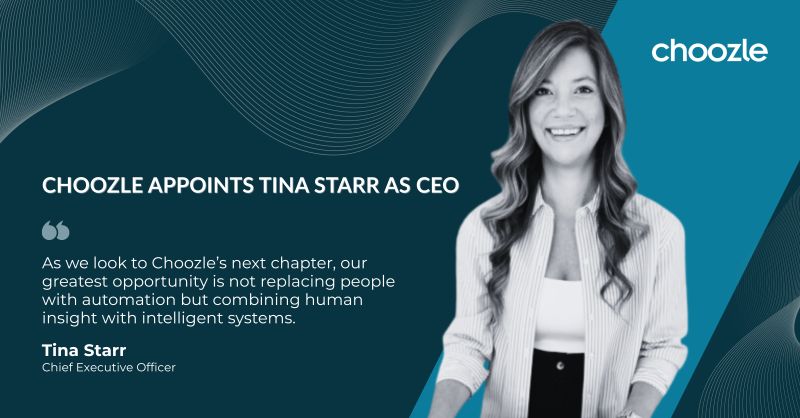
That position now carries institutional weight. Choozle appointed Starr CEO on December 15, 2025, after she had served as executive vice president of Revenue and, earlier, vice president of Account Management and Strategy. The promotion placed a longtime agency and performance-marketing operator in charge of a Denver company whose product sits amid the very complexity she keeps trying to make legible.
First, remove the seams
Starr's route to the top job can be read as a lesson in handoffs. In the vice president role, she built programs, worked on campaign execution, and led teams responsible for retention and client results. As executive vice president, she brought Sales, Account Management, and Media Solutions into one integrated revenue organization. On an org chart, that is three boxes becoming one larger box. For a client, it is the promise, the service, and the actual buying of media being asked to tell the same story.
The reorganization also explains much of Starr's later writing. She distrusts fragmentation because she has managed what happens at the joins. When teams optimize for their own piece of a process, the customer inherits the gaps. When advertising platforms report success according to their own rules, the advertiser inherits a collage of partial truths. The technology changes; the operating problem is familiar.
Before Choozle, Starr held senior posts at Next Step and the Boulder agency HumanDesign. She also contributed to the development of Google's Premier Partner Program, work that placed her near the standards and incentives of performance marketing. Her career began from a conventional foundation: a Bachelor of Business Administration in Marketing from the University of Nebraska-Lincoln, completed in 2013. The interesting turn came later, as campaign expertise widened into a theory of how the entire system should behave.
A cyborg with adult supervision
Starr is not an automation skeptic. In an interview conducted while she was Choozle's revenue chief, she described AI as a revenue enabler. She talked about behavioral signals replacing broad demographic hunches, software testing more than 100 creative variations in a day, and optimization occurring while a campaign is alive rather than after the budget has been spent. Choozle, she said, had increased media yield by more than 30 percent with AI-assisted optimization.
Starr said Choozle achieved an increase of more than 30 percent as AI helped optimize campaigns in real time.
Those are arguments for faster machinery. Her qualifications are arguments for better management. If every advertiser gains access to similar bidding algorithms, automation itself becomes ordinary. Direction becomes the advantage. Starr calls the person supplying that direction the “master producer”: someone who decides which signals matter, where the system should look, and what outcome deserves to count.
“I call it a cyborg approach, where people remain at the center and technology extends their impact.”Tina Starr
There is a quiet managerial realism in the formulation. Software does not rescue an organization from having priorities; it obeys the priorities embedded in its targets. A campaign told to find cheap clicks will become wonderfully industrious at finding cheap clicks. Whether those clicks create customers remains a human question, followed soon after by a financial one.
Starr's public framework for 2026 arranges that realism into four controls. Precision decides where effort belongs. Governance establishes who can direct it. Orchestration makes separate tools behave like a system. Transparency lets an advertiser see whether the other three are working. None is especially glamorous alone. Together they resemble the plumbing beneath a promise.
Better signals, smaller crowds
One of Starr's most useful examples begins with a woman in Denver shopping for swimwear in January. A demographic model may find the behavior seasonally odd. Commerce signals suggest a more interesting possibility: she might be planning a trip. Browsing, shopping, streaming, and purchase activity can reveal intent that a broad label misses. The person has not changed. The quality of the clue has.
This distinction leads to what Choozle calls “winnable audiences.” Advertising has traditionally flattered itself with the size of the addressable market. A very large number looks handsome in a presentation, even when much of that crowd has no present reason to buy. Starr argues for concentrating spend on people and moments where persuasion is plausible. Reach becomes a means rather than a trophy.
The idea has sharpened as Choozle expanded its Amazon DSP work. In May 2026, the company announced additional campaign and ad-group management, audience-building workflows, conversion-event tracking, and creative-approval integration inside its platform. Starr framed the problem as one of connected execution: advertisers have access to inventory and data, but their workflows remain divided across systems. The new features were meant to reduce that friction and bring more of the campaign life cycle into one view.
Her June essay on audience intelligence carried the same argument from operations into strategy. More data is not the scarce resource. The ability to distinguish a useful signal from ambient digital noise is. In that world, the operator is less a button-pusher than an editor - deciding what deserves attention and what is merely available.
The dashboard owes you an answer
Transparency, in Starr's usage, is not a tasteful report delivered when nothing can be changed. It is a control layer. Different platforms define and display performance differently; intermediaries introduce fees; teams reconcile figures that were never designed to agree. A campaign can appear healthy inside each channel while the combined investment behaves badly. The dashboard glows. The budget leaks.
Her remedy is to make measurement active. Planning assumptions should be tested against real behavior. Budgets should move while evidence is fresh. Risk should become visible before it settles into a habit. That demands comparable definitions and enough access to follow money through the system. It also gives human judgment something firmer than instinct to work with.
This is where Starr's affection for automation and her suspicion of black boxes meet. Speed is valuable only when someone can see where it is going. A self-correcting system is useful only if its definition of “correct” matches the business outcome. Radical transparency sounds like a slogan until one remembers how radical it can be to ask a complicated machine for a plain account of itself.
A career measured in widening circles
- Studied marketing at the University of Nebraska-Lincoln while volunteering in marketing for the American Cancer Society.
- Held senior roles including at HumanDesign and helped develop standards for Google's Premier Partner Program.
- Served as a managing partner at Next Step before moving into Choozle's leadership team.
- Led Account Management and Strategy, then unified three teams as executive vice president of Revenue.
- Became Choozle's chief executive officer.
- Published a four-part operating case for precision, governance, orchestration, and transparency.
Alongside the commercial work, Starr mentors emerging leaders through Upnotch and DECA and has supported Habitat for Humanity, the American Cancer Society, and Alpha Chi Omega. Choozle credits her with strengthening its leadership bench and advancing women into senior positions. These facts fit her larger argument neatly, perhaps almost too neatly: capacity grows when people are given better structures in which to exercise it.
The task in front of her is less neat. Programmatic advertising keeps adding channels, retail networks, data partnerships, and automated decisions. Every convenience risks another seam. Every new measurement can compete with the ones already on screen. Starr's bet is that a mid-sized platform can win by connecting those moving parts and being candid about what happens between the budget and the outcome.
There is no romance in a clean handoff, a consistent metric, or an intelligible fee. There is merely relief. Yet relief may be a shrewd product in a business that has sold complexity as sophistication. Starr's cyborg is not a gleaming creature from the future. It is a responsible operator with sharper tools, clearer sight, and nowhere for the machine's excuses to hide.