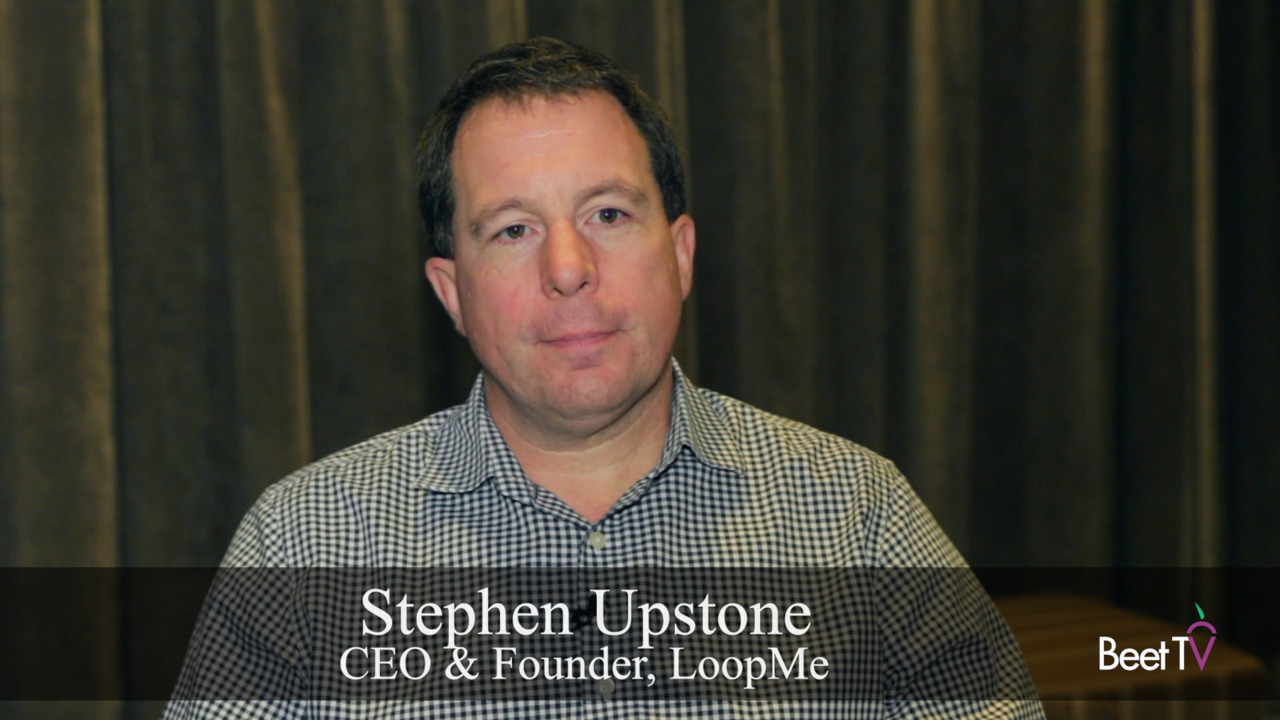
An advertisement for a car has an awkward relationship with the buy button. You might admire the car, remember the car, even begin privately rearranging your finances around the car. You are still unlikely to purchase it halfway through a video. Stephen Upstone has built much of his working life around that inconvenient interval between seeing something and wanting it.
It is a useful place to look for him. The British entrepreneur is the CEO and co-founder of LoopMe, which he started with Marco van de Bergh in 2012. His business concerns advertising, artificial intelligence and the small changes in opinion that can eventually become sales. Its central question sounds disarmingly ordinary: did the advertisement actually make a difference?
Digital advertising offers many things to count. A view. A completed video. A click. Each provides a tidy number, which is an agreeable quality in a number. Upstone’s interest lies in what those numbers leave unresolved. Someone can watch without caring. Someone else can care without clicking. Building a company around that distinction requires both a salesman’s faith in persuasion and an accountant’s appetite for evidence.
Five people, one shed, a rather large question
LoopMe’s beginnings were considerably smaller than its subject. Its early operation consisted of five people working from a shed. By 2019, it had offices in the UK, Singapore, Ukraine and the United States. The journey from shed to international operation gives the story its scale. The more interesting continuity is the question the business kept asking.
Upstone brought experience from Touch Clarity and the mobile advertising businesses Ad Infuse and Velti. His career had already placed him close to the meeting point of software, commercial growth and advertising. LoopMe gave those interests a common home. Van de Bergh was his fellow founder and the company’s technology leader; the business was a partnership, with the work of building extending well beyond the person doing the interviews.
By 2016, Upstone was explaining a system that revised its assumptions every 20 minutes. Mobile behaviour supplied signals, and the technology adjusted its choices about which advertisements to show. He was particularly interested in the moment of receptiveness: the same person might respond differently depending on when an advertisement appeared. A demographic label could describe an audience while saying remarkably little about its mood.
His argument also carried a rebuke to the industry’s familiar audience categories. In a 2016 discussion of targeting, he challenged the usefulness of inherited stereotypes in campaign briefs. The commercial attraction was clear: learning from responses could reveal prospective customers whom a rigid definition had excluded. For a business selling persuasion, an audience assumption ought to remain open to persuasion itself.
- 2012Upstone and Marco van de Bergh found LoopMe.
- 2022Mayfair announces a $120 million majority investment.
- 2024LoopMe acquires Chartboost from Zynga.
- 2026Chartboost Direct opens another route into apps.
Asking people beats admiring a dashboard
The machinery can sound elaborate. One of its inputs is refreshingly familiar: ask people a question. LoopMe uses surveys to understand responses to brands, then feeds that information into models that guide advertising delivery. Awareness, consideration and purchase intent become things a campaign can try to improve while it is still running. The survey has escaped the filing cabinet and acquired a job in operations.
In October 2022, Upstone said the business had run about 100 million surveys over the preceding 12 months. He described using the responses in real time, with AI and machine learning, to improve results. The ice cream or car advertisement served as his example of why immediate purchases cannot tell the whole story. The change may begin before the transaction becomes visible.
That thinking had already reached connected television. In 2020, he discussed extending LoopMe’s approach from mobile video to streaming TV, using outcome information to adjust campaigns as they ran. A television campaign could be examined through changes in audience response, with that information informing subsequent delivery. It was a way of bringing a feedback process to a medium historically associated with buying audiences in broad groups.
The attraction is easy to understand without imagining that any measurement settles every argument about advertising. A campaign is a bet about people. Feedback gives the advertiser a chance to revise the bet before the money is entirely spent. Upstone’s contribution has been to keep making that practical case, through changes in screens, terminology and the fashionability of the letters AI.
A simplified explanation of LoopMe’s approach, not campaign performance data.
The ten-year clock
Upstone’s advice to founders contains an unglamorous unit of time: the decade. In 2022, he urged people starting businesses to think beyond the first difficult years and allow for a long build. He divided the preparation into four concerns: market, product, investors and planning. The order begins with establishing that somebody needs the thing you intend to sell.
There is a sociable streak in his approach to money. He encourages founders to enjoy pitching, to let enthusiasm show and to remember that an investor may become a colleague for years. His advice about employees similarly looks beyond the immediate vacancy. People should have room to develop inside a business. Taken together, these comments suggest a founder thinking about the durability of relationships as well as the performance of software.
“Most significant businesses take over 10 years to build”
Stephen Upstone, 2022
LoopMe’s own tenth year supplied a financial milestone. In January 2022, Mayfair Equity Partners announced a $120 million investment to acquire a majority stake, valuing the business at close to $200 million. Expansion in the United States and Japan formed part of the plan. Upstone and van de Bergh continued with the company, alongside its wider management and existing investors.
Earlier recognition had offered a glimpse of how Upstone wanted success apportioned. When he and van de Bergh appeared in the 2018 Maserati 100, he directed attention to the more than 200 people working at LoopMe. The founders were the names on the list. He described the inclusion as reflecting the team’s work. It is a small detail, but a revealing one in a business culture rather fond of the solitary portrait.
Buying the years it would take to build
In December 2024, LoopMe bought Chartboost from Zynga. The purchase brought a mobile advertising and monetisation platform with relationships inside the app economy. For Upstone, the logic included a very practical consideration: building enough direct software integrations with publishers could take years. An acquisition offered a way to accelerate that work.
A software development kit, or SDK, is a piece of technology integrated into an app. Those integrations matter because they provide a route to advertising opportunities inside it. The strategic point is more accessible than the abbreviation suggests. If a brand wants to reach people playing games on their phones, somebody must connect the buyer to the place where those people are spending time.
Chartboost brought publisher connections and mobile expertise to a business already selling brand outcomes. The deal’s financial terms were undisclosed. Its rationale, however, was public: strengthen the connections between app publishers and brand advertisers. This was Upstone putting capital behind his view that mobile apps and connected television would matter increasingly to brand spending.
April 2026 brought Chartboost Direct. Its proposition was to give publishers more direct access to brand demand through their existing Chartboost integrations, including direct payment arrangements and deal connections. The acquisition had become a product route. Upstone’s argument now concerned the plumbing as much as the prediction: advertisers needed access, and app publishers needed workable ways to receive their budgets.
A taste for bouncing balls
For someone so closely associated with advertising models, Upstone has a revealing set of creative favourites. Asked in 2025 to name technology brands whose marketing impressed him, he chose Apple’s “1984”, Sony’s “Balls” and NVIDIA’s “The Way It’s Meant to Be Played”. Rebellion, colour and the experience of gaming figured in his explanations. It is a more entertaining selection than a collection of exemplary spreadsheets.
The choices help explain the business. Upstone’s interest in measurement coexists with an appreciation for advertisements that make people feel something. Sony’s bouncing balls conveyed colour through spectacle; Apple made a computer launch into a statement about conformity. In his reading, the experience carried the argument. His company’s task is to understand where that argument lands and what changes after it does.
The next number is still an ambition
In February 2026, LoopMe reported a gross revenue compound annual growth rate of 40% for 2018-2025. It also appointed Michael Scott as chief revenue officer and Ammar Doosh to lead product work in generative AI and data science. Upstone said the business was pushing towards more than $1 billion in revenue in the coming years. That figure belongs to the company’s ambitions, rather than its completed accounts.
Gross revenue CAGR, 2018-2025.
Reported by LoopMe in February 2026.
At Cannes in 2026, his attention was on where people would go as generative AI changed discovery. He argued that mobile apps, particularly gaming, could capture attention moving away from conventional web browsing. In August, LoopMe extended PurchaseLoop with app and web performance capabilities, connecting brand campaign intelligence with objectives such as installations, acquisitions and return on advertising spend.
The screens and products have changed since the shed. Upstone is still working on the interval between an advertisement and a decision. A person sees something, feels something, perhaps acts much later. The click provides a convenient full stop. He has made a career of asking what happened in the rest of the sentence.