Ian Colley has spent most of his career explaining machines that prefer not to be explained. Cloud infrastructure, programmatic advertising, identity systems and data platforms all run quietly beneath ordinary life, producing more acronyms than affection. The marketer's problem is to make the plumbing interesting without pretending it is a fountain. Colley's solution has been remarkably consistent: begin with the consequence.
That habit now has a new address. In May 2026, DeepIntent appointed Colley chief marketing officer, responsible for global brand, marketing and communications strategy. He arrived after seven years at The Trade Desk, including four as CMO, and after more than two decades in communications at IBM. The chronology reads like a tour through the backstage machinery of modern business. His current brief, however, is less about another platform than about what a platform might allow people to decide.
DeepIntent operates in specialized advertising, where broad reach is often a poor substitute for relevance. Colley argues that the same data used to decide where media should run could also help companies understand a market earlier. In his telling, the demand-side platform becomes a planning instrument. Advertising intelligence moves upstream, before the budget is committed and perhaps before a launch plan hardens into certainty.
The useful art of translation
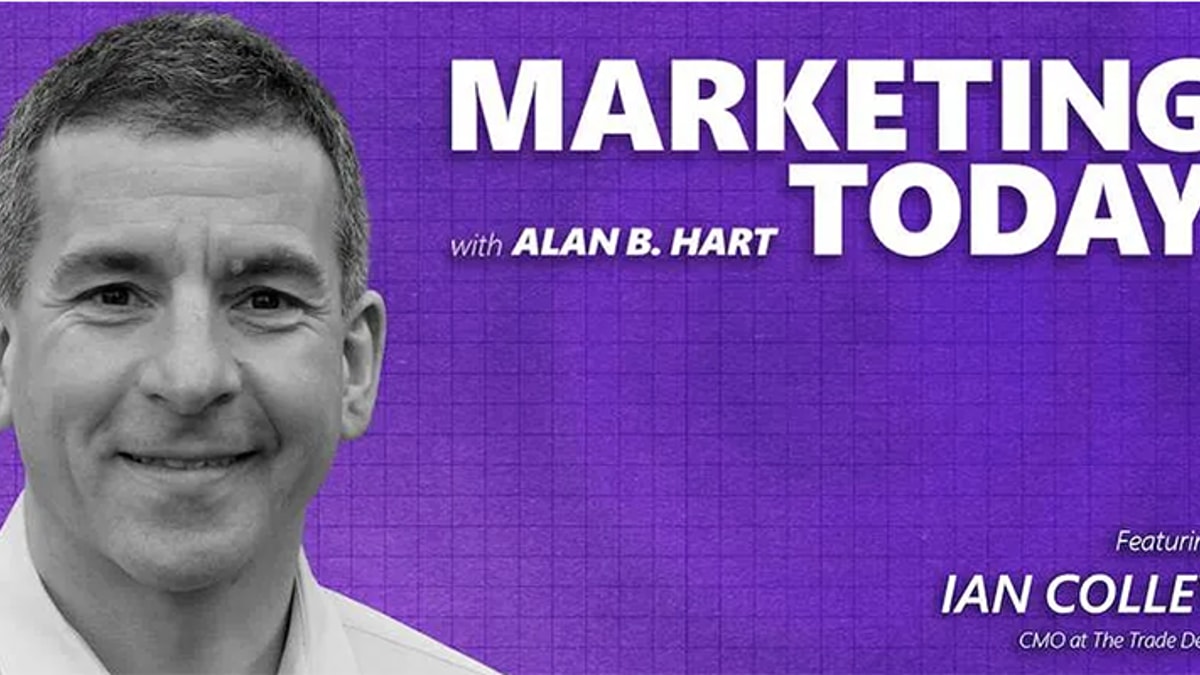
Colley did not start with a grand title. During college he worked as a chicken processor, a detail he recalled on the Marketing Today podcast. It is the sort of biographical fact corporate profiles usually polish away, which is precisely why it sticks. Before the strategy decks came repetitive work, pace and the immediate clarity of a job that either gets done or does not.
His professional career began at New York communications agencies Edward Novotny & Associates and the Weiser Walek Group. The client list was an exercise in tonal range: Goldman Sachs, Barclays Bank, Nuveen, Club Med and COMEX. Financial institutions ask for precision. A holiday company asks for desire. A commodities exchange demands that nobody confuse the two. Agency work taught the basic discipline of finding a distinct reason to care.
Then came IBM, and scale. Across more than 20 years, Colley led communications for divisions including IBM Europe, IBM Global Services, IBM Corporate and IBM Cloud. Enterprise technology can be magnificent and verbally unforgiving. The vocabulary arrives preloaded with abstraction. Communicating it requires a translator who can retain the technical truth while locating the business result.
Smaller companies, sharper briefs
At The Trade Desk, where he arrived in 2019 as vice president and head of communications, the abstraction had a political edge. The company was not merely selling software for buying advertising. It was arguing for the open internet against the concentrated power of closed platforms. When Colley asked a reporter what the reporter thought of his new employer, the answer was crisp: it was a good company in an industry everybody hated.
A less cheerful communicator might hear a warning. Colley heard a brief. The industry had disappointed investors, accumulated opaque habits and learned to speak a private language in public. The Trade Desk needed to say why an independent buying platform mattered to people outside the programmatic parish. The answer became the open internet: competition, choice, premium publishing and a media market not entirely controlled by a few giant platforms.
A category is a story people can use
Colley became The Trade Desk's chief marketing officer and executive vice president in 2022. His remit covered global marketing, communications, editorial content, content marketing and social media. The broad job description concealed a focused task: position the company as the independent alternative in digital advertising and turn a technical market structure into a memorable choice.
His public writing made the stakes explicit. He argued that open-internet advertising supports entrepreneurship and journalism, and that marketers under financial pressure need objective evidence tied to real business outcomes. Reach alone is cheap consolation. A CMO needs to know whether the work helped the business grow.
Explain the system
IBM: translate enterprise technology across cloud, services, corporate and regional operations.
Name the choice
The Trade Desk: frame the open internet as an alternative to closed advertising platforms.
Prove the outcome
DeepIntent: connect planning, activation and intelligence to measurable commercial decisions.
There is a practical lesson here for founders and operators. A category story works when it gives the customer a decision, not when it offers another definition. “Open internet” became useful because it named an alternative. At DeepIntent, Colley is attempting something similar with specialized intelligence: use the company's existing data infrastructure to frame a bigger choice about how commercialization is planned.
His move followed an abrupt spring. In April 2026, Colley left The Trade Desk during a wider leadership change. Weeks later he joined DeepIntent. The sizes were almost comic in their descent. IBM had roughly 400,000 employees during part of his tenure; The Trade Desk had grown to about 4,000; DeepIntent employed around 400 when he arrived. Yet the problem grew more specific at each stop, and specificity can make a brief more consequential.
Beyond the ad buy
Colley's thesis begins with an observation about precision. Consumer-goods companies can often sell to almost everybody. Specialized pharmaceutical products are relevant to far smaller populations. Cheap reach is therefore a blunt instrument. Programmatic decisioning, he says, fits a market where the audience is limited and relevance carries unusual weight.
The next step is the more interesting one. DeepIntent has spent a decade building data infrastructure and in March 2026 introduced Helix, a healthcare marketing cloud. Colley imagines that foundation supporting questions earlier than campaign activation: Which audience exists? How large is the opportunity? What evidence should influence a commercial plan? He predicted that within two or three years DeepIntent would be more than a DSP, becoming a planning platform using agentic AI.
AI is often marketed as a halo placed over a familiar product. Colley's version is more operational. Conversational tools could make complex data easier to query. Automated systems could help build audiences, activate across channels and adjust in response to results. The point is not the spectacle of the model. The point is reducing the distance between a difficult question and a defensible decision.
That emphasis also explains his recurring impatience with marketing-only metrics. In early 2026, he spoke about growing skepticism toward last-touch attribution and the pressure on CMOs to demonstrate actual market outcomes. The question hiding behind the dashboard is plain: what changed because the campaign ran?
The argument beneath the acronyms
Colley's public persona is built less on personal mythology than on lucid comparisons. Soap and toothpaste have broad audiences; specialized products do not. A platform may place an ad; a planning system might influence whether and how a market is approached. IBM, The Trade Desk and DeepIntent vary wildly in scale, but each required an explanation of machinery few customers wished to inspect.
He also keeps one foot in the civic argument around advertising. Since 2021, he has served on the advisory council of the Institute for Advertising Ethics. That role sits neatly beside his insistence on transparency, objective measurement and an internet that works for more than a handful of platforms. Trust is difficult to graph, but easy to notice when it disappears.
There is an appealing continuity to all this. At an agency, the translator stands between a client and the public. At IBM, he stood between engineers and enterprises. At The Trade Desk, he stood between an obscure supply chain and marketers who needed to understand its structure. DeepIntent places him between specialized data and decisions made long before anyone chooses a screen, a format or a bid. The nouns keep changing. The verb does not. Explain what the system makes possible, then give the audience enough clarity to judge whether the possibility matters.
The career lesson is not that every marketer should seek a more complicated category. Many already have one, usually hiding in the product copy. The lesson is to locate the consequence without inflating it. What choice becomes clearer? What waste is reduced? What can the customer do on Monday that was difficult on Friday?
Colley has carried that craft from agencies to an enterprise giant, from an independent adtech platform to a specialized one. His latest ambition is still being tested. The useful part is visible already: he is asking advertising technology to justify itself beyond the placement of advertising. For an industry with a famous appetite for new acronyms, a better question is a welcome piece of inventory.
Continue exploring