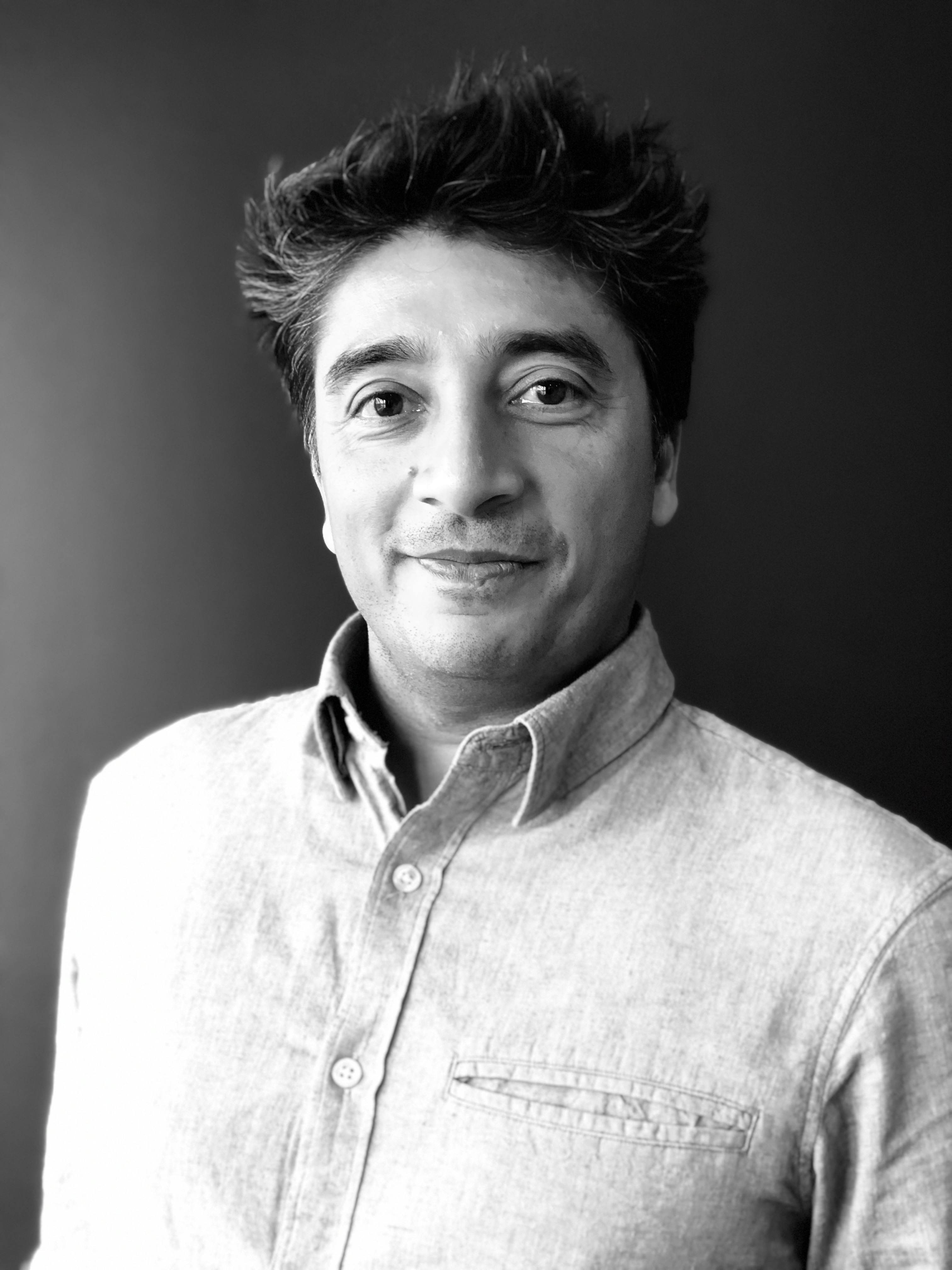
The first useful clue about Kumar Doshi is a job he did not wait to be given. Early in his career at Intel, after undergraduate study at Carnegie Mellon, he designed a rotational program for himself. Product development. Production. Finance. Marketing. Four rooms in the same house, visited by someone who wanted the floor plan before choosing where to put his desk.
Marketing won. But the other rooms never quite left him. They explain why his career reads less like a brand specialist's résumé and more like a repeated expedition into complicated systems: semiconductors, enterprise software, digital advertising, survey technology, generative AI and transaction data. In each case, the actual assignment has been remarkably stable. Find the useful signal. Give it a human shape. Make it possible for somebody to act.
01 · The originThe rotation he designed
Intel offered Doshi a view of how technology gets made. His self-created rotation supplied something more valuable: an understanding that a product is never just a product. It is an engineering decision, a production constraint, a financial bet and, eventually, a promise made to a customer. His last turn in marketing held his attention. At BEA Systems, he went on to build the “Built on BEA” co-op advertising program.
That sequence matters. Plenty of marketers learn a product from a briefing document. Doshi approached marketing after seeing the machinery on the other side of the wall. The result was a taste for translation, not simplification for its own sake, but the harder task of preserving what matters while removing what does not.
02 · Corporate scaleThe $107 million lesson
An MBA at MIT Sloan led into Microsoft, where Doshi joined what was described as a pioneering marketing innovation group. The work sat precisely in his preferred borderland. Teams collaborated with brands including Coca-Cola, Procter & Gamble, Unilever, Starwood and General Motors to make experiences that mixed technology with creative ideas.
A 2019 speaker biography credits him with helping that business grow from $2 million to $109 million. The arithmetic is striking, but the more durable lesson is about timing. Digital was still something marketers sometimes treated as a side budget. Doshi later recalled trying to convince brands to reserve 10 or 15 percent for the “emerging” medium. Today that sounds quaint, which is what happens to yesterday's argument after it wins.
“Marketing is the bridge between insight and impact.”Kumar Doshi, on joining Consumer Edge
Microsoft gave him scale, famous customers and room to explore. It also seems to have clarified what he wanted next. His public biography remembers an entrepreneurial urge and a plainspoken desire to “give it a shot.” So he left corporate comfort and co-created three ventures: CRMBZ, Serendipity and GetTexty.
03 · The detour that wasn'tGiving it a shot
Entrepreneurship often gets edited into a clean montage: whiteboard, launch, applause. Doshi's account is more useful. He says the ventures produced lessons and insight into what makes a startup work. That phrasing leaves room for the ordinary education of building: the idea customers misunderstand, the resource that runs out, the strategy forced to meet Tuesday morning.
The startup years did not cancel his corporate instincts. They gave those instincts consequences. At a large company, a positioning error can disappear inside a budget. At a small one, the error sits across from you at lunch. The combination of both experiences became Doshi's advantage when he moved through later roles at Rocket Fuel and, eventually, Lucid.
A career across the technology stack
- Intel rotation, then marketing at BEA Systems
- Microsoft marketing innovation and global brand work
- CRMBZ, Serendipity and GetTexty
- Rocket Fuel, Lucid and Cint
- Interim CMO at Beehive AI
- Chief marketing officer at Consumer Edge
04 · Research technologyThe people behind the panel
Lucid put Doshi in the business of understanding people at scale. The company provided programmatic access to survey respondents, a technical sentence with a deeply human problem underneath it: how do you know the person answering a question is the person you mean to ask?
On the MarTech Podcast in 2021, Doshi discussed research technology, respondent targeting and identity resolution. A willing survey taker is not automatically a customer. A large sample is not automatically a good sample. Data integrity depends on narrowing the audience with care, which is another version of the discipline he had practiced since Intel: understand the system before announcing what it means.
At Lucid, Doshi rose to senior vice president of global marketing. The company grew rapidly and became known as New Orleans' first unicorn before its acquisition by Cint. He helped guide the market story through the combination. Corporate integrations are where vocabulary becomes political. Two products, two cultures and two histories must suddenly agree on one sentence. Colleagues remember Doshi as a steadying presence during exactly that sort of change.
How a signal earns the right to matter
An editorial map of the recurring logic in Doshi's work, not measured performance data.
One former colleague offered a revealing detail. Through fast releases and company changes, teams looked forward to Doshi's “three key things.” He would reduce an initiative to a trio of purposes or tasks. It is easy to dismiss a numbered list as presentation technique. In a complicated company, it is closer to infrastructure. Attention is scarce. Clarity lets people move together.
05 · The AI chapterAccuracy before enchantment
After Cint, Doshi advised Flam and served as interim CMO at Beehive AI from 2024 into 2025. Beehive's pitch centered on domain-specific generative AI for customer intelligence. Doshi emphasized accuracy, particularly when companies use AI to make decisions about retention, satisfaction and adoption. General intelligence can sound impressive. A business still needs an answer grounded in its own context.
His comparison between the AI shift and the early digital shift is revealing. He does not treat a new medium as magic. He treats it as a place where customers are beginning to form opinions and make choices. Marketers who arrive early can help decide what useful practice looks like. Curiosity, in this view, is not trend chasing. It is a refusal to let an important interface be designed without the customer in the room.
06 · New York, 2025A bridge at Consumer Edge
Doshi's announcement that he would join Consumer Edge was refreshingly unvarnished. He admitted that he had not known the company when he was first introduced. Then he learned what its consumer behavior data could do, met the leadership and saw two familiar opportunities: work at the intersection of data and AI, and shape a marketing team that could sit near the center of the company's growth.
He began as CMO on September 2, 2025. Consumer Edge collects and productizes transaction, receipt, web and other datasets for investors and companies. Its customers are not short of numbers. Their shortage is time. They want to see a change in consumer behavior early enough to do something about it.
That makes the company's challenge almost comically well matched to Doshi's career. Intel taught him to see across functions. Microsoft taught him to build a business around an emerging medium. Startups taught him that every proposition eventually meets a real customer. Lucid taught him to care about who sits behind a data point. Beehive AI put accuracy at the front of the machine-learning conversation.
At Consumer Edge, those lessons meet in one place. In 2026 the company launched Cosmos Agent, a conversational tool designed to let teams ask consumer-spending questions in plain English and receive transparent answers more quickly. It is the current version of the old bridge: on one bank, an ocean of transaction records; on the other, a person deciding where to invest, what to stock or how to position a brand.
07 · The operating styleThree key things
People who worked with Doshi describe a positive leader, a consensus builder and a creative mind with program-management discipline. The descriptions are flattering, but the “three key things” anecdote is better because it shows the trait in motion. His talent is not merely having ideas. It is arranging them so a group can carry them.
His own favorite metaphor does similar work. Marketing is a bridge between insight and impact. Seven words. Two banks. One job.
The phrase also places a limit on marketing's vanity. A bridge is not useful because it photographs well. It is useful because people reach the other side. Data must become a choice. Technology must become an experience. A team must understand what happens next.
Doshi calls his career a series of journeys. It has certainly wandered across enough industries to earn the plural. Yet the itinerary has a stubborn logic. He keeps arriving where a technology is powerful, unfamiliar and slightly too pleased with its own complexity. Then he asks the question he learned to ask while moving through those first four rooms at Intel: how does the whole thing work?
After that comes the marketer's question: how can anyone else use it? Between those questions lies the work, and Doshi is still building the crossing.