There is an old television habit hidden inside Marcella Milliet Sciorra's very modern job. Before the acronyms, before the algorithms, before someone in a meeting says “omnichannel” with the solemnity of naming a new planet, you have to know whom you are talking to. Then you have to make the message worth their time. Sciorra learned the scale of that problem in media and advertising, where a single idea might need to travel through a national brand, a local sales force and a living-room screen without losing its meaning along the way.
Today she is chief marketing officer at Swoop, a New York advertising-technology company. Her vocabulary now includes machine learning, connected television, audience segments and de-identified data. Yet the center of her work is not mechanical. It is translation: between product engineers and marketers, between legal rules and practical choices, between what a platform can do and what a customer should reasonably permit it to do.
That is the clean line through a career that otherwise hops industries with cheerful disregard for neat labels. Sciorra has worked in consumer agencies, television, consulting and healthcare ad tech. She has operated inside large companies and joined smaller ones while their marketing departments were still being assembled. The scenery changed. The work kept asking the same question: how do you make complexity useful?
Act I · TranslationTwo cities, several screens
Sciorra is originally from Brazil. She studied at Universidade Santa Ursula in Rio de Janeiro, then earned a Bachelor of Science in nutrition and food science from Hunter College in New York. It is an uncommon foundation for an advertising executive, though perhaps a revealing one. Nutrition asks how systems affect people. Marketing asks how ideas reach them. Sciorra later added executive programs at the University of Virginia's Darden School of Business and Harvard Business School, plus an IAB digital media sales certification.
Her early career moved through Alcone Marketing Group, Rapp Collins Worldwide and GEM Group. At Colangelo Synergy Marketing she worked with national and international brands. She then entered the television world, taking marketing roles at NBCUniversal and Time Warner Cable Media before moving into leadership at Spectrum Reach, Charter Communications' advertising sales division.
A career measured in changing screens
Consumer agencies and global brand work
NBCUniversal, Time Warner Cable Media and Spectrum Reach
Sciorra Media Group and a Multichannel News Woman to Watch honor
Building DeepIntent's marketing organization, then serving as CMO
Chief marketing officer at Swoop
At Spectrum Reach, the scale was wonderfully unromantic. Sciorra led roughly 25 to 30 ad-sales and product-marketing professionals. Their work supported more than a thousand sales executives in 41 states and nearly 100 designated market areas. The products ranged from local linear inventory to advanced, multi-screen advertising. A big media company can make even a crisp idea feel like a parcel routed through several airports. Her job was to help it arrive intact.
“I love how our industry is always changing - always evolving.”Marcella Milliet Sciorra
She enjoyed the motion and disliked the drag. In a 2020 profile, Sciorra said her favorite part of leadership was building high-performance teams and an inclusive culture. Her least favorite part of corporate life was the slow pace of change. The pairing is telling. She was not merely impatient for a new product. She wanted organizations to become nimble enough to let good people make something of it.
Act II · The teamBuild the room before the brand
Sciorra's management advice is unusually concrete. Invest in the team. Invite differences in thought, background and belief. Encourage risks. Celebrate attempts as well as wins. Give feedback while it can still be used. Be generous with time and knowledge. These are not decorative values for a careers page. They are instructions for making decisions when the market is moving faster than the org chart.
Her own model came early. Sciorra names Margo Vallone, her boss at two different companies, as the mentor who saw potential in her before she could see it herself. That recognition appears to have compounded. Former colleagues describe a leader who connected company strategy to field-level reality and looked for growth opportunities beyond a person's job description. The story of a career is often told as a procession of bosses. Sciorra's version puts unusual weight on the people she was responsible for.
During the first months of the pandemic, she set herself a goal of networking with 100 leaders. When she wrote about high-performing teams in June 2020, the count had reached 86. Then came a more difficult test of the same instincts. She joined DeepIntent, built a marketing organization and helped relaunch the brand while the staff worked remotely. In 2022, she was promoted to chief marketing officer, responsible for brand, demand generation, events and public relations.
The title suited her, but the work still looked like translation. Healthcare advertising had technical products, specialized buyers and an ethical burden far beyond selling an ordinary household good. Sciorra had to make the company legible without sanding away that complexity. After a period as CMO at Doceree, she joined Swoop in June 2024.
Act III · The signalTelevision grows a second brain
People have announced the death of television so often that television could reasonably ask for royalties. Sciorra's view is less theatrical. Linear television still provides broad reach. Connected TV adds precision. The useful plan joins them. She has argued that the strongest media strategy does not replace one screen with another; it coordinates what each can do and measures the result consistently.
In her DeepIntent years, she became a public explainer of that convergence. A 2022 analysis discussed in Fierce Pharma reported that connected-TV impressions were more concentrated among a campaign's intended audience than linear-TV impressions. Sciorra's summary was brisk: television works, but connected TV “works harder and smarter.” The claim was not that software had made old media foolish. It was that data could make a familiar medium more exact.
The Sciorra translation loop
This is where her current work at Swoop becomes more demanding. Marketing built around sensitive data cannot treat privacy as a final review after the interesting decisions are made. In a 2025 Cannes interview, Sciorra praised brands for bringing in people who understand regulation and technology together. The distinction matters. A rule interpreted without technical knowledge can freeze useful work. A tool built without regulatory judgment can outrun the trust it needs.
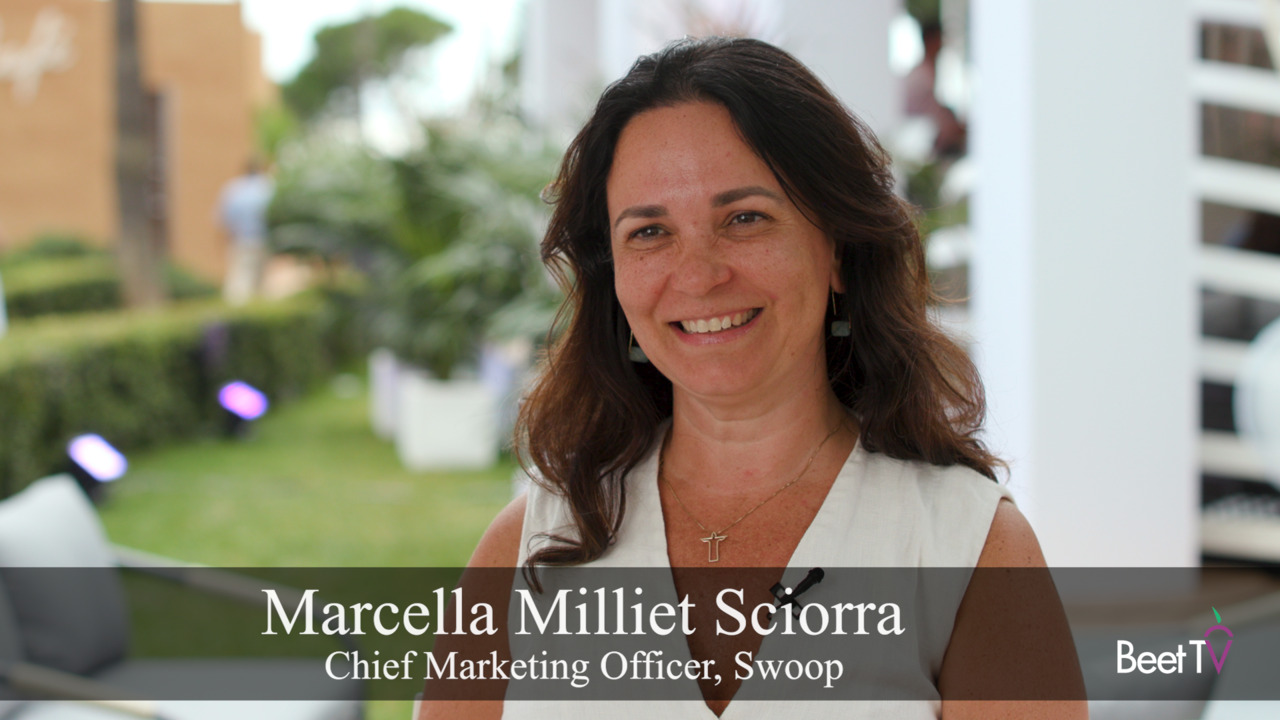
Her favorite shorthand is that omnichannel does not exist without data consistency. It is a marketer's phrase, but it contains a broadly useful warning. A fragmented system can produce an impressive dashboard while giving a person the same message too often, at the wrong moment, or without a coherent explanation. The channels are not coordinated merely because they appear together on a slide.
“You don't have omnichannel without data consistency.”Marcella Milliet Sciorra
Act IV · The identityA rebrand with its sleeves rolled up
Six months after arriving at Swoop, Sciorra introduced an evolved brand identity. She framed it as an expression of what the company had become and where it intended to go. The process preserved the company's recognizable mark and palette while modernizing the system around them. It was less a new coat of paint than an attempt to give a growing company a common visual grammar.
The project also continued a long creative relationship. Designer Rachel Gogel had worked with Sciorra across four engagements, from a Fortune 50 media company to healthcare startups. Repeated collaboration is a quiet sort of evidence. Executives often speak reverently about trusted partners; hiring the same one through several chapters is the stronger sentence.
By 2025, Swoop's marketing team had been included in the PM360 ELITE 100. Sciorra's public writing kept expanding with the company, covering brand architecture, television, AI and the practical challenge of joining multiple channels without losing a consistent audience definition. In 2026, as Swoop added the prescription-fulfillment company Nimble, her remit sat inside an even broader business. The translator had more dialects to learn.
Coda · What travelsThe message after the machinery
There is a personal footnote to Sciorra's professional fascination with television. She grew up with futebol in Brazil and later wrote about her family developing a ritual around American football on linear TV. It is a small story with a useful point: media is not experienced as a channel strategy. It is experienced as Sunday, a room, a family habit, something to discuss before the next commercial ends.
That may explain why her career does not read as a march away from old media toward shiny software. She has kept the human truth of the old thing and added the capability of the new one. A screen can reach millions. Data can narrow the distance. Neither guarantees that the message deserves attention.
Sciorra's ambitions, as she states them publicly, are institutional rather than autobiographical: better-connected systems, responsible uses of AI, teams with room to grow, marketing that can explain itself. This is sensible in a business intoxicated by scale. The cleverest machine in the room still needs someone to translate its choices. The bigger the audience becomes, the more carefully trust must travel with the message.