A medical-device company wanted to reach a particular kind of Floridian. The audience was narrow: the right age, the right location, the right medical condition. The desired action was modest, too. Visit a website. Perhaps register for a webinar. Somewhere between a television impression and that small act of curiosity lay the problem Cadent exists to solve.
- Cadent connects TV and digital advertising decisions.
- Acquisitions supplied identity, predictive buying, and YouTube expertise.
- The useful test: can better information change where the next dollar goes?
The audience left the channel
Imagine buying dinner by negotiating separately with the people who supply the plate, the fork, and the food. Advertising across screens can feel a little like that. Linear television has its buying customs. Streaming has its platforms. YouTube has its creators, contexts, and measurement tools. The viewer moves between them without giving the procurement arrangements much thought.
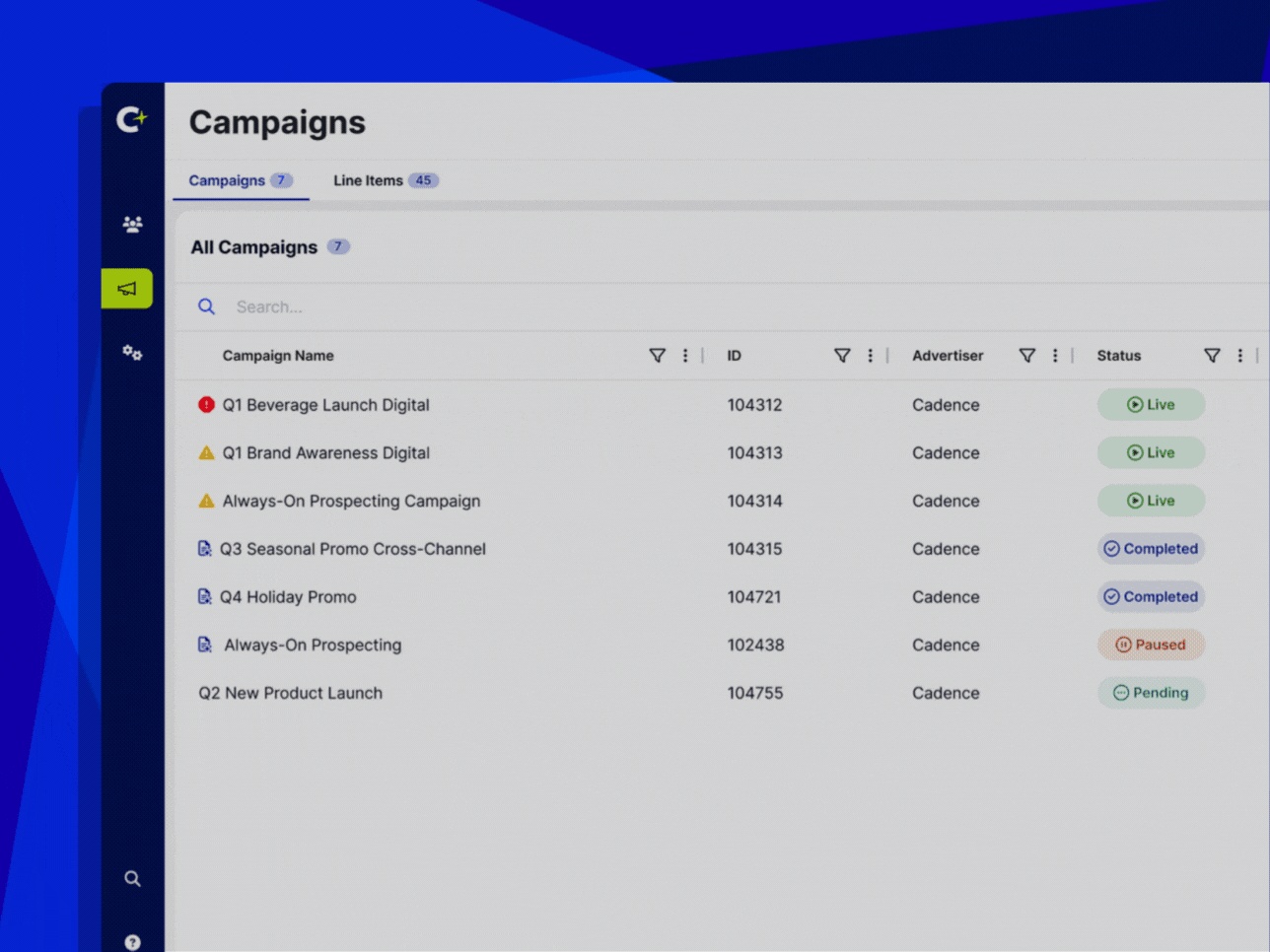
Cadent sells the coordination. Brands and agencies use its technology and services to identify audiences, activate campaigns, and measure results. Media owners use its capabilities to manage and monetize inventory. Its Total Video offering spans broadcast and cable, connected TV, digital video, and YouTube. Buyers can work through managed services or self-service arrangements.
The expertise sits in the plumbing: household identity, inventory relationships, predictive models, and the daily business of getting campaigns delivered. The customer roster spans advertisers, agencies, and distributors. VISIT FLORIDA provides a public testimonial; Liberty Global selected Cadent for addressable television in Europe. These are organizations dealing with audiences that refuse to stay inside one buying system.
- 01DefineThe business outcome
- 02ConnectAudience signals
- 03ActivateTV + digital + YouTube
- 04AdjustFollow measured results
Buying the missing pieces
Cadent’s history helps explain its product. Its predecessor, Cross MediaWorks, aggregated local cable advertising inventory for national advertisers. That is already a coordination business: assemble scattered opportunities into something a large buyer can use. The modern platform extends the same instinct into data and software.
Cross MediaWorks was formed in 2007 by Marc Krigsman, Larry Rubin, and Clarion Capital Partners. It was itself assembled through acquisitions, including TelAmerica Media. Lee Equity bought the business in 2013. By 2018, Cross MediaWorks and related brands had consolidated under the Cadent name. Buying capabilities and joining them together has been part of the business for years.
In January 2020, Cadent acquired 4INFO, whose household graph connected devices back to households. The companies had already been technology partners. In June 2024 came AdTheorent, adding machine-learning-led digital buying. The all-cash transaction valued AdTheorent at approximately $324 million. In December 2025, Cadent acquired VuePlanner, adding YouTube planning, optimization, and measurement.
There was money behind the expansion. Novacap bought Cadent in August 2023; Axios put that transaction at roughly $600 million. That number describes an ownership deal, rather than a pool of advertising credits or a customer price. The acquisition sequence reveals the strategy: connect the television business to the places its audiences have gone.
Cadent occupies a crowded market. The Trade Desk offers omnichannel programmatic buying. Comcast’s FreeWheel serves video buyers and sellers. Cadent’s particular combination joins television operations, household identity, predictive digital buying, and YouTube specialization. A buyer should compare those capabilities against the campaign’s needs. Owning more components only helps when they work together.
The budget changed its mind
Return to Florida. Cadent’s published medical-device case describes audience onboarding from Swoop, household and device connections, and activation across connected TV and online video. Website pixels supplied feedback. Reporting then revealed that online video converted more efficiently. The client shifted spending toward it and paused weaker creative.
The initial allocation needed revising. Evidence changed it. Cadent reported an approximately 51% reduction in cost per visitation and a 42% week-over-week increase in qualified homepage visits. Those figures belong to this campaign; the useful lesson travels further. Define an action, instrument it, and give yourself permission to move the budget.
Less cost per visit.~51%reduction
A second example exposes the measurement question. Celtra describes a Farm Bureau Health Plans campaign in which Cadent delivered location-specific CTV messages and QR codes. The reported video completion rate was 98%. That establishes viewing, while QR scans indicate another action. Neither measure, alone, tells you how many new customers were created.
An audience with adjustable ingredients
The same discipline applies before buying starts. In May 2026, Cadent introduced Predictive Audience Builder. Buyers can select, exclude, and weight signals such as geographic visitation, keyword behavior, and viewing activity. Instead of accepting a preassembled audience segment, they can examine more of the ingredients and tune the model.
In the launch announcement, McCoy’s Building Supply described testing Cadent’s predictive audiences against third-party segments derived from its own point-of-sale data. “This allowed us to simplify our approach,” said marketing and media strategist Elizabeth Crawford. The interesting word is “tested.” A segment’s name is a hypothesis about likely buyers. Its performance supplies the argument for keeping it.
For a prospective customer, the practical starting point is a measurable objective, usable data, and a conversation about inventory and fees. Commercial terms are negotiated. Before comparing proposals, put the media cost, data charges, measurement, and service work on the same page. Otherwise, a cheaper-looking offer may simply include a different set of jobs. The question for procurement is what the complete campaign needs to deliver. Ask what counts as a conversion, how overlap is handled, and whether results show incremental behavior. A small, single-channel campaign may gain little from added coordination. Sparse feedback or unreliable conversion signals can leave prediction optimizing the wrong thing.
The next test is inside the company
Cadent has applied AI to its own work, too. In December 2025, Cadent and Google Cloud reported 75% employee adoption within 90 days and more than 3,000 hours saved. The work included recurring tasks such as proposal responses and campaign planning, grounded in corporate systems. The reported numbers suggest a useful implementation principle: start with work people already do repeatedly.
“We are focused on creating true business transformation, not simply adopting new technology.”
Eoin Townsend / Chief Product & Technology Officer / December 2025
Execution now falls to a changing leadership team. Lisa Utzschneider became interim CEO and board chair in September 2026, with Nick Troiano moving into an advisory role. Cadent has assembled the parts. Its continuing test is wonderfully concrete: when the audience moves again, can the person managing the campaign make a better decision before the money runs out?