The first investment was $99, and Tim Vanderhook needed his brother’s credit card to make it. In 1999, at 18, he wanted a domain name for an online advertising business. Chris would supply the card and receive a share of the startup. Their brother Russell joined soon afterward for $33. A family partnership had acquired its first lesson in corporate finance.
The business became Specific Media and, eventually, Viant Technology. There would be private equity, Myspace, streaming television, a sale, a buyback and a stock-market debut. The teenager buying a web address would become the chief executive and chairman of a public company. He would also, years into that job, sit down and code an early version of its AI software.
There is a tempting way to arrange those events into a procession of correct decisions. It would leave out the interesting parts. Vanderhook’s career has involved learning new trades while the old ones were still paying the bills, and finding that an acquisition could acquire a different purpose after the headlines had moved on.
A brother’s credit card, a working education
The brothers began at their parents’ home in Yorba Linda, California. Tim was tired of odd jobs and saw an opening in online ads. Experience was in shorter supply than enthusiasm. “We taught ourselves everything,” he said, describing the launch. First came the mechanics of online advertising; an understanding of the wider advertising business followed.
Early work included pop-up advertising, a format unlikely to inspire affectionate nostalgia in anyone who remembers closing the windows. The business moved toward targeting ads using audience information. The technical problem kept changing: how to put a commercial message in front of someone for whom it might be relevant, and persuade the buyer that doing so was worth the money.
By 2007, Specific Media had attracted a $100 million investment from Francisco Partners. The money was intended to fund acquisitions. Vanderhook was discussing expansion into video, text advertising and overseas businesses. Already, the plan involved learning through purchases as well as building internally. An advertising network was becoming a buyer of other advertising businesses.
1999 / Tim was 18.
The peculiar afterlife of Myspace
In 2011, Specific Media bought Myspace in a deal involving Justin Timberlake. Few acquisitions could have supplied a more conspicuous contrast with the relatively obscure business of placing advertisements. Here was a name millions of people knew, carrying memories of music, profiles and friendships, alongside an uncomfortable question about what it should become.
The entertainment plans attracted scrutiny. A year after the purchase, the promised overhaul had yet to appear, traffic was largely flat and competitors in digital music were moving ahead. Celebrity involvement could get people to look. Giving them a reason to stay was a separate assignment. The gap between those two tasks was now very public.
Myspace also developed a less glamorous use. In 2015, Vanderhook described a Thursday traffic pattern: people returned to retrieve old photographs for their social posts elsewhere. An archive had become a recurring destination. The old profile might be unfashionable; the photograph inside it could still have an appointment on Instagram.
By 2016, he was discussing Myspace’s audience data as part of Viant’s advertising operation. That supplied another way to understand the purchase. The entertainment brand and the advertising infrastructure existed in the same business, with different measures of usefulness. Myspace could remain a familiar punchline while retaining a practical role behind the scenes.
Selling, then coming back
Time Inc. acquired a 60 percent interest in Viant in 2016. In 2017, Viant bought Adelphic, a demand-side platform, or DSP. The initials describe software that lets advertisers organize media purchases across channels. Owning that software helped Viant move from providing advertising services toward giving customers a platform they could operate themselves.
Then the owner acquired an owner. Meredith bought Time Inc. in 2018, inheriting the Viant stake. In October 2019, a transaction returned that 60 percent interest to the Vanderhook parties. The aggregate purchase price was $25 million. Viant was independent again, with the founders still involved and a software business to develop.
The sequence resists the usual tidy ending of a startup sale. Vanderhook had sold control, continued working and returned to independent ownership. Adelphic, acquired during the intervening period, became central to the company’s direction. The public offering arrived in February 2021, when Viant began trading on Nasdaq under a symbol that doubled as a description of its business: DSP.
Television keeps returning
Another 2011 project proved important to the trajectory. Tim and Chris started Xumo, an advertising-supported streaming service. Comcast acquired it in February 2020. At the time, Xumo offered more than 190 channels, with free live and on-demand programming organized in a channel guide. Television had found a new distribution system and a very familiar way to pay for itself.
For Vanderhook, streaming connects the publisher’s business to the advertiser’s problem. Free viewing requires somebody to buy the commercial breaks. Those buyers want to reach households, avoid wasting money and understand what happened after an ad ran. Viant’s platform sits on that purchasing side, where television meets the less telegenic business of settings, bids and reports.
The shortcomings can be painfully familiar from the sofa. In a 2022 interview, Vanderhook complained about seeing the same ad repeatedly. He linked the repetition to inadequate identification in ad transactions. To a viewer, it is an annoyance. To a marketer, repeated exposure beyond what is useful can mean paying again for a job already done.
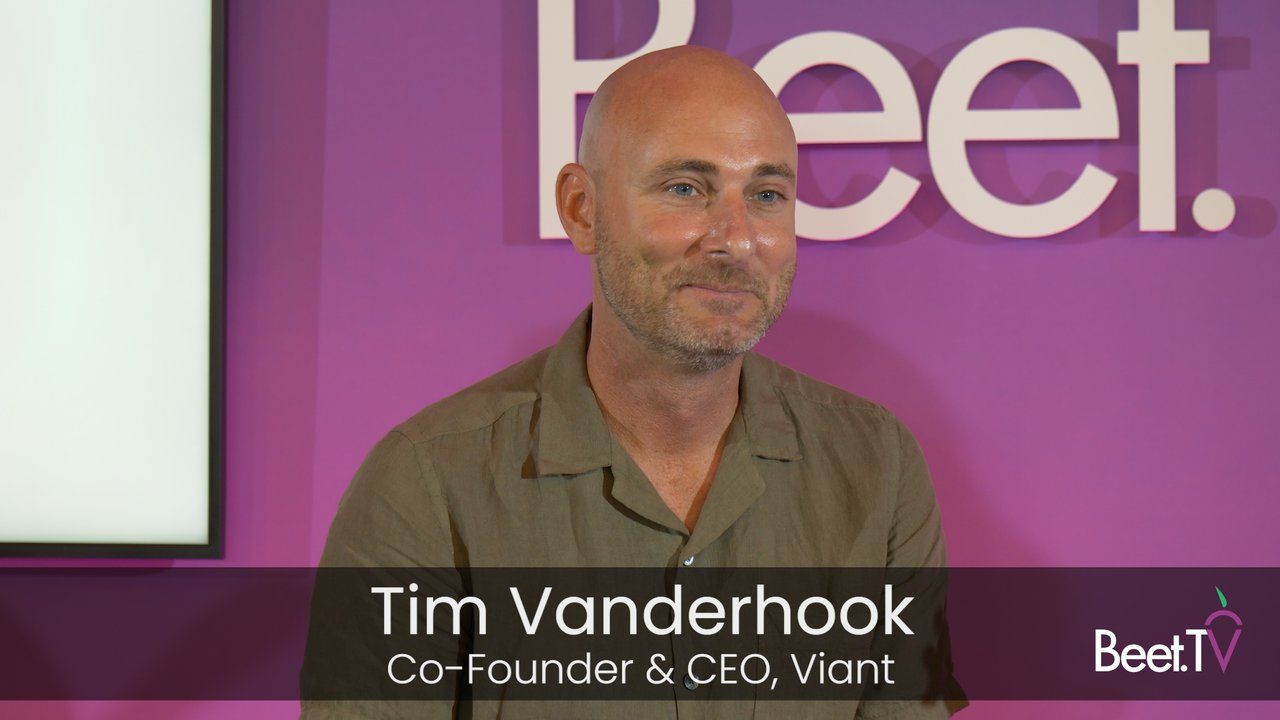
The CEO opens the code editor
His proposed answer to a growing pile of operational work is autonomous advertising. The reasoning begins with combinations: websites, apps, streaming channels and audience groups multiply the decisions a media buyer must make. Software can buy an ad electronically while still leaving a human with an exhausting amount of preparation and supervision.
Vanderhook took a direct role in testing that idea. Viant says he personally designed and coded the initial alpha of ViantAI. It is an unusually concrete detail in an executive biography. A prototype makes an ambition available for inspection. Someone has to decide what goes on the screen, what the inputs mean and what the system should do next.
At CES in January 2026, Viant introduced Outcomes, a product intended to manage campaigns toward a business goal such as customer acquisition or return on advertising spend. The aspiration moves more campaign decisions into the software. Whether that arrangement earns repeat business will depend on the results advertisers get, a practical examination for any elaborate piece of technology.
Three purchases, three different questions
The recent acquisitions help explain what Vanderhook wants that software to know. IRIS.TV, whose acquisition was announced in November 2024, provides information about video content. Its technology analyzes episodes, films and clips, supplying context for an advertisement. A description of the program can be useful even when the viewer is not individually identified.
Lockr, acquired in February 2025, addresses a different problem: helping publishers collect and use their own audience data, and connect it with advertising identifiers. Each separate technical integration can require engineering and ongoing maintenance. Making those connections easier is part of Viant’s effort to make its identification tools more widely usable across the open internet.
TVision added attention measurement in 2026. Its signals concern whether people are in the room, watching the screen or viewing together. That introduces a pointed distinction between delivering an ad and having somebody present to see it. Vanderhook discussed the issue at Cannes: counting delivery alone can leave the buyer paying without the human attention the purchase was supposed to obtain.
WHAT THE PURCHASES ADD
What is playing?
Can publisher data travel?
Is somebody watching?
An editorial guide to their roles within Viant’s advertising business.
Explaining the purchases is another part of his job. An ad buyer may want the technical detail; an investor wants to understand the money. “I have to context switch all the time,” Vanderhook said in a 2025 interview. It is a compact description of the distance between designing a product and running the public company responsible for it.
The home address in the story
Viant reported second-quarter 2026 revenue of $104.3 million, up 34 percent from a year earlier. Its connected-TV advertiser spending increased nearly 50 percent. Those are company results, rather than a personal scorecard, but they give the latest chapter a scale the original credit-card transaction could scarcely suggest. They also place a date on the current television emphasis.
His personal geography has been steadier than the ownership chart. “We love Orange County,” he said around the IPO, crediting local business mentors. He serves on Chapman University’s board of trustees. Viant employees have also brought practical advertising instruction into Chapman classrooms, connecting the company with students learning how marketing and data work together.
His official biography includes four children with his wife Laura, an enthusiasm for sports and work as a youth coach. Those details place the chairman somewhere beyond the earnings call. The business began in a family home; family remains part of the working story, including the brother who supplied that first credit card.
At the IPO, Vanderhook recalled his parents’ advice about working hard to get what he wanted. The omitted detail, he observed, was the duration: “for a really, really long time.” That is the useful correction to the $99 beginning. The purchase was small. The education kept sending assignments.
“For a really, really long time.”
Tim Vanderhook, on how long the work takes / 2021