An advertiser can know precisely what makes a customer valuable and still buy advertisements through software that cannot act on that knowledge. The insight belongs to the buyer. The decision belongs to the platform. Beeswax found a business in the awkward space between those two sentences.
- The offer: managed auction infrastructure, with room for your own data and bidding rules.
- The buyers: brands, agencies, media companies and ad-tech firms; named customers included Uber, DraftKings and Nexstar.
- The destination: acquired by FreeWheel in 2021; its technology continues within Comcast’s advertising business.
Programmatic advertising sounds forbidding until you reduce it to the decision underneath: should I buy this opportunity to show an advertisement, and what should I pay? Repeat that question at machine speed across websites, apps and television screens. A demand-side platform, or DSP, does the buying. Beeswax’s wager was that some customers wanted more say in the answers.
The buyer knew something the machine did not
Ari Paparo, Shamim Samadi and Ram Kumar Rengaswamy founded Beeswax in 2014 after working at Google. Their backgrounds covered advertising products and large-scale engineering. They understood the appeal of a ready-made platform. They also understood the irritation of discovering that your distinctive business must squeeze into its standard settings.
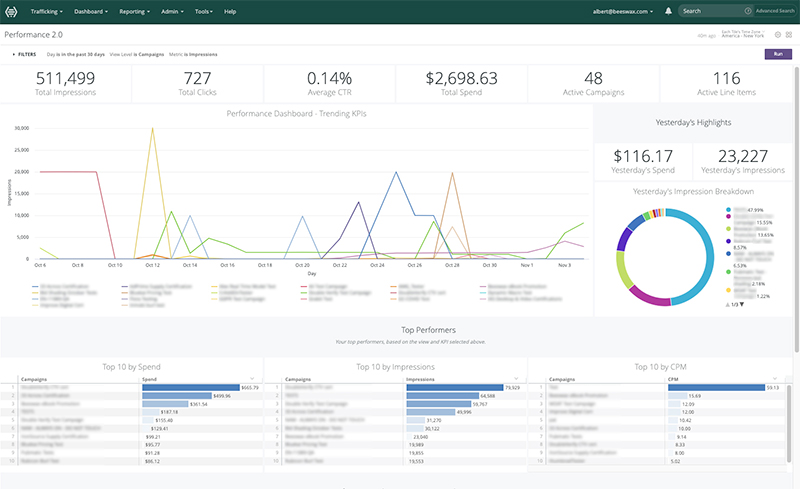
Beeswax called its alternative Bidder-as-a-Service. Customers could use managed real-time bidding infrastructure while supplying proprietary logic, data and workflows. APIs made the machinery accessible to other software. An individual bidder instance gave buyers their own operating environment. White-label capabilities let them present parts of the experience under their own brand.
The useful distinction was where the work stopped. Building an auction engine requires infrastructure, exchange connections and relentless attention to reliability. Building a rule that recognizes your best customers requires knowledge of your business. Beeswax offered to handle the former so buyers could concentrate on the latter. Nobody needed to become sentimental about server maintenance.
A meter, rather than a slice
Its business model sharpened the argument. Beeswax historically sold software capacity measured in queries per second, or QPS, rather than taking a percentage of the customer’s media spending. A query is an opportunity the system evaluates. The invoice therefore followed the load placed on the bidder, not simply the price of the advertisements it bought.
Consider the arithmetic. Under a hypothetical 10% media fee, doubling spending from $100,000 to $200,000 doubles the fee from $10,000 to $20,000. Capacity pricing need not rise simply because the same number of opportunities becomes more expensive. But more traffic can require more capacity. The advantage depends on the workload, the contract and how selectively the buyer filters incoming opportunities.
Example assumes a 10% media fee. These are explanatory numbers, not Beeswax prices. QPS contracts meter capacity separately.
This mattered as Beeswax moved toward connected television, where expensive impressions made percentage-based charges conspicuous. In January 2019, it raised $15 million from investors including RRE, Foundry, Amasia and You & Mr Jones. That financed expansion, but growth did not make the fundraising conversation effortless. Paparo told AdExchanger: “There is enormous skepticism about ad tech.”
“There is enormous skepticism about ad tech.”
Ari Paparo · January 2019
The glamorous business of entering an order once
The customers’ problems were often less theatrical than a custom algorithm. Media companies selling audience extension buy inventory beyond their own properties to fulfill advertiser campaigns. Suddenly a publisher is also a buyer, with two systems to operate and an invitation to type the same order twice.
Beeswax’s 2019 integration with Operative addressed that nuisance. Orders could flow from the order-management system into Beeswax’s Buzz interface, carrying targeting, delivery settings and metadata. Delivery information could travel back. The integration’s case-study page reports a 50% reduction in trafficking errors. That is a specific reported outcome, not a promise for every installation.
Elsewhere, a testimonial from customer executive Bruno Vannod reported average savings of 10% on media buys. The lesson is narrower than “customization saves money.” Control becomes valuable when somebody uses it to solve an identifiable problem: unnecessary expense, missing data or duplicated work. A more elaborate cockpit does little for a pilot without a destination.
Comcast had the other half of the conversation
In April 2020, Beeswax acquired MediaGamma assets and added three data-science team members to its London office. In December, FreeWheel announced its agreement to acquire Beeswax; the acquisition followed in 2021. FreeWheel’s announcement put Beeswax’s funding at approximately $28 million.
The strategic fit was unusually legible. FreeWheel served television publishers and operated advertising marketplaces. Beeswax supplied customizable buying technology. Publishers seeking extra inventory, and buyers seeking video audiences, could benefit from a closer connection between the two. FreeWheel also offered Beeswax greater television expertise, supply relationships and product investment.
The subsequent product work widened the audience. In 2022, FreeWheel described a more accessible Beeswax DSP built on the same underlying engine as BaaS, with managed services and more than 70 supply-side platform integrations. Sophisticated customization remained available, while the interface reduced the amount of engineering needed to get started.

Keep the part that makes you different
Today, FreeWheel’s naming announcement maps the former BaaS offering to Buyer Cloud and the Beeswax DSP to FreeWheel DSP. The names have moved closer to the parent. The underlying proposition still concerns how much of the buying process a customer can shape.
For anyone copying the approach, start with one decision your data can improve. Test that decision, inspect the logs and count the operating costs alongside the media costs. Teams needing only straightforward campaign execution may find a turnkey platform more practical. Customization earns its keep when there is expertise to use it and a measurable reason to care.
Beeswax’s enduring idea is a sensible division of ambition: rent the machinery that must run reliably, and build the judgment that gives your business an advantage. Advertising has plenty of elaborate promises. This one comes with an engineering boundary.