Before Jon Schulz sold cars, built an advertising brand, or lectured business students, he helped office computers learn a new trick. At Eli Lilly in the early 1990s, he developed software for sales representatives and mapped the hardware and software used by a 250-person marketing team. The destination was Windows 3.0. Personal computers were only beginning to become ordinary furniture at work, and Schulz was already standing between the machinery and the people who needed it.
It is a useful opening scene because his career has kept him in that same narrow, consequential space. Technology makes a promise. Marketing wants a result. Somebody has to translate between them, ask whether the numbers mean what everyone says they mean, and make the system useful to people with budgets, customers and impatient bosses.
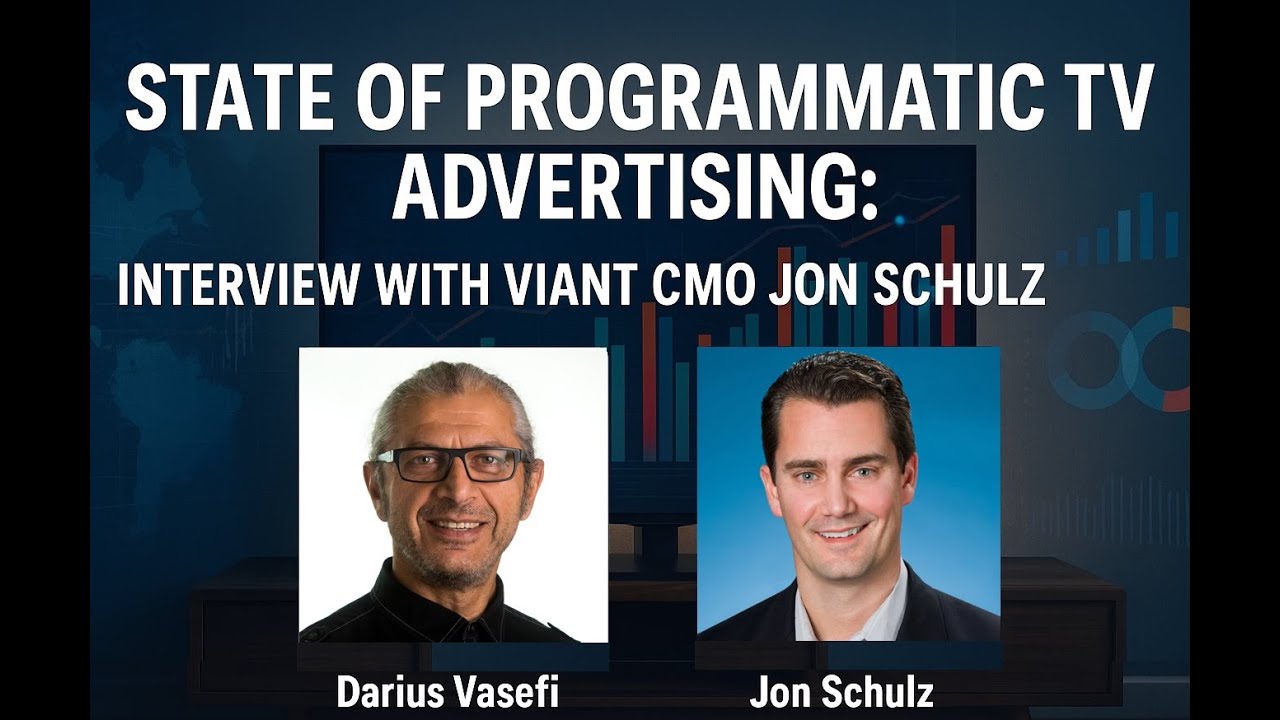
Schulz, now chief marketing officer at Viant Technology, has been doing variations of that job for more than three decades. His route passes through enterprise software, Ford dealerships, vehicle launches, web analytics, data partnerships, company acquisitions, a Nasdaq listing and connected television. It looks eclectic from a distance. Up close, it has a recurring plot: make a sprawling commercial machine legible, then make it perform.
A computer degree with a marketer inside it
At Central Michigan University, Schulz studied management information systems and graduated summa cum laude. The credential pointed toward technology, but his ambition pointed toward marketing. He later described his technical training as pre-internet: DOS, dBase and coding principles old enough to sound archaeological in a world of cloud platforms. The principles, he noted, travel better than the product names.
An MBA in marketing from Indiana University's Kelley School of Business gave the other half of the combination a formal shape. Schulz was an inaugural member of the school's Sports & Entertainment Academy and vice president of its MBA Marketing Club. Then Ford gave him the kind of education that does not fit neatly inside a syllabus.
From 1996 to 2006, he rotated through brand management, dealer operations, sales and global marketing. He wholesaled vehicles to dealers in a major metropolitan market. He worked on product, pricing, packaging and launch advertising. He built a lease-payment model meant to speed the creation and legal approval of local ads. In 1998, work on the launch of the Lincoln Navigator earned him a Lincoln Excellence Award.
The sequence matters. Before Schulz was responsible for a national digital operation, he had watched cars move through the actual commercial system. He knew the dealer network, the incentives, the financing and the customer-service side. A click could never be mistaken for the whole purchase.
The showroom meets the spreadsheet
In 2006, Schulz took charge of U.S. digital marketing and direct-to-consumer marketing for Ford, Lincoln and Mercury. His stated annual budget was $200 million. The assignment included vehicle and dealer websites, direct mail, email, telephone marketing and a custom-publishing partnership with Time Inc. for MyFord Magazine.
The more revealing work sat underneath the media. Schulz developed a web-analytics model to follow lower-funnel behavior, track return on investment and optimize campaigns across national and local retail advertising. This was the unglamorous question behind the glamorous car spot: what happened next?
“What gets measured gets done.”Jon Schulz
That line appears in his later remarks about sustainability, but it doubles as a compact career philosophy. Measurement, in Schulz's public work, is not decoration added after a decision. It is a way of making the decision answerable. At Ford the object was sales activity. At Viant it became audiences, devices, channels, attention, business outcomes and, eventually, carbon.
Viant, through all its plot twists
Schulz joined Viant in 2008 as senior vice president of global category development. His automotive experience arrived during a brutal car market, yet his University of Michigan-hosted CV records global automotive revenue growth of more than 40 percent in his first year. He then became executive vice president of business development, establishing a company-wide partnership function and working on go-to-market plans around acquired businesses including Myspace, Broadband Enterprises and Vindico.
When he became CMO in 2014, the brief widened again. He led brand and product marketing, demand generation, corporate communications, strategic partnerships and creative services. He also led a broad rebranding and repositioning effort while Viant developed the market identity of Adelphic, its advertising software.
Corporate history rarely offers the clean narrative marketers prefer. Viant bought Myspace in 2011, was acquired by Time Inc. in 2016, became part of Meredith, and was later bought back by its founders before listing on Nasdaq in 2021 under the symbol DSP. Schulz's role was to help explain the through-line while the ownership, products and industry vocabulary kept changing.
The household is larger than the click
Connected TV gives Schulz a familiar category of messy reality. People watch together. They look at their phones during commercial breaks. A television can be on while nobody is in the room. A household may contain several viewers and even more devices. The tidy fiction of one impression, one person and one response collapses on the sofa.
Schulz argues for measurement built around the household and the viewing context. In a 2025 streaming interview, he described Viant's buy-side-only position as important because it avoids steering advertisers toward inventory the platform itself owns. He also emphasized household identifiers for categories where decisions are commonly shared. His automotive background is easy to hear in the reasoning: expensive choices have participants, research stages and offline consequences.
A less fictional television impression
His recent commentary pushes beyond reach toward attention. Large audiences are not automatically attentive audiences, he has argued in public posts. In live sports, the conventional commercial break even announces the ideal moment to leave the room. Branded elements that coexist with play may retain attention better than an interruption. Here again, the proposition is grounded in observed behavior rather than the inherited shape of the ad unit.
Automation should return the afternoon
Schulz's case for AI is similarly practical. In Viant's short-form Adtech Decoded series, he describes autonomous campaign management as a way to reduce or eliminate time spent on repetitive optimization. The human sets a clear goal. The system steers toward it. The useful product is partly performance and partly “time back,” which can be reinvested in work closer to strategy and the business itself.
It is an operator's framing of artificial intelligence. There is little romance in moving another bid by hand. Nor does automation relieve leaders of judgment. Schulz's more recent public writing argues that as foundation models become more interchangeable, advantage migrates toward proprietary data, domain expertise, workflows and applications. A fluent machine still needs a worthwhile question.
“Data is an amplifier, not an engine.”Jon Schulz, writing about sports and attention
That distinction also appears in his comments about sports. Leagues possess vast stores of first-party data, but personalization cannot manufacture interest in an uninteresting product. Improve the game, build the story, develop the star. Then data can amplify the attention that exists. It is a refreshingly stern message from an ad-tech CMO: sometimes the problem is the thing being advertised.
The 60,000-wristband problem
At a Detroit Lions game, Schulz watched the crowd receive electric wristbands. The effect presumably worked. Then the lights came up. He recalled seeing roughly 60,000 wristbands discarded on the ground. The anecdote gives physical form to a problem digital advertising usually hides behind glass: media has weight.
Servers use electricity. AI demands more computing. Ad production requires travel and materials. Programmatic auctions can create long supply chains in which multiple systems expend energy competing to serve the same moment. Schulz has used Viant's sustainability work to press for carbon measurement, renewable-energy support and more efficient supply paths. He also recognizes the test: commitments become less comfortable when they threaten the bottom line.
The wristbands are a perfect Schulz story because they join spectacle to systems. A marketer can appreciate the glowing stadium and still count what is left on the floor. The trick is to hold both ideas at once.
A working life of translation
Schulz teaches digital advertising at the University of Michigan's Ross School of Business and has advised automotive-technology startups. His public record also includes mentoring through Techstars and volunteering with Detroit-area organizations. His official biography mentions sports and Northern Michigan lake life, two interests that keep his biography anchored close to home even as the company he represents is based in California.
Teaching is a fitting parallel occupation. His career has depended on explaining one professional language to people who speak another: code to marketers, analytics to brand teams, automotive behavior to technologists, and a mutable ad-tech company to the market. Translation is easy to dismiss because its best result looks obvious after someone has done it.
The tools have traveled from DOS commands to algorithms that adjust campaigns without waiting for a trader. The central task has moved less. Define the real outcome. Understand the whole system around it. Measure without mistaking the metric for the customer. Leave room for human judgment. And after the lights go down, look carefully at what is left on the floor.