In July 2012, Michael Yavonditte gave a brief explanation for the end of his startup, Hashable: the team had not made it good enough. The service, which tried to improve the way people remembered their business connections, would close that month. He was returning to mobile advertising. There was no elaborate farewell tour. An experiment had failed; another business was taking shape.
For someone who had already led an advertising company to an acquisition by AOL, admitting that a digital address book had beaten him was useful candor. It also supplied a better introduction than a polished list of exits. Yavonditte could sell, build, invest, and begin again. He could also recognize when a product had failed to earn its place on someone’s phone.
The return produced Yieldmo, co-founded in 2012. Fourteen years later, he remains its CEO. Follow the route through his earlier jobs and subsequent experiments, and a recurring concern becomes visible: how to make the machinery connecting advertisers and publishers easier to understand. His latest work asks buyers to inspect the goods before the auction. In advertising, that apparently modest request can occupy a career.
Selling before the search box
Yavonditte started at Ziff-Davis Publishing in New York, working in sales and management. He studied business and political science at Pace University. His early professional education, however, came through negotiating how companies reached customers and how publishers got paid. Before the vocabulary grew to include predictive models and contextual intelligence, there were agreements to close.
He joined Juno Online Services in 1997 as a business development director and became a vice president the following year. When Juno introduced a paid internet service in 1999, his group worked on software distribution agreements with hardware manufacturers. Getting a service onto a computer was part of getting a customer. Distribution was a practical problem with signatures attached.
At AltaVista, which he joined in 2000, he negotiated major commercial agreements and helped develop its Trusted Feed paid-inclusion program. A subsequent role at USA Networks involved outsourced ecommerce alliances. These were jobs at the boundary between technology and the commercial arrangements that kept it running. They help explain why his later companies paid so much attention to the mechanics of a transaction.
- 1997Juno
Distribution & deals - 2002Quigo
The CEO chair - 2007AOL
Quigo acquired - 2012Yieldmo
Back to advertising - 2026YMax.ai
Before the bid
A publisher was more than a category
In 2002, Yavonditte became CEO of Quigo. The company had been founded by Yaron Galai and Oded Itzhak, and its AdSonar product connected advertisers with publishers through an auction-based, pay-per-click marketplace. Context mattered: an advertisement could sit beside material relevant to what it was selling.
Quigo also offered advertisers visibility into the specific pages where their ads would appear. That detail deserves a moment. A publication has an identity, a relationship with its readers, and particular places where an advertiser might want to be seen. Treating all of those locations as an undifferentiated bucket can make an efficient system feel rather like a hotel that refuses to tell you which city it is in.
The proposition found customers. In 2007, Time and Quigo announced a relationship they expected to generate more than $100 million in advertising revenue over its first three years. That was a forecast for a partnership, rather than a tally of money already collected. Later that year, AOL acquired Quigo. Yavonditte had helped turn a different approach to selling publishers’ inventory into a business an established internet company wanted to own.
The address book gets its revenge
Hashable took him away from advertising and into the etiquette of meeting people. It offered a way to record relationships and interactions: the breakfast, the introduction, the person whose name might otherwise disappear between a conference and the flight home. The idea was recognizable to anyone who had ever returned from an event carrying more business cards than memories.
In a 2011 conversation, he described making the collection of information about a network enjoyable. There were tags, social interactions, and plans for a location layer at South by Southwest. Remembering people could become an activity in its own right. The difficulty, of course, was persuading people to keep doing it after the novelty had worn off.
By July 2012, the company told users to export their histories before the service shut down on July 25. Yavonditte’s explanation pointed back to the team’s advertising expertise. Read alongside Quigo and Yieldmo, Hashable supplies an essential complication. Experience can help a founder raise money and assemble colleagues; it cannot oblige a new product to work. Knowing when to close it is another kind of judgment.
“we simply couldn’t make Hashable good enough”
Michael Yavonditte, July 2012
An experiment with a very fast answer
Yieldmo brought him back to ad markets, with colleagues whose working relationships stretched back to Quigo. Rick Eaton, its co-founder and CFO, had also been Quigo’s CFO. In a conversation marking roughly a decade in business, Yavonditte spoke with pride about the team’s long association. Amid the changing products, the continuity of people was something he chose to emphasize.
He described the attraction of the work in unusually practical terms: large amounts of data, frequent experiments, and rapid feedback. He called himself an “optimization person”. Advertising lets someone with that disposition change a system and find out quickly whether the change helped. There is satisfaction in a question that comes back with an answer while it is still interesting.
Speed cuts both ways. He also described a marketplace where buyers can start spending quickly and stop even faster. The same flexibility that makes programmatic advertising attractive to customers gives an operator little shelter when budgets contract. A good experiment and a dependable business are related ambitions, but they still demand different work.
His interest in measurement has a formal counterpart. A US patent granted in February 2021, naming Yavonditte among its inventors and assigned to Yieldmo, concerns quantifying advertising impressions. The title is admirably unromantic. It addresses a basic commercial problem: two appearances of an advertisement may both count as impressions, while offering different opportunities to attract someone’s attention.
Read the page before buying the audience
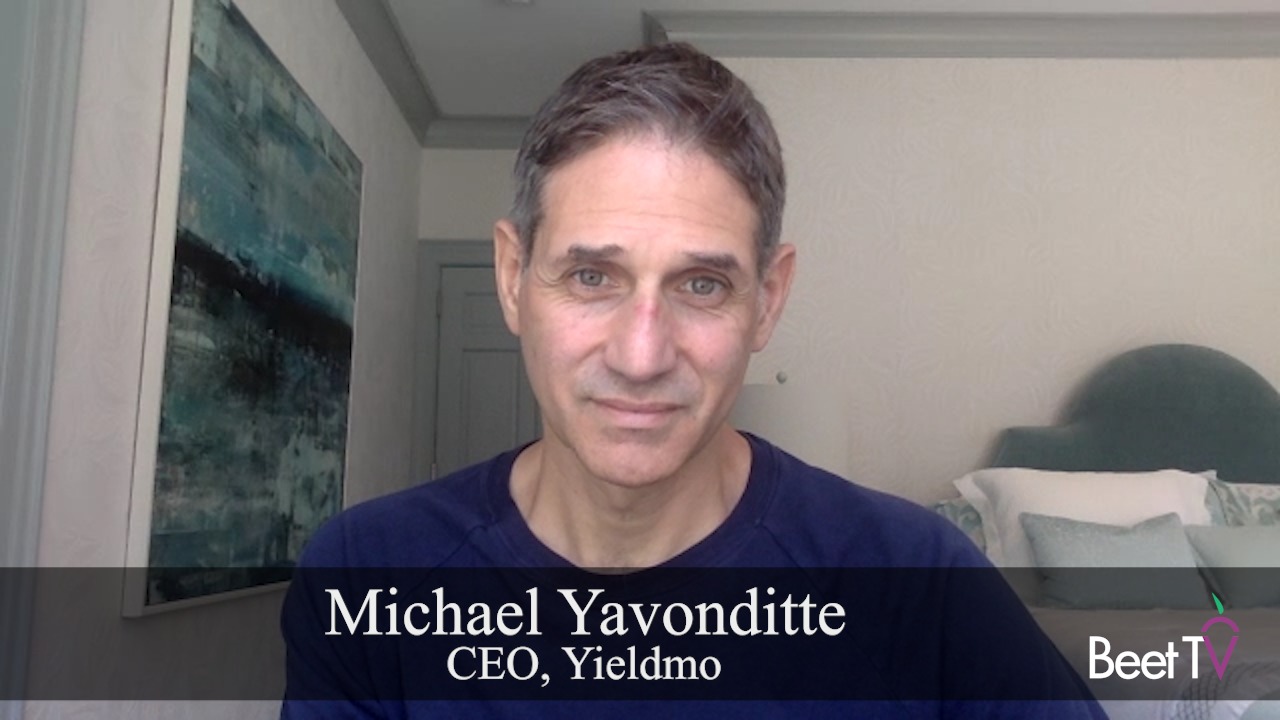
By 2021, Yavonditte was describing years of investment in infrastructure for collecting and organizing signals from advertising environments. The objective was to feed models that correlated those signals with advertisers’ desired results. Much of the work happened beneath the visible advertisement, in the systems deciding which opportunities deserved a bid.
That distinction matters to his story. A reader encounters an ad as a rectangle, a video, an interruption, or occasionally something useful. The operator sees choices about placement, format, timing, and value. Yavonditte’s career has repeatedly returned to making those choices more deliberate. A better-looking advertisement has limited use if it arrives in the wrong place.
Yieldmo’s current YMax platform puts that interest into an interface. The company describes tools that accept natural-language prompts, campaign briefs, or creative assets, then help buyers examine relevant inventory. It offers visibility down to an individual article’s URL before activation, alongside projected performance. The commercial promise is straightforward enough to survive the industry terminology: know more about the proposed purchase while there is still time to change it.
The June 2026 expansion of YMax.ai tied that promise to more than eight years of proprietary performance and pricing data. Yieldmo presented the platform as a way to combine semantic targeting, creative optimization, and pre-bid information. The forecasts remain forecasts; a predicted result is a reason to test, rather than a receipt for an outcome. For Yavonditte, the interesting shift is moving more of the decision ahead of the spending.
a creative asset
projected performance
then run the campaign
The fans outside the arena
The approach has acquired a sports application. On March 24, 2026, Pacers Sports & Entertainment launched the Fieldhouse Media Network with Deloitte and Yieldmo. It used YMax.ai alongside Deloitte’s fan-data technology to extend sponsorship activity into digital media. The premise was that a team’s commercial relationships could follow fans beyond the venue and beyond game day.
There is an appealing continuity here. Years earlier, Quigo treated a publisher’s individual pages as places worth choosing. In sports, the question becomes where people are already reading about the teams and events they follow. The arena has a fixed number of seats. Interest in what happens there has a less convenient seating plan.
In July 2026, Yieldmo and Partnerbrite, owned by WSC Sports, announced a partnership combining fan-data activation, contextual advertising, and automated content creation. The planned offering spans social media, connected television, and the open web. These are company initiatives involving many people. They also show where the company Yavonditte leads is taking its long-running interest in the relationship between content and advertising.
Technology investments alongside an operating career.As described in Yieldmo’s public executive biography.
A builder who also takes the other chair
Yavonditte has another view of company building as a private investor in more than 100 technology businesses. His publicly listed investments include Trello, Meetup, Tapad, Beeswax, and YipitData. The list puts him on both sides of a familiar conversation: the operator explaining a business and the investor deciding whether to believe in it.
His professional biography pairs an interest in art and design with math and data. That combination fits the work better than a purely numerical portrait would. Advertising has to function as a system and appear as something a person might willingly notice. An optimization model still has to contend with a reader who would prefer to get on with the article.
In his 2025 account of using AI, Yavonditte favored keeping people involved in decisions, particularly creative approvals. He also described helping his son prepare for the SATs by building diagnostic tests with AI. It is a small domestic example beside an advertising platform, and a revealing one: find a task, make a tool, see whether it helps.
Hashable remains part of that picture. The failed address book and the continuing advertising company belong to the same working life. Yavonditte’s record is more interesting with both included. The products have changed; the commercial questions keep returning. Who needs this? What can they inspect? What will persuade them to use it again? Before another dollar moves, he would like a better answer.
Continue the conversation
- Yieldmo - company and leadership
- Michael Yavonditte on LinkedIn
- Michael Yavonditte on Twitter/X
- The Hashable closure, July 2012
- Watch: a conversation with ff Venture Capital
- Watch: the 2021 Beet.TV interview
- Listen: Dave Lerner’s interview
- AI, judgment, and transparency - the 2025 interview
- YMax.ai expansion, June 2026
- The Fieldhouse Media Network announcement