A woman hears a podcast advertisement. Later, a display ad reminds her of the same clothing brand. She buys. In the accounting department of digital advertising, an argument has just begun: did the podcast do the persuading, or did the display ad? The receipt is real. The division of credit is considerably less tidy.
- Digital Remedy buys and manages media for brands, agencies and media companies.
- Echo measures across channels; RemyAI helps teams interrogate campaign data.
- Its proposition combines software with the people who run and adjust campaigns.
The sale had two witnesses
Digital Remedy published a case that makes this problem unusually concrete. An unnamed women’s apparel advertiser ran a one-month podcast-and-display test with an initial $42,000 budget. Display advertisements followed podcast exposure. The team adjusted creative, audiences, geography and placements as conversion data arrived.
The company reported more than $122,000 in revenue and 291% return on ad spend, using a seven-day lookback window. Nearly 90% of checkouts were attributed to display retargeting. Read only the closing channel’s report and you might decide that podcasts deserve a smaller cheque. Read the sequence and another explanation becomes possible: the reminder benefited from an introduction.
That second explanation is plausible, not proven by the case. Attribution assigns credit; an incrementality test asks whether the sale would have happened anyway. This distinction sits near the centre of Digital Remedy’s present business. Buying advertising is one job. Understanding what the buying accomplished is another, and the two often quarrel.
A quarter-century of changing the question
Mike Seiman started the business while studying at Hofstra University. Founded in 2000, it operated under earlier names including CPX Interactive and CPXi before becoming Digital Remedy in 2017. Its history belongs to an advertising market that repeatedly changes its vocabulary, machinery and preferred screen.
In 2014, CPXi announced $30 million in funding from the Business Development Corporation of America for programmatic technology and services. The pandemic supplied a different pressure. In a 2020 interview, marketing executive Tiffany Coletti Kaiser described stalled budgets and paused campaigns, followed by AdReady+, a self-service offering giving clients access to internal planning, buying and reporting tools. Flexibility became a product requirement.
The ownership story changed in March 2025. Sinclair bought the remaining 75% it did not already own for approximately $30 million. That June, it rebranded Compulse under Digital Remedy’s name. Today’s company therefore carries the combined business’s broader workflows and services. A historical headcount or revenue estimate cannot neatly describe the operation now.
Echo listens across the room
Digital Remedy works for brands, agencies and media companies. A small agency can add programmatic execution without assembling every capability internally. A direct-to-consumer brand can put connected television into a performance plan. A media company can use licensed software and fulfillment services. These are different buyers sharing a familiar shortage: time to make disconnected systems cooperate.
Its offerings group around Performance TV, Performance Action and Performance Brand. The first covers television campaigns, including linear and connected TV; the others organize media around consumer actions or brand goals. Planning, buying, targeting, creative, optimization and analytics surround the software. Sinclair’s annual report describes a business earning revenue from platform licensing and managed digital initiatives.
“Marketers don’t have a lack of data - they have a lack of clarity.”David Zapletal, chief operating officer · Echo launch, February 2026
Echo, launched in February 2026, is the measurement expression of that argument. Digital Remedy says it is designed to unify data from more than ten demand-side platforms and over 200 data providers. Its capabilities include flexible attribution models, journey analysis, incrementality testing, and signals showing audience overlap and frequency.
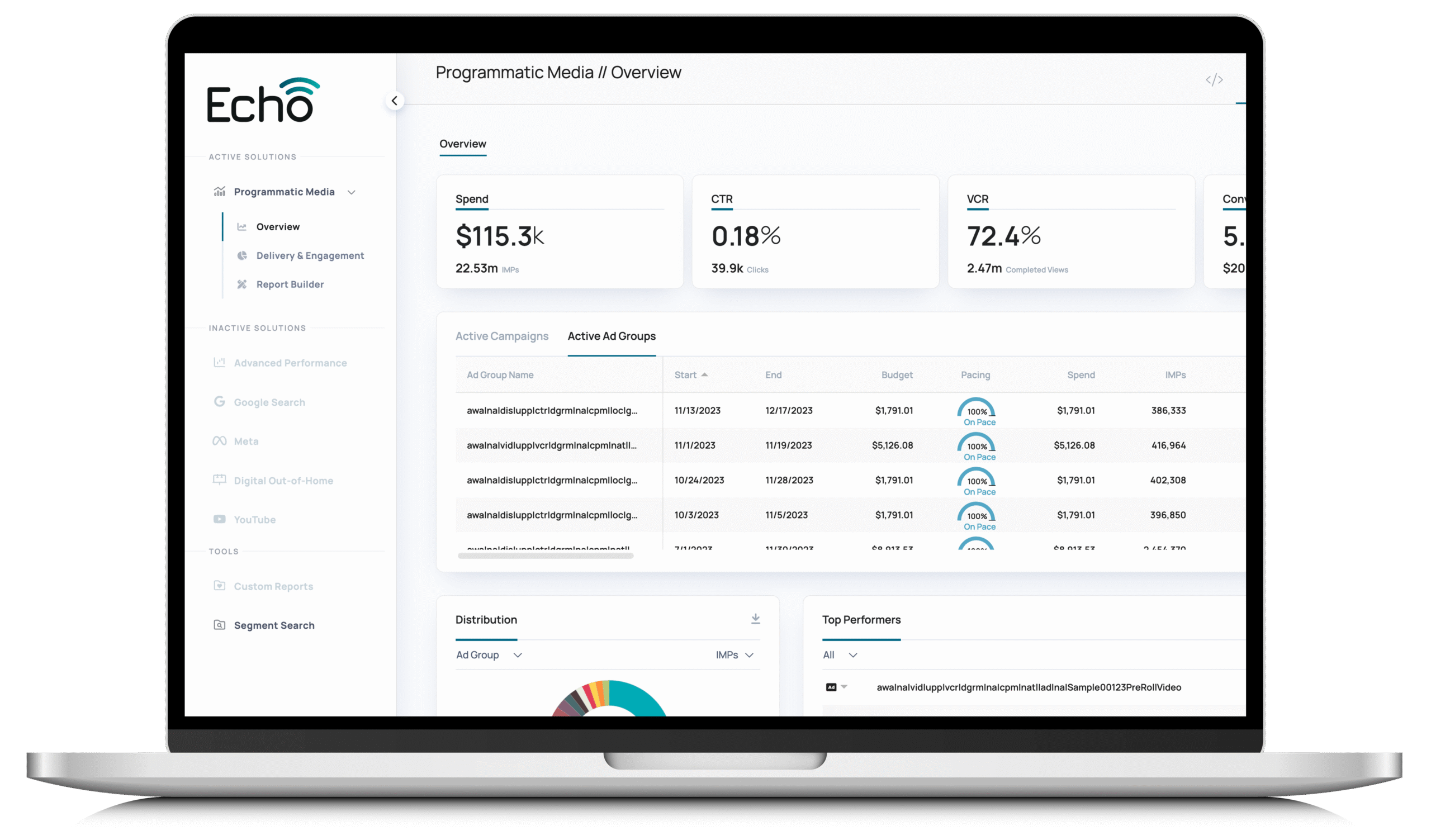
For an agency, this means a chance to discuss how channels interact while a campaign is still running. Digital Remedy’s positioning joins that measurement to execution across buying systems. The alternative may be a specialist CTV vendor, a managed programmatic partner, or an internal team coordinating its own platforms. The useful comparison is the work each option takes off the buyer’s desk.
The report now answers back
RemyAI arrived in July 2025. Integrated into the platform, it lets media teams ask campaign questions in ordinary language and generate summaries, visualizations and exportable reports. External datasets can be uploaded. Agencies can customize the branding. VI Marketing and Branding participated in the beta rollout, helping shape the tool around actual media workflows.
An account manager might ask which creative performs best in a particular market instead of requesting another spreadsheet. The practical attraction is shorter distance between question and decision. It still matters what data was supplied, which conversion window was chosen, and whether the answer describes a relationship or establishes a cause.

People remain part of the proposition. Digital Remedy advertises 24/7 account support. It also ranked first on Crain’s 2024 Best Places to Work in NYC list, its twelfth consecutive appearance. A workplace award cannot guarantee campaign results. It does offer a more concrete glimpse of the organization than another declaration that the algorithm is clever.
A prettier ad, a more practical lesson
For accessories brand Machete and agency Marketwake, Digital Remedy deployed interactive Product Tiles showing several products inside one advertisement. The published case reports 409% ROAS in the first 30 days and a 21% month-over-month improvement. Onsite tracking informed revenue optimization; the reported success prompted further audience tests. These are company-reported outcomes, rather than a forecast for the next advertiser.
The method is copyable: choose the business action, make the offer visible, track revenue, and adjust before the budget is gone. Evaluate the creative and its audience together. For buyers, the commercial question should include media spending, service charges and software access separately. A campaign’s $42,000 test budget is not a subscription price.
Beyond the shopping basket
In May 2026, Digital Remedy launched The Political Desk, with VoterReach mapping delivery to congressional and state legislative districts. In July, its Arrivalist partnership added travel-behavior audiences and measurement of visitation and visitor spending, including exposed-versus-control analysis. The outcomes change; the demand for accountable media persists.
These approaches depend on usable outcome data, sensible measurement windows and credible comparisons. Fragmented inputs or an unsuitable control group can make a handsome report misleading. Digital Remedy’s most interesting promise is the opportunity to investigate before spending again. The advertiser gets to ask a better question: what should we do with the next dollar?
Keep following the campaign
Website · Platform & demos · Company news · Blog · YouTube videos