The modern advertisement has an identity problem. For years, its machinery worked by collecting enough crumbs - a cookie here, a mobile identifier there - to decide that the person holding a screen might want a hatchback, a credit card or a week in Mallorca. Then browsers restricted cookies, Apple made app tracking a choice, privacy rules tightened and consumers became harder to recognize. The marketing brief remained. The familiar trail did not.
Ogury has spent the past decade building an answer that sounds almost impolite in a business obsessed with one-to-one precision: stop trying to know everybody. The London adtech company groups people into anonymous personas, learns what those groups care about, and predicts the digital places where they are likely to appear. It targets the placement, not a personal dossier.
That distinction is the company’s product and its sales pitch. Ogury calls the underlying system Persona Intelligence. The input starts with large-scale surveys in which people declare interests, preferences and purchase intentions. The company enriches those responses with contextual and semantic information, bid-request data, campaign delivery results, public datasets and AI modeling. The output is a map of groups: what matters to them, which sites and apps they visit around a topic, when they tend to be online and where a campaign might reach them.
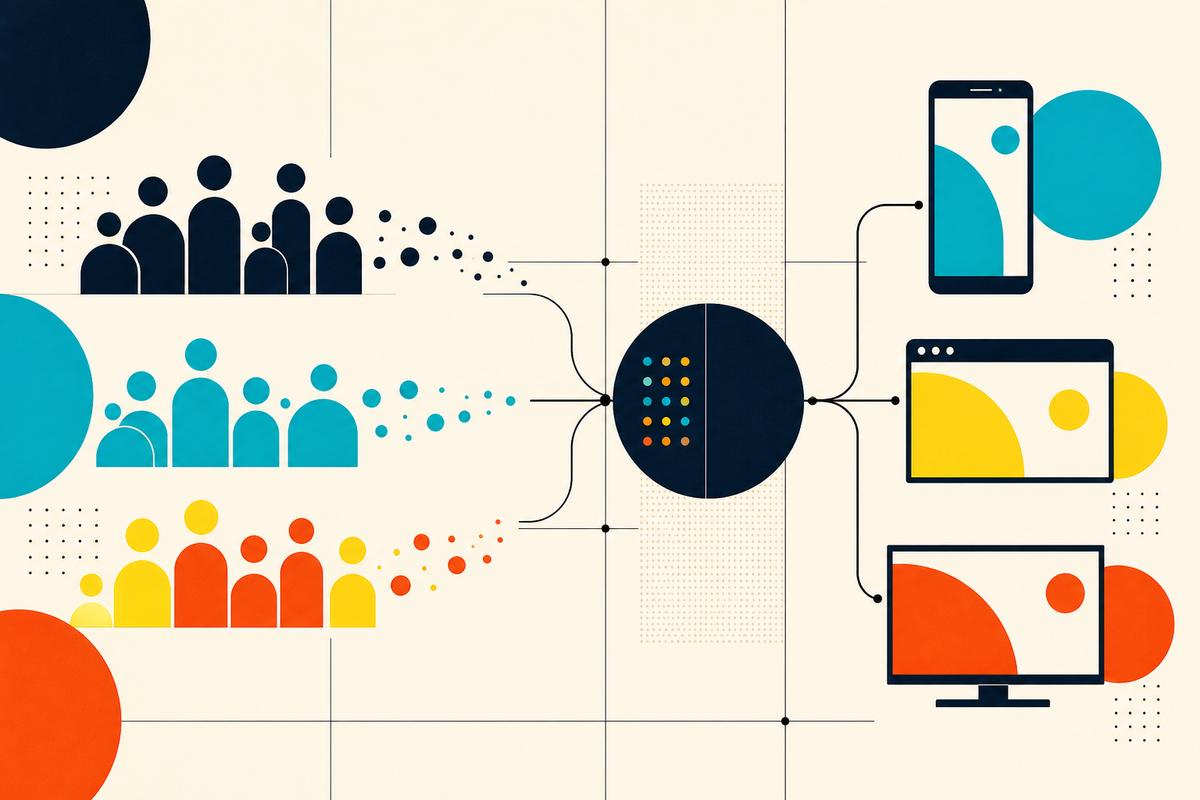
A persona is a compromise with ambition
Traditional behavioral targeting tries to infer an individual’s interests from a history of actions. Pure contextual advertising ignores the person and buys against the meaning of a page or video. Ogury sits between the two. Its personas carry audience knowledge, but the activation happens at placement level. If the model expects a certain persona to be concentrated around a particular combination of content, device, place and time, the campaign bids there.
How the model moves
The compromise is useful. Advertisers retain something richer than a keyword, while consumers need not be represented by a persistent identity graph. It is also testable. Survey panels can be skewed. Models can age. A persona may look coherent in a slide deck and prove elusive in an auction. Ogury’s response is a feedback loop from thousands of campaigns, which it says continuously refines the data model. The company’s credibility depends on whether that loop produces measurable lift, not whether the word “persona” sounds friendly.
“We’re not just building adtech, we’re rebuilding trust in advertising.”Ogury’s stated company mission
One platform, four doors
Ogury’s market is easier to understand as four connected customers. Brands want reach and measurable outcomes without leaning on disappearing identifiers. Agencies want research that survives the journey from a planner’s presentation to a live media buy. Publishers want stronger demand and yield without wrecking the reader or player experience. Demand-side platforms want audiences and quality inventory that buyers cannot already find everywhere else.
Brands
Audience discovery, high-impact creative, media activation and outcome measurement.
Agencies
Planning and activation built around one consistent persona definition.
Media owners
Demand, integrations and yield tools for app, mobile web and desktop inventory.
DSPs
Persona audiences, differentiated supply and creative formats inside existing buying tools.
Ogury One is the connective tissue. Launched in 2025, the client-facing platform combines audience insight, planning, activation, optimization and reporting. Buyers can use a self-service portal, APIs or integrations with familiar agency and programmatic systems. Campaigns can run across in-app, mobile web, desktop and connected TV. On the supply side, publishers connect through SDK bidders, mediation and header-bidding setups, then gain access to Ogury’s advertiser demand.
The newest layer is SONA, introduced in June 2026. A user gives the chat-based system a campaign brief. SONA structures it into scalable, combinable personas, exposes the behaviors and geographic reasoning behind its suggestions, and makes those groups available for activation. It can sit in Ogury One or in a client’s preferred AI environment. The practical promise is less glamorous than “agentic AI,” and more valuable: the audience described at the beginning should remain recognizable when the campaign reaches the auction.
The customers provide the plain-English version
Public campaigns show what a persona does after the diagram. Microsoft used Ogury to find students and families interested in computer protection. Visa used video to encourage local shopping. Automotive work for Nissan, Kia, Dacia and Peugeot sought awareness or consideration among carefully described drivers. Other case studies name Intel, Vodafone, Australian insurer nib, Walmart and Japan’s ANA.
The work tends to combine three things ad buyers normally purchase from separate vendors: audience research, the media itself and measurement after exposure. A partnership with Annalect Germany, for example, put Ogury’s panel data into planning for Dacia and then carried the defined audience into activation. Happydemics provides brand-lift studies. A 2025 collaboration with YouGov translated declared Black Friday intentions into five programmatic personas, including tech-focused value seekers and high spenders.
Scale is part of the argument. Ogury has advertised monthly reach above 2.5 billion unique devices and persona insights in 33 markets. Those are platform reach measures, not a count of known people. The difference is the point, though buyers should still ask how much eligible inventory and statistically useful signal exists for their exact audience, geography and channel.
Ogury is privately held and does not publish pricing, take rates or current audited revenue. Public and supplied company datasets estimate roughly $92 million in total funding and more than 500 employees; a supplied third-party revenue estimate of $270.9 million is not company-reported.
A company rebuilt while the rules changed
Jean Canzoneri and Thomas Pasquet founded Ogury in 2014 after working in video advertising. The first version was a mobile data and marketing business built around consent. Its technology appeared inside apps, where people could choose whether to share data. That was unusual before Europe’s GDPR and California’s privacy law made consent a boardroom subject. It also taught Ogury something commercially inconvenient: given a clear choice, many people would rather not be tracked.
The company moved toward personas before the industry’s technical signals disappeared completely. Funding supported the transition: a $15 million Series B in 2016, followed by later financing and a $50 million round led by Idinvest Partners in December 2019. Public databases place total capital raised at approximately $92 million across five rounds, with Ventech, CoVent Partners and ACG among earlier backers.
Leadership changed with the product. Former GroupM Nexus global chief Nicolas Bidon became CEO in December 2025, succeeding Geoffroy Martin. Canzoneri remained chairman. Bidon inherited more than 500 employees across 18 countries and a company positioned between the giant advertising ecosystems and narrower point solutions.
Where Ogury sits in the adtech bazaar
The competitive map is crowded by design. Seedtag and GumGum sell contextual intelligence. Criteo, Teads, Quantcast and StackAdapt offer programmatic reach, data or creative formats. LiveRamp and UID2 support forms of addressability. Google, Meta and Amazon operate closed systems with enormous first-party datasets. Ogury cannot win by having more logged-in identities than those platforms. It argues that it has a different asset: exclusive declared data joined to supply, creative and campaign delivery.
That integrated model also explains the business. Brands and agencies pay for managed or self-service campaigns and measurement. Ogury accesses advertising inventory, routes demand to publishers and shares revenue with media owners. DSP partnerships put personas and supply into buying systems where traders already work. The company earns its place when its data makes an impression more valuable to both sides.
Its difference is therefore narrow enough to state and hard enough to prove: richer than context, less personal than identity. The model must keep survey respondents representative, predictions current, inventory clean and measurement credible. Privacy is not a substitute for performance, and performance is not proof of privacy. Ogury has to deliver both on every campaign.
The clever move is not replacing a cookie with a friendlier label. It is moving the decision from a person’s history to the likelihood of a place.
What comes after the cookie argument
By 2026, the industry’s endless “post-cookie” rehearsal matters less than the operating reality: signals are fragmented across browsers, apps, televisions and retail networks. Ogury has extended its model accordingly. Connected-TV targeting arrived in February. SONA followed in June. Partnerships with NIQ and Japanese location-intelligence company unerry connect persona planning to purchase and store-visit outcomes. The company is also using 51toCarbonZero to measure and reduce emissions across global operations.
Those moves suggest Ogury wants to become a decision layer, not simply another source of segments. The audience definition would begin in research, stay consistent across channels and return with measurable outcomes. That is a sensible ambition in a market where a strategy can be diluted each time it passes from research vendor to agency desk, DSP, exchange and publisher.
The most appealing thing about Ogury’s proposition is its modest claim about the individual. It does not need to know that a particular person wants an electric Peugeot. It needs enough honest answers, enough context and a good enough model to know where people with that mindset are likely to gather. In an industry built on knowing too much, knowing the crowd may be sufficient.