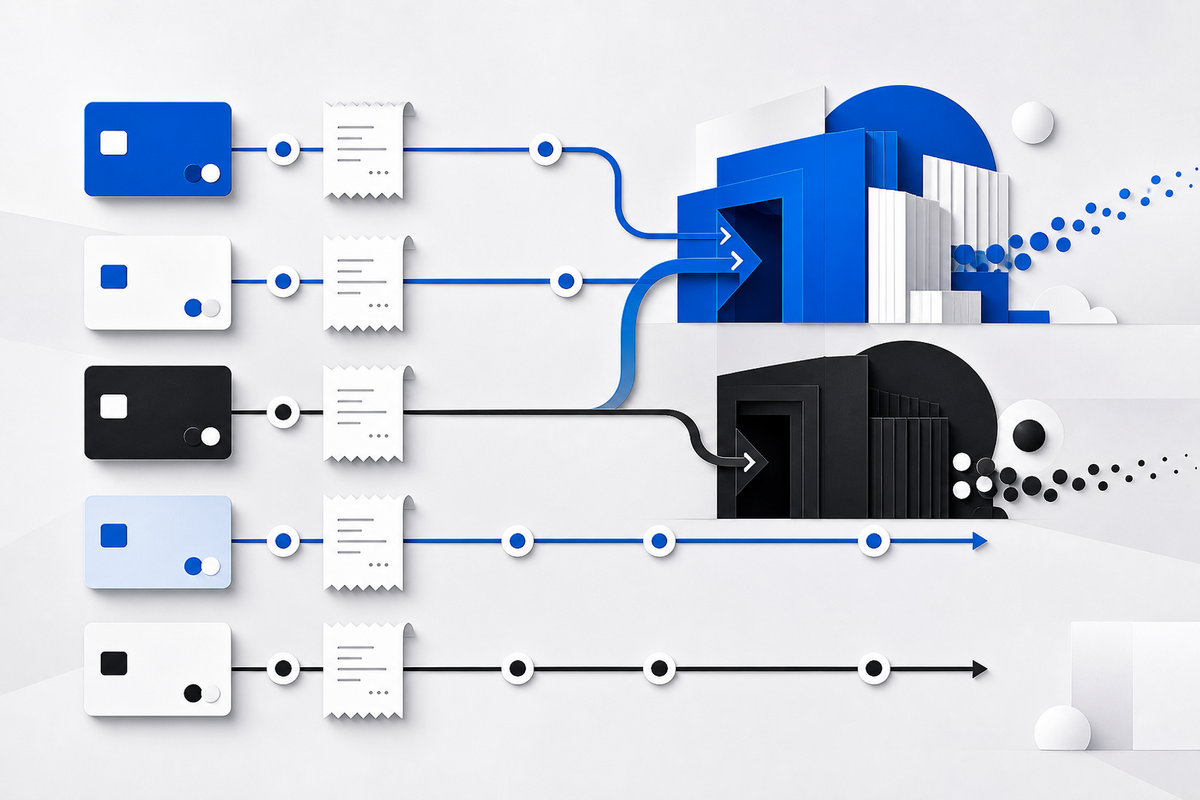
The most revealing thing about the modern expense report is how little anyone wants to see it. Employees want to snap a receipt and move on. Controllers want a clean ledger entry. CFOs want a policy enforced before money leaves the building. The software companies have spent years compressing that chain into a card swipe, a mobile prompt and an automatic accounting sync. Now the companies themselves are compressing, too.
Consider a shortlist that would have looked ordinary a few years ago: Ramp, Airbase, Divvy, Emburse and Center. Today, it needs translation. Divvy is BILL Spend & Expense. Paylocity bought Airbase and has folded its capabilities into Paylocity for Finance. American Express bought Center and says it will introduce a new expense platform after that acquisition. The names have not all disappeared, but the independent choices have.
This matters because spend software sits in an awkwardly powerful place. It knows who works for you, what they may buy, which vendor gets paid, how the transaction should be coded and where the receipt went. A feature grid can tell you who supports virtual cards or NetSuite. It cannot tell you what happens when that data becomes the connective tissue for a payroll company, a financial-operations suite or a global card network.
The corporate card was only the opening move
The first pitch was pleasantly concrete: stop sharing one plastic card and chasing its statement. Give employees controlled cards, set limits by person or merchant and see transactions immediately. From there, every vendor moved outward. Receipts became expense automation. Vendor payments became accounts payable. Purchase requests became procurement. Flights and hotels became travel. The card was less a destination than a wedge into the finance stack.
Where the familiar names lead now
Ramp is the purest expression of that expansion. It describes itself as a finance operations platform and puts cards, expenses, bill pay, procurement, travel, accounting automation and reporting into one orbit. Its core card and expense product has a free tier; more advanced integrations, approvals, multi-entity support and procure-to-pay features live higher in the plan structure. This makes Ramp an obvious benchmark for teams that want a modern, card-led system without first buying payroll or accounts receivable.
Its advantage is also the diligence question. The more workflows a company routes through Ramp, the less useful it is to evaluate the product as merely a better corporate card. Buyers should test the unglamorous edges: how exceptions reach accounting, what happens to historical data, which payment methods carry fees and whether procurement feels native to requesters who never open finance software.
The product decision is becoming a decision about where employee identity, payment data and the ledger should meet.YesPress analysis
Three survivors, three different centers of gravity
Ramp
Finance operationsBest framed as a consolidated, card-led operating layer. The appeal is breadth with a modern interface; the test is how much of that breadth your team will actually adopt.
BILL
SMB financial opsDivvy's budgets and cards now sit beside BILL's payables and receivables. That can reduce handoffs for an SMB already using BILL, while making the wider BILL relationship part of the decision.
Emburse
Travel and expenseA broader family of products for expense, travel, cards, payments, audit and analytics. Emburse Spend also lets SMBs keep an existing card program, a meaningful distinction for card-agnostic buyers.
BILL offers the clearest case study in absorption without erasure. It completed the Divvy acquisition in June 2021 after announcing a transaction valued at about $2.5 billion. In 2023, the company renamed Divvy to BILL Spend & Expense. The Divvy name survives on the BILL Divvy Card, while the application belongs to a larger system spanning accounts payable, accounts receivable, spend and expense.
For a small or midsize business, that may be exactly the point. A budget request can become a controlled card transaction, which can become a coded expense alongside bills and incoming payments. One login and fewer integrations can be more valuable than another clever receipt animation. But the buyer should ask whether BILL's credit model, card program and broader financial workflow match the business. A free software label does not make credit terms, payment fees or process change irrelevant.
Emburse comes from a different lineage. It is a suite rather than one monolithic product, with offerings across travel, expense, cards, AP automation, payments, analytics and audit. Emburse Spend targets US small and midsize teams and explicitly supports existing business or corporate cards. Its public pricing begins at $8 per submitting user per month for Basic and $12 for Plus, with a 15-user minimum listed on the pricing page. Larger and global organizations encounter a wider Emburse catalog and more custom packaging.
That card flexibility is easy to underrate. A company may have negotiated bank rebates, regional issuing relationships or a travel card employees already understand. Keeping the card while replacing the expense layer can reduce disruption. The tradeoff is product selection: a buyer must identify which Emburse edition, travel product and payment add-on fits, then confirm where data and support cross those boundaries.
Airbase now begins with the employee record
Paylocity completed its acquisition of Airbase on October 1, 2024. The deal agreement put the cash purchase price at approximately $325 million. The strategic logic was visible immediately: Paylocity had payroll and HR data, while Airbase brought bill pay, accounts payable automation, cards, expenses and procurement. Paylocity could now address payroll and non-payroll spend through one platform.
The current presentation makes the shift explicit. Paylocity for Finance brings expense management, corporate cards, AP automation, guided procurement and headcount planning together, powered by the employee record. This is more than a new logo above the old interface. The employee record can determine who receives a card, who approves a purchase and how access changes when a person joins, moves teams or leaves.
That is useful if Paylocity is already authoritative inside the company. It is less automatically compelling if HR and payroll live elsewhere. The right evaluation is not whether Airbase once appeared on a best-of-breed list. It is whether Paylocity's combined data model, implementation team and finance roadmap now suit the buyer. Existing Airbase customers should ask how contracts, support ownership and release priorities have changed, while prospects should evaluate the current product rather than the memory of the independent startup.
Center became a roadmap
American Express completed its Center acquisition on April 16, 2025. At the time, Amex said it would integrate Center's expense technology with its corporate and small-business cards. The acquisition supplied software for policy setup, point-of-spend controls and accounting, the connective work around a payment network's core product.
The important update arrived in American Express's 2026 commercial roadmap. The company said it plans to introduce new expense-management software following the acquisition, combining cards and expense management with physical and virtual card requests, spend insight, and connections to accounting, ERP and HR systems. That is a product direction, not a reason to treat the former Center as a currently independent bid.
For buyers, the distinction is simple. If an Amex-centered expense platform sounds attractive, assess what is available now, what is announced and what remains to be delivered. Ask how existing Center customers migrate, which Amex card programs qualify, what third-party cards can do and when critical integrations reach production. A roadmap can be strategically convincing and operationally premature at the same time.
A familiar product name can survive an acquisition. The buying context never does.YesPress Newsroom
How to buy without getting trapped by the grid
Begin with the mess, not the menu. If the problem is late receipts on an existing card program, Emburse's card-agnostic route deserves attention. If the business wants cards, payables, procurement and travel in one modern layer, Ramp is the reference point. If accounts payable and receivable already run in BILL, adding Spend & Expense may remove more friction than adopting a separate system. If Paylocity already owns the employee record, its finance platform has a structural advantage. If the business is committed to Amex, the post-Center platform may become a natural fit, but announced capability should not be scored as shipped capability.
Run this evaluation with your own transactions
- Map one card purchase, one reimbursement, one vendor invoice and one rejected request from start to ledger.
- Test a new hire, a department transfer and a termination. Permissions should change without cleanup theatre.
- Price the payment rails, implementation, support and add-ons, not just the software seat.
- Request the roadmap in writing and separate generally available features from previews.
- Export your data before signing. The exit path belongs in the buying decision.
Then talk to references that resemble your company in entity count, geography, ERP and monthly close. A glowing case study from a 50-person US startup says little about a multinational with subsidiaries and local reimbursements. Likewise, an enterprise procurement suite may be costly ceremony for a team whose real problem is ten missing lunch receipts.
Spend management is not shrinking as a job. It is expanding into fewer, larger containers. That can produce better automation and fewer brittle integrations. It can also concentrate switching costs and subordinate a useful product to its owner's broader strategy. The winning choice is not the platform that promises to do everything. It is the one whose center of gravity already matches yours, with enough evidence that the workflows, economics and owner will still make sense at renewal.
Questions buyers keep asking
Does Airbase still exist independently?
No. Paylocity completed the acquisition in October 2024. Airbase capabilities now sit within Paylocity for Finance, though some current pages still use “Airbase by Paylocity.”
Is Divvy the same as BILL Spend & Expense?
Yes. BILL acquired Divvy in 2021 and renamed the software in 2023. The card still carries the BILL Divvy Card name.
What happened to Center?
American Express acquired Center in April 2025. Amex has announced a new expense-management platform following that acquisition, so buyers should distinguish available features from the announced roadmap.
Which option works with existing corporate cards?
Emburse Spend explicitly supports an existing card program. Paylocity also says companies may use existing cards or Paylocity-issued cards. Confirm the exact issuer, feed and geography during evaluation.
What should finance teams compare first?
Compare operating fit: card-led or card-agnostic, SMB or enterprise, ERP and HR connections, approval complexity, international needs, implementation effort, payment fees and data portability.