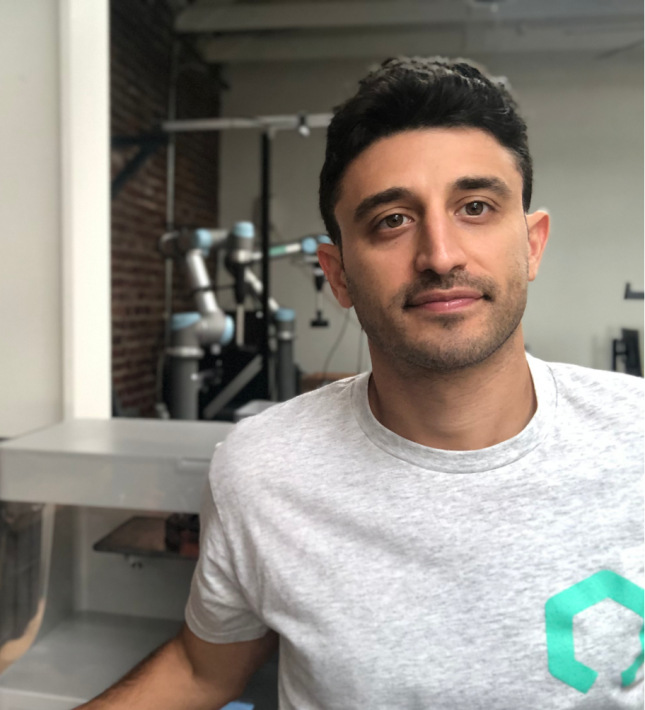
He started with gecko feet and a gyroscope bicycle
At Ohio State in 2013, Simon Kalouche was building robots that stuck to walls. The technology was borrowed from geckos - synthetic adhesive materials that mimicked the Van der Waals forces that let lizards walk upside-down. He was doing this in collaboration with NASA's Jet Propulsion Lab, as an undergrad. That's the kind of researcher Kalouche was before he was a CEO.
His mechanical engineering degree came with honors. His FEH (Fundamentals of Engineering Honors) program - combining mechanical design, electronics, and programming into one messy course - was, by his own account, what "really sparked my interest in robots." He also built a self-balancing bicycle using a control moment gyroscope, co-founded an Air Force and NASA-funded autonomous vehicle team as an undergraduate, and walked out of Ohio State in 2014 with the Outstanding Research Award and the Denman Forum first prize.
Carnegie Mellon was next. And CMU is where the invention happened.
"The equations are great, but really to build something you have to tinker with it, you have to wire up the Arduino."- Simon Kalouche
In 2016, working at the CMU Robotics Institute, Kalouche combined commodity drone motors with low-ratio planetary gearboxes to create the first low-cost quasi-direct-drive (QDD) actuators. Traditional robotic joints were expensive and rigid. His version was neither. It was backdriveable, force-controllable, and cost roughly one-tenth of existing alternatives. A $40 motor combination that let robots feel and respond to their environment rather than just execute preprogrammed trajectories. The MIT Mini Cheetah runs on this principle. So does the Unitree H1. So does Tesla's Optimus. Kalouche's thesis work became a foundational piece of the modern legged robotics industry.
He posted about it later with characteristic understatement: "Bezos browsing through my thesis is all one can hope for from a masters thesis."