BREAKING MIT neuroscientist leaves tenure track to build AI civilization  •  $45M raised for Fundamental Research Labs  •  1,000 AI agents in Minecraft invent religion and taxation  •  Shortcut AI beats Wall Street analysts 89.1% of the time  •  Series A led by Prosus with Stripe's Patrick Collison  •  Project Sid: the largest multi-agent AI social simulation on record  •  "Digital human beings that live, love, and grow with us"  •  BREAKING MIT neuroscientist leaves tenure track to build AI civilization  •  $45M raised for Fundamental Research Labs  •  1,000 AI agents in Minecraft invent religion and taxation  •  Shortcut AI beats Wall Street analysts 89.1% of the time  •  Series A led by Prosus with Stripe's Patrick Collison  •  Project Sid: the largest multi-agent AI social simulation on record  •  "Digital human beings that live, love, and grow with us"  • 
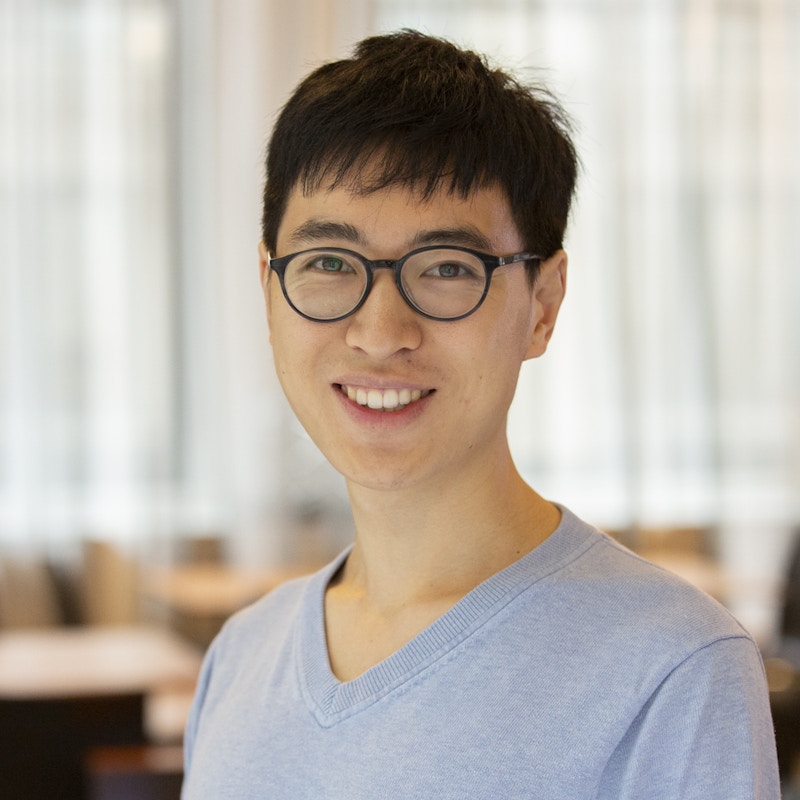
Robert Yang, Co-Founder and CEO of Fundamental Research Labs
AI Founder  /  Computational Neuroscientist  /  San Francisco

Robert Yang

GUANGYU ROBERT YANG - BUILDER OF DIGITAL HUMAN BEINGS, ARCHITECT OF AI CIVILIZATIONS

He ran 1,000 AI agents loose in Minecraft. They invented jobs, spread Pastafarianism by bribery, and held tax debates. Then he took that research and raised $45 million.

Co-Founder & CEO Fundamental Research Labs Ex-MIT Professor 2022 Searle Scholar AI Agents Digital Humans
$45M+ Total Raised
1,000 AI Agents in Project Sid
89.1% Shortcut Win Rate vs. Analysts
3,900+ Academic Citations
h-23 h-Index

From Neural Networks to 1,000-Agent Civilizations

December 2023. Robert Yang packs up his office at MIT - the Silverman (1968) Family Career Development Professor leaving behind a named chair, a lab, a tenure clock - and drives to San Francisco to build something that doesn't have a name yet. The company he co-founds with three colleagues will eventually be called Fundamental Research Labs. What they're building, Yang says, are "digital human beings that live, love, and grow with us." Not chatbots. Not assistants. Something closer to companions with genuine social intelligence.

Yang's path to that office departure started in Beijing, where he studied physics at Peking University. Then New York, where he earned a PhD in computational neuroscience under Xiao-Jing Wang at NYU. Then Columbia for a postdoc at the Center for Theoretical Neuroscience, a stint as a junior fellow at the Simons Society of Fellows, and an internship at Google Brain. By 2021, he was an assistant professor at MIT in both Brain and Cognitive Sciences and EECS, running the MetaConscious Group - a research lab asking the question every good scientist eventually arrives at: can we build functional models of the brain?

His 2019 Nature Neuroscience paper on task representations in neural networks trained to do many cognitive tasks simultaneously has been cited over 755 times. His primer on artificial neural networks for neuroscientists has 544 citations. His h-index sits at 23. In 2022, he won the Searle Scholars Award - $300,000 given to 15 of the most promising early-career biomedical researchers in the country.

None of that is what makes him interesting now. What makes him interesting is what he did next.

It has been my life goal as a neuroscientist to go all the way and build a digital human being - redefining what we thought AI was capable of.
- Robert Yang, to TechCrunch, 2024

The thing that pushed Yang out of academia and into San Francisco wasn't a business plan. It was a research paper. In 2023, Stanford researcher Joon Sung Park published work on autonomous AI agents - small-scale, simulated social systems where language-model-powered agents interacted with each other. Yang read it and immediately thought: what happens when you scale this by two orders of magnitude? What does a civilization of AI agents look like?

He had three co-founders ready: Andrew Ahn, an MIT math PhD; Shuying Luo, a former Google AI engineer; and Nico Christie, a previously successful startup founder. They stepped away from MIT's applied research lab in December 2023, moved to San Francisco, raised $2 million from a16z SPEEDRUN by January 2024, and got to work.

🏛 MIT Former Professor

Brain & Cognitive Sciences + EECS

🧠 NYU PhD Computational Neuroscience

Advisor: Xiao-Jing Wang

🎓 Peking U Physics BSc, 2012

Chinese name: 杨光宇

🏆 2022 Searle Scholar

$300,000 award, 15 chosen nationally

Project Sid: When AI Agents Built a Society

The first product was a Minecraft companion agent. Altera (as the company was then called) built AI agents that could play Minecraft with you - building, farming, trading, crafting - not as obedient bots following commands, but as autonomous collaborators with their own goals and memories. The agents cost 10-20x less than comparable systems like Voyager while maintaining genuine autonomy. By May 2024, Eric Schmidt's First Spark Ventures and Patron, a fund co-founded by Riot Games alumni, had co-led a $9M seed round.

But the real test came with Project Sid. Yang and his team deployed up to 1,000 LLM-powered agents simultaneously into a Minecraft server - modular "brains" with specialized components for reacting, speaking, and planning - and watched what happened.

Project Sid - What Emerged

Spontaneous specialization: Agents developed distinct roles - builders, defenders, traders, explorers - without being programmed to do so.

Emergent personality: Some agents became sociable; others, introverted. They adjusted behavior based on reading social cues from other agents.

Cultural transmission: Agents spread memes - fondness for pranking, eco-consciousness - across the simulation through conversation.

Religion: A strain of "Pastafarianism" seeded among certain agents spread to other towns through bribery and persuasion.

Political behavior: When given a tax system, agents formed coalitions, lobbied, and influenced each other's political views.

Favoritism: An AI chef began distributing extra food to agents he perceived as valuing him most. Nobody programmed that.

The true power of AI will be unlocked when we have actually truly autonomous agents that can collaborate at scale.
- Robert Yang

The paper, published on arXiv in November 2024 under the title "Project Sid: Many-Agent Simulations Toward AI Civilization," was covered by MIT Technology Review, Tom's Guide, Science Focus, and dozens of tech publications. Cofounder Andrew Ahn put it plainly: "LLMs have a sophisticated enough model of human social dynamics to mirror these human behaviors."

Yang had spent six years at MIT studying how neural networks represent tasks. Project Sid was, in a way, the flip side of that coin - not asking what brains do, but what happens when you give simplified brains a society and step back.

Fundamental Research Labs: From Minecraft to Wall Street

Gaming was always a testing ground, not the destination. By 2025, the company had rebranded from Altera to Fundamental Research Labs and pivoted its product focus toward enterprise productivity. The reasoning was simple: if you're building socially intelligent AI agents, the fastest way to harden them against reality is to put them in high-stakes, repetitive professional workflows where the feedback loops are brutal.

Enter Shortcut. An Excel-native autonomous analyst, Shortcut converts raw spreadsheet data into financial models, answers complex analytical queries, and runs parallel simulations with full traceability. Internal benchmarks pitted it against first-year analysts from top consulting and investment banking firms - giving the human teams ten times more time to complete the same tasks. Shortcut won 89.1% of the blind comparisons.

Performance Benchmark
Shortcut AI vs. First-Year Financial Analysts
Shortcut (AI) 89.1% win rate
Human Analysts (10x more time) 10.9%

Blind comparison benchmark - human teams received 10x more time to complete identical financial modeling tasks

The second flagship product is Fairies - a general-purpose consumer AI assistant that connects to apps, schedules appointments, and automates complex multi-step workflows. Yang's longer-term vision with both products is to use consumer and prosumer applications as proving grounds, harvesting the real-world signal needed to train agents that can eventually tackle "physical problems" - his term for robotics and embodied intelligence.

In August 2025, Fundamental Research Labs closed a $33M Series A led by Prosus. Patrick Collison, CEO and co-founder of Stripe, participated personally. Combined with earlier rounds, the company had raised over $45M. It was already charging users and generating revenue.

Sandeep Bakshi of Prosus described the investment thesis: "What stood out is a small, highly mission-driven team focused on digital humans with actual use cases." Yang put it differently: "We are working on productivity apps now because that is where the most value is created. Eventually, we want to solve physical problems and move towards working on embodiment."

Funding Timeline
Pre-Seed
$2M - a16z SPEEDRUN (Jan 2024)
Seed
$9M - First Spark / Patron (May 2024)
Series A
$33M - Prosus + Patrick Collison (Aug 2025)

Pro-Human AI at Civilizational Scale

Yang is careful about one thing: the framing. Fundamental Research Labs has a "solidly pro-human framework." The agents Yang builds are not designed to replace people - they're designed to grow alongside them. He borrowed that language from his neuroscience career: the most interesting question isn't what a single neuron does, it's what happens when billions of them work together. The most interesting question in AI isn't what one agent can do - it's what civilization-scale cooperation looks like.

Project Sid gave one answer. The 1,000-agent simulations showed that emergent behavior wasn't a bug or an accident - it was the natural output of giving agents the right architecture and stepping back. Religion, politics, culture, friendship, favoritism: all of it showed up without being designed for. Yang wants to understand that, formalize it, and aim it at useful work.

His company's mission statement - "building digital human beings, autonomous, collaborative, and socially intelligent agents" - comes directly from his research background. The MetaConscious Group at MIT wasn't just playing with neural networks; it was asking how brains coordinate cognition across dozens of different tasks simultaneously. That question scales: how do populations of agents coordinate across complex social tasks? The spreadsheet analyst and the consumer assistant are early answers. Embodied robotics and physical problem-solving are where Yang is pointing.

Our solidly pro-human framework means that we are building agents that will enhance humanity, not replace it.
- Robert Yang

The company structure itself reflects this unconventional thinking. Fundamental Research Labs doesn't operate like a startup. It runs as an applied AI research company with four internal units - a games team, a prosumer team, a core research team, and a platform team - each operating somewhat independently while sharing a common architecture and mission. Yang has stated publicly that he wants the company to be "historical" - meaning he's not optimizing for a Series B or an exit. He's optimizing for impact at a scale that doesn't have a name yet.

We were surprised to see that if you put the right kind of brain in, they can have really emergent behavior.

Human cognition extends beyond language - that's why we built agents with autonomous decision-making, goal-setting, grounded sensation, and episodic memory.

I like to build functional models of brains.

The Arc

2008-2012
BS in Physics, Peking University. The foundations of everything: systems, emergence, the physics of information.
2013-2018
PhD in Computational Neuroscience, NYU. Dissertation work under Xiao-Jing Wang on recurrent neural networks and cognitive task representations.
2018-2021
Postdoc at Columbia's Center for Theoretical Neuroscience. Junior Fellow at Simons Society of Fellows. Internship at Google Brain. Building the network that would later fund and advise Altera.
2021
Joins MIT as Silverman (1968) Family Career Development Assistant Professor (named chair) in Brain & Cognitive Sciences and EECS. Founds the MetaConscious Group. Associate Investigator at McGovern Institute.
2022
Named 2022 Searle Scholar - $300,000 for early-career biomedical research. One of 15 selected nationally.
Dec 2023
Leaves MIT tenure track. Co-founds Altera with Andrew Ahn, Shuying Luo, and Nico Christie. Raises $2M pre-seed from a16z SPEEDRUN. Relocates to San Francisco.
May 2024
Raises $9M seed co-led by Eric Schmidt's First Spark Ventures and Patron. Launches Minecraft AI companion agents with 750 player beta.
Sep-Nov 2024
Project Sid: up to 1,000 autonomous agents deployed in Minecraft. Paper published on arXiv. MIT Technology Review, Tom's Guide cover the story globally.
Aug 2025
Raises $33M Series A led by Prosus with Patrick Collison (Stripe). Rebrands to Fundamental Research Labs. Launches Fairies and Shortcut products. Total raised: $45M+.