Breaking
Nicholas Flanders raises $645M for Twelve's AirPlant One - world's first commercial e-fuels facility IAG signs 14-year SAF deal with Twelve for 785,000 tonnes of E-Jet fuel Twelve's CO2Made polycarbonate now in Mercedes-Benz vehicles and Tide detergent Forbes 30 Under 30 in Energy | Echoing Green Climate Fellow | Keeling Curve Prize Winner AirPlant One in Moses Lake, WA begins operations - converting CO2 into sustainable aviation fuel Nicholas Flanders raises $645M for Twelve's AirPlant One - world's first commercial e-fuels facility IAG signs 14-year SAF deal with Twelve for 785,000 tonnes of E-Jet fuel Twelve's CO2Made polycarbonate now in Mercedes-Benz vehicles and Tide detergent Forbes 30 Under 30 in Energy | Echoing Green Climate Fellow | Keeling Curve Prize Winner AirPlant One in Moses Lake, WA begins operations - converting CO2 into sustainable aviation fuel
Co-Founder & CEO, Twelve

Nicholas
Flanders

Carbon Transformation / Sustainable Aviation Fuel / Climate Tech

The air around you contains the raw material for jet fuel, car parts, and laundry detergent.
Nicholas Flanders is the person building the factory to prove it.

$790M+
Total Raised
270
Employees
785K
Tonnes SAF Committed
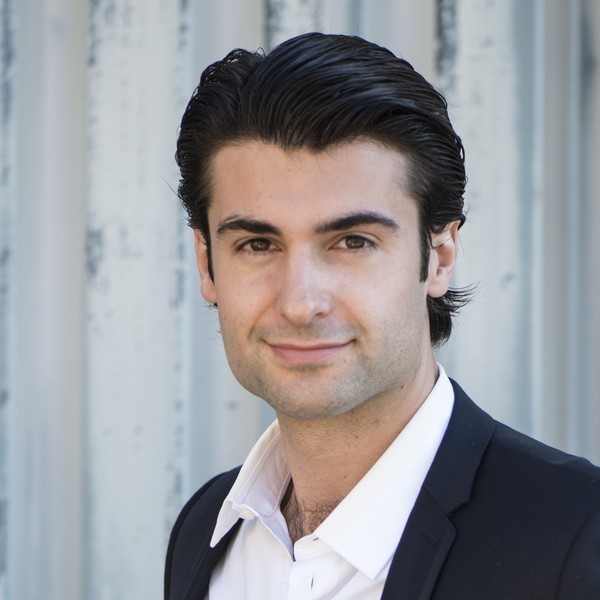
Nicholas Flanders, Co-Founder and CEO of Twelve
Nicholas Flanders - Twelve, San Francisco
Twelve's E-Jet SAF cuts lifecycle emissions by 90% vs. conventional jet fuel - and the world's first commercial AirPlant is already under construction in Moses Lake, Washington.
Profile

The man who turned a postage stamp into a pipeline

The first prototype fit in the palm of your hand. A catalyst the size of a Post-it note, stacked in layers, pulling CO2 out of the air and pushing it through an electrochemical reaction to produce carbon monoxide and hydrogen - the building blocks of almost everything petroleum is used for today. The lab called it a proof of concept. Nicholas Flanders called it a company.

That company is Twelve - formerly Opus 12, renamed for carbon's atomic weight on the periodic table. It is a quiet statement: carbon is not the villain. Carbon is the point. The atom that built the fossil fuel economy is the same atom Flanders wants to use to replace it.

In September 2024, Twelve announced $645 million in financing - a $200 million Series C and $400 million in project equity led by TPG Rise Climate. The round is one of the largest in e-fuels history. The money is going into AirPlant One, a commercial-scale facility in Moses Lake, Washington that will convert CO2 and water into sustainable aviation fuel using renewable electricity. When it reaches full capacity, it will produce roughly one million gallons of E-Jet SAF per year.

The same month, International Airlines Group - which operates British Airways, Iberia, Aer Lingus, and Vueling - signed a 14-year supply agreement for 785,000 tonnes of that fuel. A decade after the postage stamp, Flanders has an airline customer with a contract that outlasts most marriages.

"We wanted to help solve climate change by making products that are emissions-intensive, yet essential to the global economy, in a much more environmentally positive way."

Nicholas Flanders - Lombard Odier, February 2025

The path from concept to construction loan was not a straight line. Flanders grew up on a farm in upstate New York - the son of parents who had immigrated from Iran - with a landscape-level instinct for natural systems and a science fiction reader's appetite for industrial-scale solutions. He left for Cornell, triple-majored in mathematics, economics, and international relations, then spent four years as a McKinsey consultant in the cleantech practice, working across seven countries including Syria, Ethiopia, and the Dominican Republic. He arrived at Stanford for an MBA in 2013 with the specific intention of pivoting into climate. He found more than a pivot. He found a lab.

The Stanford Jaramillo Group was already world-leading in CO2 electrocatalysis. Two of its doctoral researchers - Dr. Etosha Cave and Dr. Kendra Kuhl - had been quietly building toward what would become Twelve's core technology. Flanders met them not in a lecture hall, but in a student space club. The company that would eventually close the largest e-fuels financing round in US history started over a shared interest in propulsion systems.

Flanders brought business architecture to the scientific breakthrough. In 2015, the three co-founders joined the first cohort of the Cyclotron Road Fellowship at Lawrence Berkeley National Laboratory - a two-year program for scientists trying to commercialize hard technology. While the scientists went deeper on the chemistry, Flanders built the company around it. That instinct - treating the founders' scientific credibility as a resource to be deployed, not showcased - runs through everything Twelve has done since.


$645M
2024 Financing Round
Led by TPG Rise Climate
14yr
IAG Supply Agreement
785,000 tonnes SAF
90%
Emissions Reduction
vs. conventional jet fuel
2015
Founded
First Cyclotron Road cohort
How AirPlant Works - Industrial Photosynthesis
🌅
Input
CO2 + Water
Power
Renewable electricity
Reactor
CO2 electrolyzer
📈
Output
Syngas (CO + H2)
Products
E-Jet SAF + Chemicals

Carbon is not the problem. Where it comes from is.

Twelve's technology works by passing CO2, water, and electricity through a reactor about the size of a suitcase. The electrochemical process splits those inputs into carbon monoxide and hydrogen - a mixture called syngas. From syngas, you can make almost any hydrocarbon compound that currently requires petroleum. Jet fuel. Polycarbonate for car parts and eyewear. Ingredients for laundry detergent. The same chemistry, starting from a different place.

The company calls it "A World Made from Air." The technology is essentially a machine that does what plants do with sunlight - using energy to build complex molecules from CO2 - but at industrial scale and at a speed that agriculture cannot match. Flanders describes it as a solar panel you can use for chemistry instead of electricity.

The practical implications are already showing up in products consumers use daily. Twelve's CO2Made polycarbonate went into the C-pillar of a Mercedes-Benz - the first time any car had used material made from CO2 electrolysis as a structural component. Procter & Gamble reformulated Tide detergent with CO2-derived ingredients. Pangaia incorporated CO2Made polycarbonate into eyewear. These are not experiments. They are products on shelves and roads.

Aviation is the harder problem - and Flanders has consistently focused there. Jet fuel is almost impossible to replace with batteries. The energy density required for long-haul flights means liquid hydrocarbons will be necessary for decades. E-Jet SAF - Twelve's synthetic aviation fuel - delivers lifecycle emissions 90% lower than conventional petroleum-based jet fuel. It is a "drop-in" fuel, meaning it can be blended and used without modifying existing engines or aircraft. No new hardware. No infrastructure overhaul. Just different chemistry at the refinery end of the supply chain.

The International Airlines Group deal is the clearest signal yet that airlines are not waiting for regulation to force the transition. A 14-year commitment for 785,000 tonnes is a statement about where IAG expects fuel markets to go - and a bet that Twelve will be there to supply them.

"Everything is being electrified and demand for green electricity is exploding in virtually every sector. I believe humanity will address the climate crisis, but we're currently acting too slowly to avoid some damaging effects."

Nicholas Flanders - Lombard Odier, February 2025

Moses Lake, Washington was chosen for AirPlant One because of its access to abundant, low-cost hydroelectric power from the Columbia River basin. Renewable electricity is the key input cost in the AirPlant process, so geography matters more than it does for conventional chemical plants. The facility represents the first construction loan ever issued for an e-fuel plant in the United States - a financing milestone as significant as the technical one.

Flanders is precise about what Twelve is and is not. The company does not capture CO2. It converts it. Partners upstream - industrial emitters, direct air capture companies - supply the CO2 feedstock. Partners downstream - airlines, automakers, consumer goods companies - buy the products. Twelve occupies the middle: the reactor, the chemistry, the transformation. It is a deliberately narrow position in a very long chain, held with unusual conviction.


What Flanders actually says

"It's kind of like a solar panel. We have this core reactor that's about the size of a suitcase - it's many orders of magnitude more efficient and durable than early prototypes the size of a postage stamp."

CleanTechnica Interview, 2021

"Every day I wake up and I go to work and I feel great and aligned and motivated."

CleanTechnica Interview, 2021

"There's been a huge shift with a lot more institutional investors, big private equity funds, getting involved in climate tech."

CleanTechnica Interview, 2021

"We wanted to help solve climate change by making products that are emissions-intensive, yet essential to the global economy, in a much more environmentally positive way."

Lombard Odier, February 2025

From McKinsey to Moses Lake

2004-2008

Triple major at Cornell University in Mathematics, Economics, and International Relations. Academic foundation for a career that would need to span science, finance, and diplomacy.

2008-2012

Business Analyst at McKinsey & Company's cleantech practice. Co-authored studies on the global energy system. Worked across 7 countries including Syria, Ethiopia, and Dominican Republic.

2012-2015

COO & CFO at Levo, a venture-backed startup. First taste of operational leadership in a fast-growth environment before founding his own company.

2013-2016

MS in Engineering (renewable power) and MBA at Stanford. Meets Dr. Etosha Cave and Dr. Kendra Kuhl through the Stanford student space club - not a chemistry seminar.

2015

Co-founds Opus 12 (later Twelve) with Cave and Kuhl. Joins the first-ever Cyclotron Road Fellowship cohort at Lawrence Berkeley National Laboratory.

2016

Named Forbes 30 Under 30 in Energy. Awarded Echoing Green Climate Fellowship. First institutional recognition that Twelve's approach is credible.

2020

Mercedes-Benz unveils the world's first C-pillar made from CO2-electrolysis polycarbonate. Procter & Gamble begins using CO2Made ingredients in Tide. Company featured on Netflix's "Inside Bill's Brain."

2021

Raises $57M Series A. Rebrands from Opus 12 to Twelve - named for carbon's atomic weight. The name is a quiet manifesto: this is a company built around carbon, not against it.

2022

Raises $130M Series B led by DCVC and the Chan Zuckerberg Initiative. Continues scaling CO2Made product partnerships and SAF development.

2024

Announces $645M financing round led by TPG Rise Climate - one of the largest e-fuels financing rounds ever. Signs 14-year IAG offtake deal for 785,000 tonnes of E-Jet SAF. Secures first US construction loan for an e-fuels facility.

2025

AirPlant One in Moses Lake, Washington progresses toward first operations as the world's first commercial-scale sustainable aviation fuel facility. Twelve employs 270 people.


The companies already betting on CO2

Mercedes-Benz
CO2Made C-pillar parts
Procter & Gamble
Tide CO2Made ingredients
IAG
14yr SAF offtake deal
Pangaia
CO2Made eyewear polycarbonate
LanzaTech
Polypropylene from CO2
Trinseo
Polycarbonate production
Microsoft
Investor
United Airlines
Strategic investor
Breakthrough Energy
Investor
Mitsui
Investor

Details that explain the decisions

🌿
Farm kid with a physics textbook
Flanders grew up on a rural farm in upstate New York after his family immigrated from Iran when he was two. The combination - hands-on relationship with land, immigrant family's drive, science fiction reading habit - produced someone who sees large-scale industrial systems as solvable problems, not fixed facts.
🚀
The space club origin story
Flanders met his future co-founders Etosha Cave and Kendra Kuhl not in a chemistry seminar or an accelerator, but in Stanford's student space club. The detail is not decorative. It suggests the specific kind of intellectual curiosity - systems, scale, propulsion - that produced Twelve's approach to carbon transformation.
📜
The naming decision
Renaming Opus 12 to Twelve in 2021 was not a branding exercise. Carbon's atomic weight is approximately 12. The name announces that the company exists to use carbon, not to avoid it - a distinction that matters enormously in a climate tech landscape full of companies focused purely on reduction.
📋
The postage stamp to pipeline arc
Twelve's first CO2 electrolyzer prototype was the size of a postage stamp. The commercial AirPlant reactor is the size of a suitcase. AirPlant One is a warehouse. The scale-up is not just engineering - it is a ten-year proof that academic research can become industrial infrastructure.
🌍
Seven countries before 35
Flanders' McKinsey years took him across seven countries - including Syria and Ethiopia - doing cleantech strategy work. That global exposure, before founding a company, built a practical understanding of how energy systems actually work in places that don't have the luxury of treating decarbonization as optional.
👣
First cohort of Cyclotron Road
When Twelve joined the inaugural Cyclotron Road Fellowship in 2015, the program was an experiment itself - Lawrence Berkeley National Lab's attempt to translate hard science into companies. Flanders was part of the first test of whether that model could work. It has since produced a roster of leading climate hardware companies.

Things worth knowing

Carbon's atomic weight = 12 = company name Met co-founders in a space club, not a lab CO2Made plastic already in Mercedes cars Worked in Syria before founding a clean energy company First US construction loan for e-fuels facility Triple major: Math, Econ, Intl Relations Technology is basically industrial photosynthesis Born Iran, raised upstate New York IAG deal: 14 years, 785,000 tonnes SAF First Cyclotron Road Fellowship cohort (2015)

Nicholas Flanders on camera

Turning CO2 into products - a full interview with Nicholas Flanders, CEO of Twelve, covering the technology, company origin story, and the future of carbon transformation.

Humans of the Atlas - a profile interview with Nicholas Flanders at Twelve, discussing climate motivation, the company's trajectory, and the vision for a world made from air.


The circular carbon economy

"I believe humanity will address the climate crisis, but we're currently acting too slowly to avoid some damaging effects."

Nicholas Flanders - Lombard Odier, 2025

The phrase Flanders uses repeatedly is "circular carbon economy" - a system where CO2 is not sequestered underground and forgotten, but cycled through manufacturing and back again. In that system, every petrochemical product has a potential carbon-neutral equivalent. Jet fuel. Plastics. Detergent. Car parts. Cosmetics. The building blocks of the modern economy, made from the same atom, drawn from the same atmosphere, powered by the sun.

AirPlant One is a proof that the system can work at commercial scale. If it does, the model replicates. More AirPlants. More products. More airlines, automakers, and consumer goods companies signing long-term supply agreements for materials that were made from the air they breathe. Flanders is not building a single factory. He is building a template for how industrial chemistry transitions away from fossil feedstocks.

He has been working on this for a decade. The postage stamp is now a suitcase. The suitcase is now a warehouse. The warehouse is just the beginning.